MODULE: Youth Participation Projects and Co-operation at Local Level
Youth participation projects and co-operation at local level
Section outline
-
-
-
What you'll learn: What a community really is — beyond geography — and why deep understanding of your community is the starting point for any meaningful participation project.
-
Students mustMark as done
What is a community?
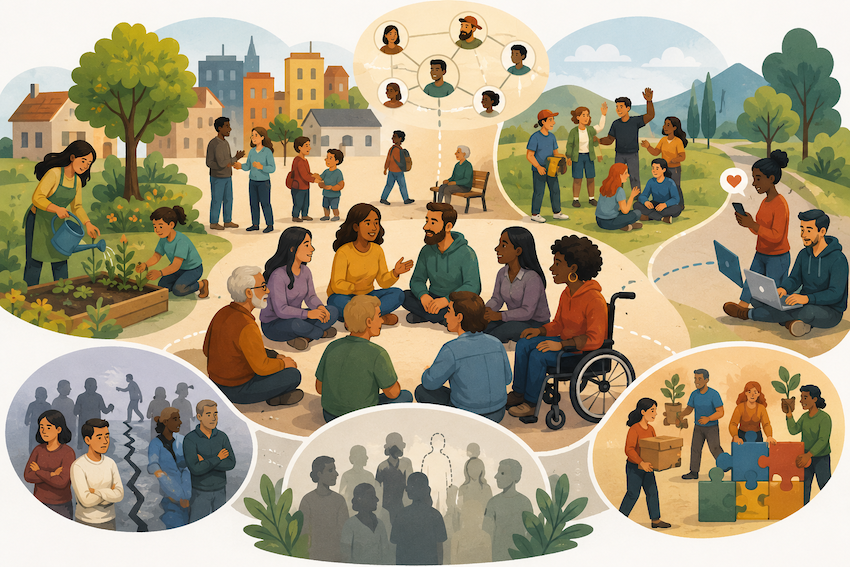
The word "community" is used so often that it can lose its meaning. We talk about the school community, the local community, the online community, the community of practice. But what does it actually mean?
At its core, a community is a group of people who share something — a place, an interest, an identity, a set of experiences, a challenge. What makes a community more than just a crowd is a sense of belonging: the feeling that you are connected to others, that what happens to them matters to you, and that what you do matters to them.
Communities are not static. They evolve, they divide, they grow, they shrink. They contain disagreements and tensions as well as solidarity and shared purpose. Understanding a community means understanding all of this — the connections and the fractures, the visible actors and the invisible ones, the resources that are used and the needs that go unmet.
-
Students mustMark as done
Three dimensions of community
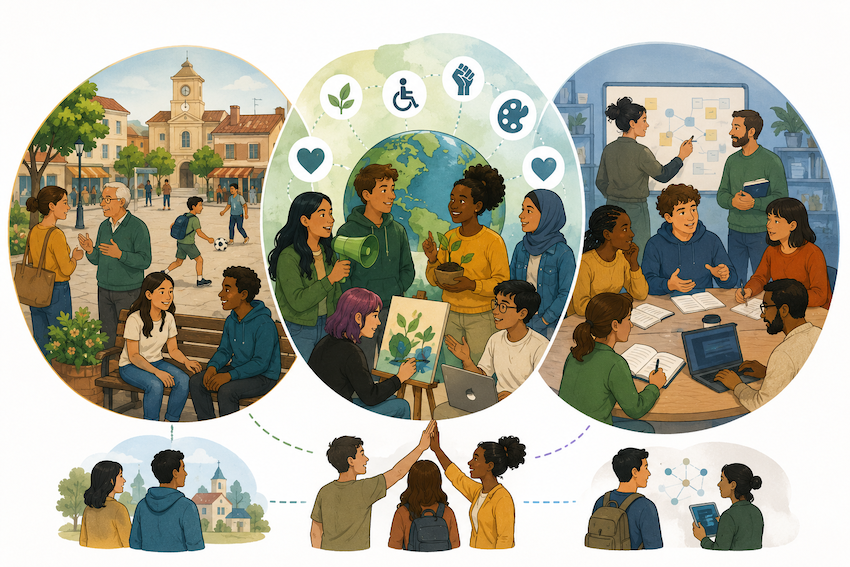
1. Physical community — place and belonging
A physical community is defined by geography: a neighbourhood, a village, a district, a town. It is the most traditional understanding of community — the people who share the same streets, the same local institutions, the same public spaces.
Physical communities have visible structures: a town hall, local associations, schools, churches or mosques, markets. But they also have invisible structures: informal networks, unwritten rules about who belongs and who doesn't, histories of conflict or cooperation that shape how people interact today.
For a youth participation project, the physical community is your operating context.
You need to understand it before you can act within it.
2. Community of interest — shared concern
A community of interest brings people together around a shared concern, passion, or identity — regardless of where they live. Young people who care about climate change. People with disabilities who advocate for accessible public spaces. Artists who use their work for social commentary. Migrants navigating a new country.
Communities of interest often cross geographical boundaries — especially in the digital age. They can be the basis for powerful collective action, because the shared concern creates natural motivation and commitment.
Many effective youth participation projects are born at the intersection of a physical community and a community of interest: young people who live in the same neighbourhood and share a concern about the same local issue.
3. Community of practice — shared learning
A community of practice is a group of people who learn together by doing things together. They develop shared tools, language, and knowledge over time. Youth workers, social entrepreneurs, educators, and activists often form communities of practice — both within their organisations and across networks.
Understanding communities of practice matters for your project because they are often where the most useful knowledge and skills already exist. Connecting your project to existing communities of practice can accelerate your learning and strengthen your legitimacy.
-
Students mustMark as done
Identity, belonging, and diversity
No community is homogeneous. Every community contains people of different ages, genders, ethnic backgrounds, economic situations, beliefs, and abilities. This diversity is not a complication — it is one of the community's greatest assets. But it also means that no single voice speaks for the whole community.
When designing a participation project, one of the most important questions to ask is: whose voices are currently missing from local decision-making? Young people are often underrepresented. So are women, migrants, people with disabilities, and people from lower-income backgrounds. A participation project that only reaches the most visible or vocal community members risks reinforcing existing inequalities rather than challenging them.
-
Students mustMark as done
The role of young people in local change
Young people are often described as "the future" — which is another way of saying that their role in the present is secondary. This framing is both wrong and counterproductive.
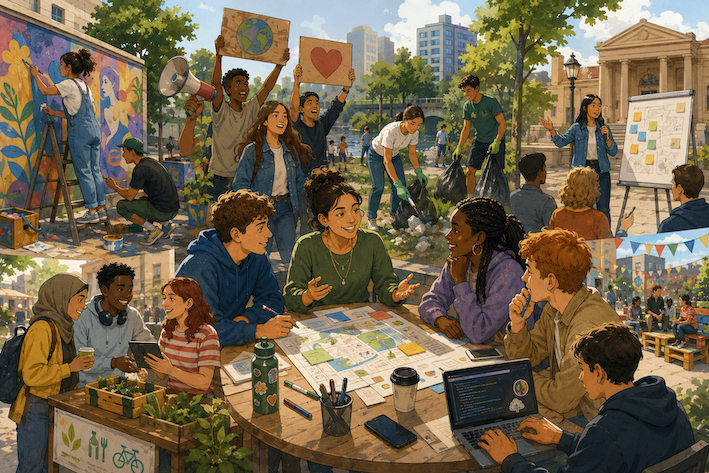
Young people are active community members right now. They observe their communities with fresh eyes, unencumbered by the assumption that things have to be the way they are. They are often more connected across social divides — across neighbourhoods, across cultures, across digital and physical spaces — than older generations. And they bring energy, creativity, and a genuine stake in the long-term future of their communities.
Across Europe and beyond, young people have led community initiatives that changed local policies, transformed public spaces, built services that institutions had failed to provide, and created cultures of participation where none had existed before.
-
Students mustMark as done
💡 NFT connection
Digital tools — including NFTs — can extend the reach and visibility of local community action. A neighbourhood mural, a youth-led campaign, a community archive — any of these could inspire a digital artwork that tells the story beyond the local context. NFTs created from community initiatives have been used to document local history, raise funds for neighbourhood projects, and connect local communities to global supporters. As you explore your own community, notice the stories and images that are worth preserving and amplifying.
-
-
-
-
What you'll learn: How to map your community's needs, resources, and key actors — using practical tools that turn observation into structured, actionable knowledge.
Why mapping comes before acting
One of the most common mistakes in community projects is moving from idea to action without adequately understanding the context. A team identifies a problem, designs a solution, and launches a project — only to discover six months later that a similar project already existed, or that the people they wanted to reach don't actually have the problem they assumed, or that a key local actor is hostile to their approach.
Community mapping is the antidote to this. It is the process of systematically gathering information about your community — its needs, its resources, its actors, its dynamics — before you decide what to do. Mapping takes time. But the time it saves later, by preventing you from building the wrong thing, is far greater.
Mapping is also, in itself, a participatory practice. When you involve community members in the process of understanding their own community, you build relationships, generate shared knowledge, and begin the process of engagement that your project will depend on.
-
What to map — the three dimensions
1. Needs — what is missing or not working
Needs are the gaps between what exists and what the community requires for its members to live well, participate fully, and develop their potential. They can be material (a lack of safe public spaces, inadequate transport, poor housing), social (isolation, lack of intergenerational connection, absence of support for newcomers), or civic (no spaces for youth participation, lack of access to decision-making processes).
It is important to distinguish between felt needs (what community members say they need when asked) and real needs (what a deeper analysis of the situation reveals). These are not always the same. A community may express a need for more security cameras — when the underlying need is for more safe, well-lit, animated public spaces. Stopping at the surface level produces surface-level solutions.
2. Resources and assets — what already exists
Asset-based community development (ABCD) is a framework that starts from the strengths of a community rather than its deficits. This does not mean ignoring needs — it means recognising that every community, however challenged, has resources that can be mobilised.
Resources can be:
• Physical: buildings, green spaces, community centres, schools, markets, transport links.
• Human: skills, knowledge, and energy of community members, especially those who are often overlooked — older residents, young people, newcomers.
• Social: networks, associations, trust relationships, traditions of mutual support.
• Economic: local businesses, employment, markets, purchasing power.
• Cultural: arts organisations, cultural traditions, community events, shared history.
An effective participation project does not try to bring everything from outside. It starts with what is already there — and builds on it.
3. Actors — who does what, and who has influence
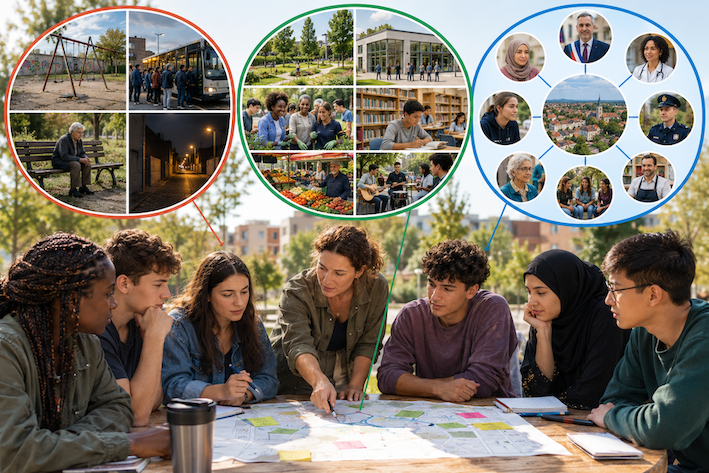
A community is not a blank canvas. It has a history, existing power structures, and a complex web of relationships between individuals and organisations. Understanding who the key actors are — and how they relate to each other — is essential before you try to do anything.
Key actors to map include:
• Formal institutions: local government, schools, health services, police, social services.
• Civil society organisations: associations, NGOs, youth organisations, cultural groups, religious organisations.
• Informal leaders: individuals who are trusted and influential in the community, even without official titles — a respected elder, a popular youth worker, a community activist.
• Businesses: local employers, shopkeepers, market traders — often overlooked but potentially important allies.
• Marginalised groups: communities within the community who are often invisible to formal institutions — migrants, young people not in education, people with disabilities.
-
Students mustMark as done
Community mapping tools — practical options
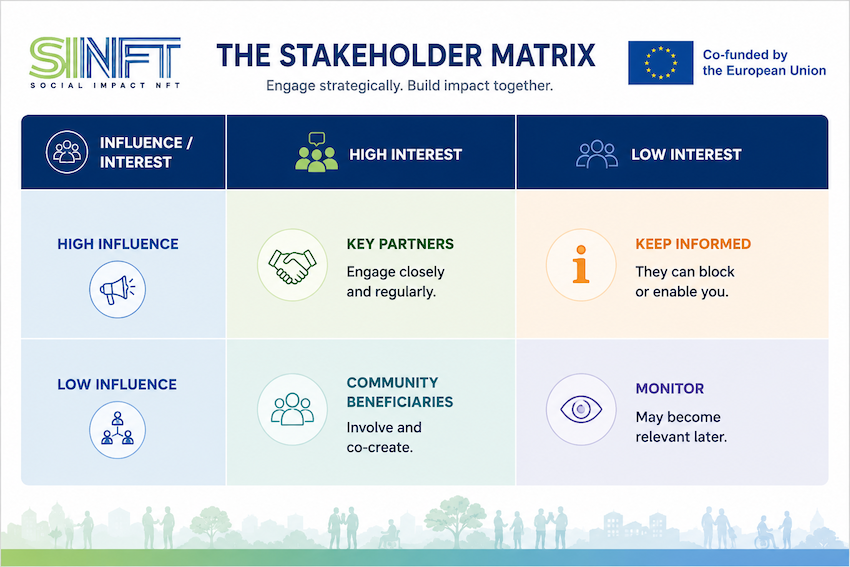
Stakeholder mapping
A stakeholder matrix places your project at the centre and positions key actors around it according to their relevance and their power. A simple version has two axes: interest (how much they care about your issue) and influence (how much power they have over it). This helps you prioritise who to approach, in what order, and with what message.
Community Walk
A community walk is exactly what it sounds like: walking through the community with open, observant eyes — ideally with community members as guides. You observe public spaces, note what is missing, listen to how people describe their environment. A community walk often reveals things that no data set or document can: the informal gathering spots, the places people avoid, the small signs of neighbourhood life that tell a larger story.
Document what you observe with photos, notes, or short video clips. Organise your observations afterwards into categories: needs, assets, and actors.
Semi-structured interviews
A semi-structured interview is a conversation guided by a set of open questions but flexible enough to follow unexpected threads. It is the most powerful tool for understanding how community members themselves see their situation — their priorities, their frustrations, their ideas.
Key principles for a good community interview:
• Ask open questions that cannot be answered with yes or no.
• Listen more than you speak — aim for the community member to talk 70% of the time.
• Ask about concrete experiences, not abstract opinions: 'Tell me about the last time you tried to...' rather than 'What do you think about...'
• Take notes on their exact words, not your interpretation of what they said.
Digital mapping tools
Several free digital tools support community mapping and make the results easy to share and update:
• Miro: a collaborative whiteboard where you can place actors, needs, and resources visually and invite others to contribute in real time.
• Padlet: a simple digital board for collecting and organising community observations, photos, and comments from multiple contributors.
• Google Maps (custom): you can create a custom map layer marking community assets, needs, and actors by location — useful for geographically-grounded projects.
• Mentimeter / Slido: for gathering quick community input in group settings — workshops, school sessions, public meetings.
-
Students mustMark as done
💡 NFT connection
Community mapping can itself produce material for a digital storytelling or NFT project.
Photos from a community walk, stories gathered in interviews, sketches of neighbourhood assets — all of these could become the basis for a collection of digital artworks that document a community's identity and needs.
Before any content is used in this way, however, informed consent from everyone involved is essential. Community documentation is powerful; community exploitation is not.
-
-
-
-
What you'll learn: How to turn a community need into a well-designed participation project — with clear objectives, realistic activities, and a structure that involves the community at every stage.
From observation to idea — the transition
Your community mapping has given you a picture of your community: its needs, its assets, its actors. Now comes the creative and strategic step: turning that picture into a project.
This transition is not as simple as it sounds. The gap between 'we identified a need' and 'we designed a project that addresses it well' is where many participation initiatives stumble. The most common mistakes are:
• Designing for the community instead of with it.
• Choosing activities before defining objectives.
• Setting objectives that are too vague to be measurable.
• Underestimating the time, resources, and relationships that implementation requires.
This lesson gives you the tools to avoid all four.
-
Students mustMark as done
Participatory design — the principle that changes everything
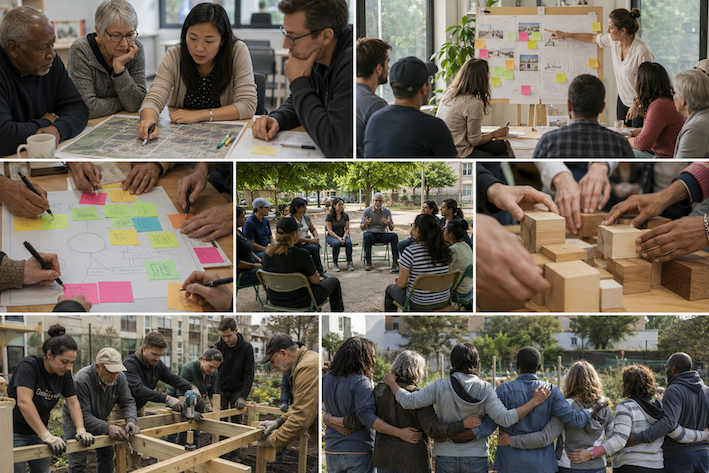
Participatory design is an approach to project development in which the people the project is designed to serve are actively involved in designing it. Not consulted at the end. Not asked to validate a plan already made. Genuinely involved from the beginning — in identifying priorities, generating ideas, making decisions, and taking responsibility for implementation.
Why does this matter?
• Better outcomes: projects designed with community members are more likely to address real needs and less likely to produce solutions that don't fit the context.
• Stronger ownership: when people have shaped a project, they feel ownership over it. They are more likely to participate, to spread the word, and to sustain the work when difficulties arise.
• Greater equity: participatory design actively counters the tendency of projects to reproduce existing power structures, by ensuring that usually-silent voices have genuine influence.
Participatory design is not the absence of structure. It requires skilled facilitation, clear processes, and honest management of expectations. Saying 'the community decides everything' is often a way of avoiding the responsibility of good facilitation. Genuine participation means giving people real power within a clear and honest framework.
-
Students mustMark as done
Defining your objectives — the SMART framework
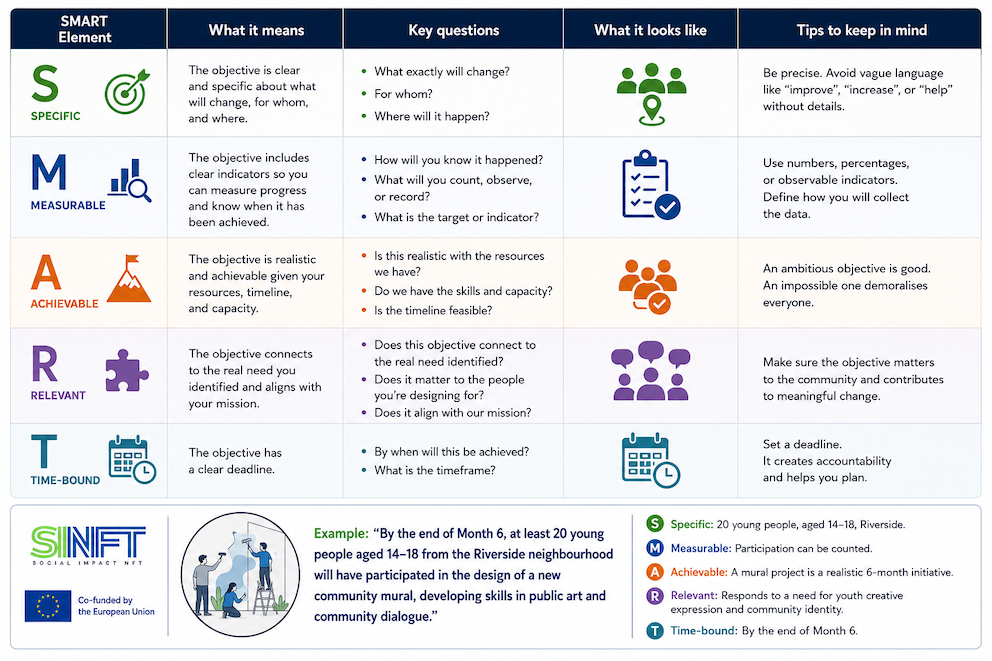
Before you design activities, you need to be clear about what you want to achieve. Objectives are the specific, defined changes you are aiming for. They are the standard against which you will later evaluate whether your project succeeded.
The SMART framework helps you write objectives that are useful — not just aspirational:
-
Students mustMark as done
Participatory methods — practical tools
Several structured methods support participatory project design:
World Café
A World Café is a structured conversation method in which participants rotate between small tables, each exploring a different question related to the project. After several rounds, the whole group reconvenes to share key insights. It is excellent for generating ideas and building shared understanding across a diverse group in a short time.
Future Workshop
Developed by Robert Jungk, the Future Workshop has three phases: a critique phase (what doesn't work in our community?), a fantasy phase (what would our ideal community look like?), and an implementation phase (how do we get there?). It is particularly powerful for engaging people who feel cynical or disillusioned about the possibility of change.
Participatory action research (PAR)
PAR combines research and action. Community members are not just subjects of research but co-researchers who investigate their own situation, analyse the findings, and use them to design collective action. PAR is especially powerful in contexts where the community's perspective has been consistently ignored by formal institutions.
Open Space Technology
Open Space Technology is a self-organising meeting format in which participants set the agenda themselves. Anyone can propose a topic for discussion; sessions happen in parallel; participants move freely between them. It works best with groups that have a shared sense of purpose and a complex challenge with no pre-determined solution.
-
Students mustMark as done
💡 NFT connection
A participatory design process can itself generate powerful material for a digital storytelling project. The ideas generated in a World Café, the visions drawn in a Future Workshop, the research findings of a PAR process — all of these could be the basis for a digital collection that documents the community's own vision for its future. Creating NFTs from this material is a way of giving that vision permanence and visibility beyond the local context.
-
-
-
-
What you'll learn: How to identify the partners your project needs, approach them effectively, and mobilise the resources — financial and non-financial — that will make your project possible.
Why partnerships are not optional
A youth participation project that works in isolation rarely lasts. Local action needs local roots — relationships with institutions that have legitimacy, resources that you don't have, and networks that reach people you can't reach alone.
Partnerships are not just practical. They are also a statement about how change happens. A project that partners with a school says something different from one that works around schools. A project that involves the local municipality says something different from one that ignores it. Partnership choices communicate your project's values and your understanding of how power works in your community.
But partnerships are also relationships — and like all relationships, they require investment, honesty, and mutual respect. This lesson gives you the tools to build partnerships that are genuinely productive, not just formally ticked.
-
Students mustMark as done
Types of partners in local participation projects
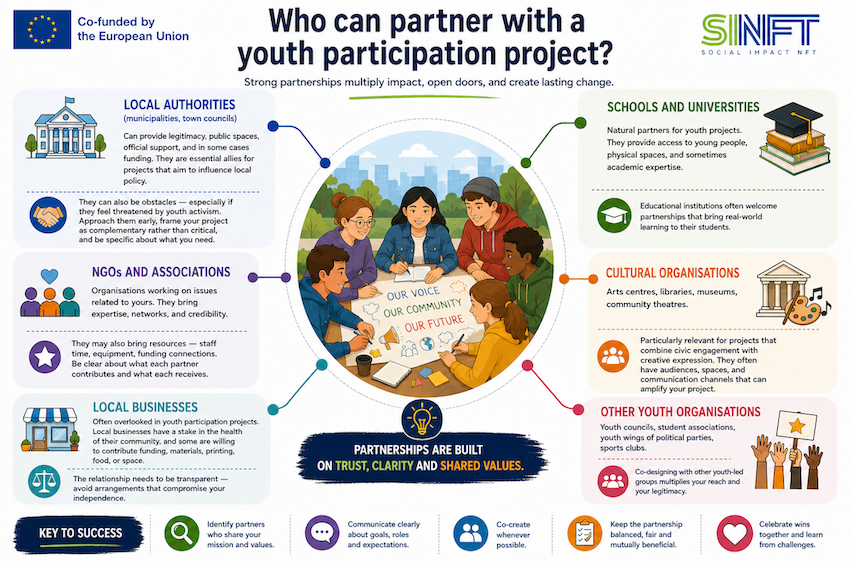
-
Students mustMark as done
How to approach a potential partner — step by step
1. Research first: understand the potential partner's mission, priorities, and current activities. Look for genuine overlap with your project. Approaching someone who has no interest in your cause wastes both your time and theirs.
2. Make the first contact human: send a short, personal message — not a generic template. Mention something specific about their work. Ask for a conversation, not a commitment.
3. Listen before you pitch: in the first meeting, ask about their work, their challenges, and their priorities. Show genuine interest. Find the intersection between what they care about and what you're building.
4. Propose something specific and mutual: be clear about what you're asking for and what you offer in return. Good partnerships are not about charity — they are about mutual benefit. What does your project give the partner: visibility, community connection, new audiences, shared learning?
5. Start small: before committing to a major collaboration, suggest a small joint activity. A shared event, a co-facilitated workshop, a contribution of space for one session. Small steps build the trust that larger partnerships require.
Document agreements: even informal partnerships benefit from a written summary of what each party commits to. A one-page partnership agreement that covers roles, timescale, and expectations prevents misunderstandings before they become conflicts.
-
Students mustMark as done
Mobilizing resources — beyond money
Many young project leaders assume that the main barrier to action is money. In practice, the most critical resources are often non-financial — and they are available if you know where to look.
Human resources — skills and time
Volunteers with specific skills (graphic design, facilitation, translation, legal advice, photography, IT) can contribute far more value than their equivalent in cash. Building a network of skilled volunteers begins with mapping the skills in your community — often in unexpected places.
Important principle: value volunteer contributions appropriately. Recognise them publicly, give them meaningful roles, and never exploit volunteer goodwill. An exploited volunteer is a lost ambassador.
In-kind resources — spaces, equipment, materials
Many organisations are willing to provide resources in kind — a meeting room, printing services, catering for events, equipment loans — even when they cannot provide cash. In-kind contributions can substantially reduce a project's financial needs.
Financial resources — where to find them
For small local projects, the most accessible financial resources are usually:
• Local authority small grants: many municipalities have small grant programmes specifically for youth and community initiatives. These are often under-subscribed.
• Community foundations: local foundations that distribute grants to community projects. Research what exists in your region.
• Crowdfunding: platforms like Ulule, Goteo, or local equivalents allow you to raise small amounts from large numbers of supporters. Works best when you have a compelling story and an active network to share it.
• European youth funding: Erasmus+ supports youth exchanges and participation projects. The amounts are modest but the eligibility criteria for small youth groups are accessible.
-
Students mustMark as done
💡 NFT connection
NFTs offer an additional, innovative fundraising channel that can complement traditional sources. A community project that creates NFTs from participant artwork or storytelling can raise funds while also building visibility and engagement beyond the local context. The key conditions: community members must consent to their contributions being used, the fund allocation must be transparent, and the NFT campaign must be presented as a complement to — not a substitute for — meaningful community relationships.
-
-
-
-
What you'll learn: What social impact means in the context of a local participation project, how to set simple indicators, and how to communicate your results in ways that matter to your community and your partners.
Why measurement matters — and why it often goes wrong
Impact measurement is one of the most discussed — and most misunderstood — topics in community work. Many project teams treat it as a bureaucratic requirement: something you do to satisfy funders, after the real work is finished. The result is measurements that don't capture what actually changed, reports that nobody reads, and a missed opportunity to learn from the project's experience.
At its best, impact measurement is a learning practice. It helps you understand what is working and what isn't, so you can improve. It helps you communicate the value of your work to partners, funders, and the community itself. And it helps you build the case for continuation, replication, or scaling — if the evidence supports it.
The goal is not to prove that your project worked. The goal is to understand what happened — honestly — and to use that understanding to do better.
-
Students mustMark as done
What is social impact?
• Output: what the project produced directly and measurably. '12 workshops held', '48 young people participated', '3 community murals created'. Outputs are important but not sufficient. A project can produce many outputs without creating meaningful change.
• Outcome: what changed for participants in the short to medium term as a result of their involvement. 'Participants report increased confidence in speaking in public', '70% of participants feel more connected to their neighbourhood', '8 participants joined a local association after the project'. Outcomes are the real test of whether the project worked.
• Impact: the broader, longer-term change in the community or society that the project contributed to. 'The neighbourhood has a new community space that 200 people use weekly', 'Youth participation in local consultations increased by 30%'. Impact is harder to measure and attribute — many factors contribute — but it is the ultimate goal.
-
Students mustMark as done
Setting indicators — simple and honest
An indicator is a piece of evidence that tells you whether a change has happened. Good indicators are specific, observable, and honest — they measure what they claim to measure, not a convenient proxy.
For a local participation project, indicators can be:
• Quantitative: numbers that can be counted. Number of participants. Percentage who reported a specific change. Number of partnerships created. Number of community members who say they feel more involved in local decisions.
• Qualitative: descriptions of change that cannot be reduced to numbers. Testimonials from participants. Changes in how community members talk about themselves and their community. The emergence of new community leaders. Shifts in how local institutions engage with young people.
A common mistake: measuring only what is easy to count (number of events, number of participants) and ignoring harder-to-measure changes (shifts in confidence, new relationships, changed community dynamics). The most important changes are often the hardest to quantify — but they can be captured through testimonials, focus groups, observation, and honest reflection.
-
Students mustMark as done
Data collection methods — practical and light
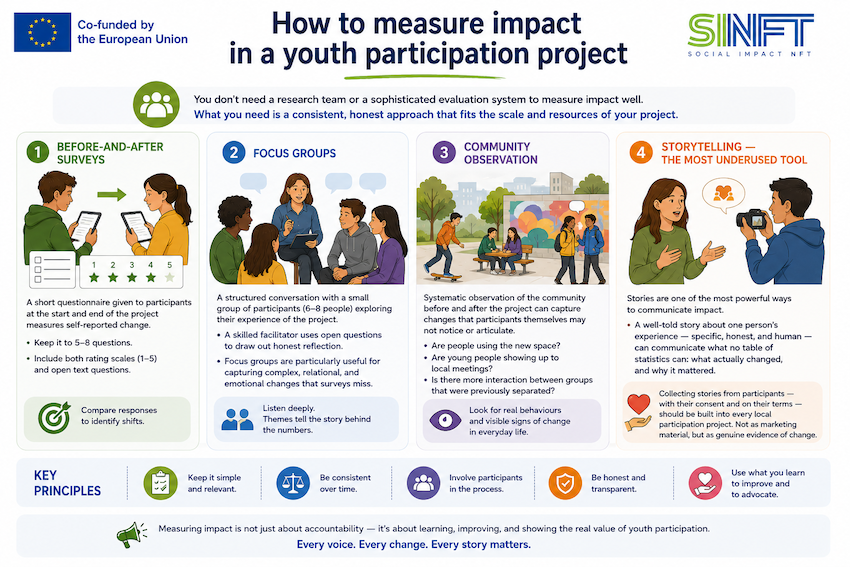
-
Students mustMark as done
A simple impact reporting structure
1. Context: What was the situation before the project? What need did it address?
2. What we did: Key activities and outputs — concisely.
3. What changed: Outcomes for participants and the community — with evidence (numbers, testimonials, observations).
4. What we learned: What worked? What didn't? What would we do differently?
5. What comes next: How will the project continue, adapt, or scale?
This structure works for a 1-page community report, a 5-slide presentation to the local council, a funding report, and a social media campaign. The same honest story, told at different lengths for different audiences.
-
Students mustMark as done
Communicating impact — know your audience
Measurement is only useful if the results are communicated to the people who need them. Different audiences need different kinds of communication:
• The community: wants to know what changed in their neighbourhood. A community report, a public event, a mural, a short video — accessible, visual, human.
• Funders: want evidence that their investment created value. Impact data, testimonials, and an honest account of challenges and lessons.
• Partner organisations: want to see that the collaboration was worthwhile. Focus on shared achievements and what the partnership made possible.
• Local authorities: want evidence relevant to policy. Numbers, scale, and a clear link to local priorities.
• Young people themselves: want to see that what they did mattered. Celebrate their contribution visibly and specifically.
-
Students mustMark as done
💡 NFT connection
Impact stories can become the basis for a digital archive of community action — a collection of stories, images, and testimonials that documents what young people achieved. If this archive is turned into an NFT collection, it becomes both a permanent record and a fundraising tool for future projects. The key ethical requirement: every person whose story or image appears must have given specific, informed consent for its use in this form. And the community should benefit directly from any funds raised.
-
-
Shape the Future.
Mint the Change.