
Lesson 5 - Measuring Impact at Local Level
Youth participation projects and co-operation at local level
Section outline
-
What you'll learn: What social impact means in the context of a local participation project, how to set simple indicators, and how to communicate your results in ways that matter to your community and your partners.
Why measurement matters — and why it often goes wrong
Impact measurement is one of the most discussed — and most misunderstood — topics in community work. Many project teams treat it as a bureaucratic requirement: something you do to satisfy funders, after the real work is finished. The result is measurements that don't capture what actually changed, reports that nobody reads, and a missed opportunity to learn from the project's experience.
At its best, impact measurement is a learning practice. It helps you understand what is working and what isn't, so you can improve. It helps you communicate the value of your work to partners, funders, and the community itself. And it helps you build the case for continuation, replication, or scaling — if the evidence supports it.
The goal is not to prove that your project worked. The goal is to understand what happened — honestly — and to use that understanding to do better.
-
Students mustMark as done
What is social impact?
• Output: what the project produced directly and measurably. '12 workshops held', '48 young people participated', '3 community murals created'. Outputs are important but not sufficient. A project can produce many outputs without creating meaningful change.
• Outcome: what changed for participants in the short to medium term as a result of their involvement. 'Participants report increased confidence in speaking in public', '70% of participants feel more connected to their neighbourhood', '8 participants joined a local association after the project'. Outcomes are the real test of whether the project worked.
• Impact: the broader, longer-term change in the community or society that the project contributed to. 'The neighbourhood has a new community space that 200 people use weekly', 'Youth participation in local consultations increased by 30%'. Impact is harder to measure and attribute — many factors contribute — but it is the ultimate goal.
-
Students mustMark as done
Setting indicators — simple and honest
An indicator is a piece of evidence that tells you whether a change has happened. Good indicators are specific, observable, and honest — they measure what they claim to measure, not a convenient proxy.
For a local participation project, indicators can be:
• Quantitative: numbers that can be counted. Number of participants. Percentage who reported a specific change. Number of partnerships created. Number of community members who say they feel more involved in local decisions.
• Qualitative: descriptions of change that cannot be reduced to numbers. Testimonials from participants. Changes in how community members talk about themselves and their community. The emergence of new community leaders. Shifts in how local institutions engage with young people.
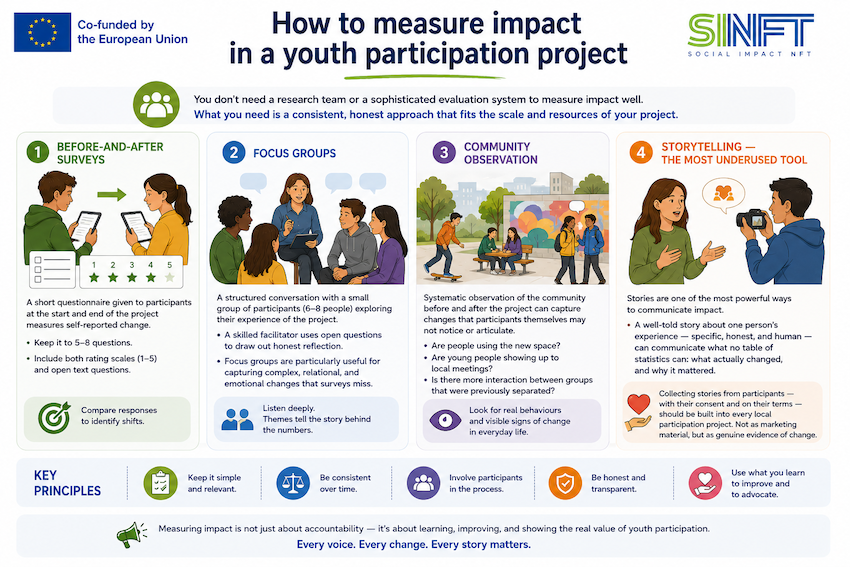
A common mistake: measuring only what is easy to count (number of events, number of participants) and ignoring harder-to-measure changes (shifts in confidence, new relationships, changed community dynamics). The most important changes are often the hardest to quantify — but they can be captured through testimonials, focus groups, observation, and honest reflection.
-
Students mustMark as done
Data collection methods — practical and light
-
Students mustMark as done
A simple impact reporting structure
1. Context: What was the situation before the project? What need did it address?
2. What we did: Key activities and outputs — concisely.
3. What changed: Outcomes for participants and the community — with evidence (numbers, testimonials, observations).
4. What we learned: What worked? What didn't? What would we do differently?
5. What comes next: How will the project continue, adapt, or scale?
This structure works for a 1-page community report, a 5-slide presentation to the local council, a funding report, and a social media campaign. The same honest story, told at different lengths for different audiences.
-
Students mustMark as done
Communicating impact — know your audience
Measurement is only useful if the results are communicated to the people who need them. Different audiences need different kinds of communication:
• The community: wants to know what changed in their neighbourhood. A community report, a public event, a mural, a short video — accessible, visual, human.
• Funders: want evidence that their investment created value. Impact data, testimonials, and an honest account of challenges and lessons.
• Partner organisations: want to see that the collaboration was worthwhile. Focus on shared achievements and what the partnership made possible.
• Local authorities: want evidence relevant to policy. Numbers, scale, and a clear link to local priorities.
• Young people themselves: want to see that what they did mattered. Celebrate their contribution visibly and specifically.
-
Students mustMark as done
💡 NFT connection
Impact stories can become the basis for a digital archive of community action — a collection of stories, images, and testimonials that documents what young people achieved. If this archive is turned into an NFT collection, it becomes both a permanent record and a fundraising tool for future projects. The key ethical requirement: every person whose story or image appears must have given specific, informed consent for its use in this form. And the community should benefit directly from any funds raised.
-

Shape the Future.
Mint the Change.