
Lesson 2 - Tools & Methods for Community Mapping
Youth participation projects and co-operation at local level
Section outline
-
What you'll learn: How to map your community's needs, resources, and key actors — using practical tools that turn observation into structured, actionable knowledge.
Why mapping comes before acting
One of the most common mistakes in community projects is moving from idea to action without adequately understanding the context. A team identifies a problem, designs a solution, and launches a project — only to discover six months later that a similar project already existed, or that the people they wanted to reach don't actually have the problem they assumed, or that a key local actor is hostile to their approach.
Community mapping is the antidote to this. It is the process of systematically gathering information about your community — its needs, its resources, its actors, its dynamics — before you decide what to do. Mapping takes time. But the time it saves later, by preventing you from building the wrong thing, is far greater.
Mapping is also, in itself, a participatory practice. When you involve community members in the process of understanding their own community, you build relationships, generate shared knowledge, and begin the process of engagement that your project will depend on.
-
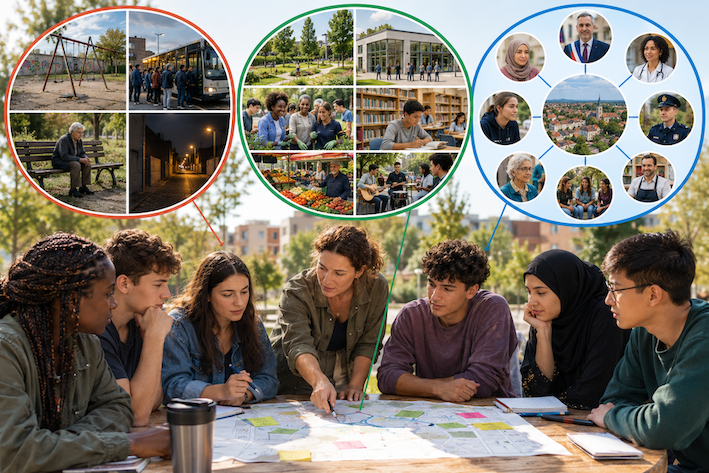
What to map — the three dimensions
1. Needs — what is missing or not working
Needs are the gaps between what exists and what the community requires for its members to live well, participate fully, and develop their potential. They can be material (a lack of safe public spaces, inadequate transport, poor housing), social (isolation, lack of intergenerational connection, absence of support for newcomers), or civic (no spaces for youth participation, lack of access to decision-making processes).
It is important to distinguish between felt needs (what community members say they need when asked) and real needs (what a deeper analysis of the situation reveals). These are not always the same. A community may express a need for more security cameras — when the underlying need is for more safe, well-lit, animated public spaces. Stopping at the surface level produces surface-level solutions.
2. Resources and assets — what already exists
Asset-based community development (ABCD) is a framework that starts from the strengths of a community rather than its deficits. This does not mean ignoring needs — it means recognising that every community, however challenged, has resources that can be mobilised.
Resources can be:
• Physical: buildings, green spaces, community centres, schools, markets, transport links.
• Human: skills, knowledge, and energy of community members, especially those who are often overlooked — older residents, young people, newcomers.
• Social: networks, associations, trust relationships, traditions of mutual support.
• Economic: local businesses, employment, markets, purchasing power.
• Cultural: arts organisations, cultural traditions, community events, shared history.
An effective participation project does not try to bring everything from outside. It starts with what is already there — and builds on it.
3. Actors — who does what, and who has influence
A community is not a blank canvas. It has a history, existing power structures, and a complex web of relationships between individuals and organisations. Understanding who the key actors are — and how they relate to each other — is essential before you try to do anything.
Key actors to map include:
• Formal institutions: local government, schools, health services, police, social services.
• Civil society organisations: associations, NGOs, youth organisations, cultural groups, religious organisations.
• Informal leaders: individuals who are trusted and influential in the community, even without official titles — a respected elder, a popular youth worker, a community activist.
• Businesses: local employers, shopkeepers, market traders — often overlooked but potentially important allies.
• Marginalised groups: communities within the community who are often invisible to formal institutions — migrants, young people not in education, people with disabilities.
-
Students mustMark as done
Community mapping tools — practical options
Stakeholder mapping
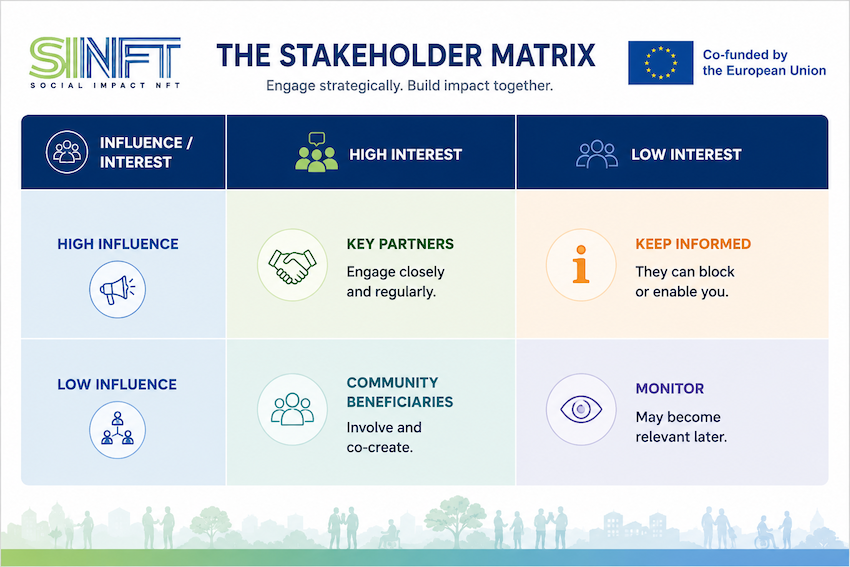
A stakeholder matrix places your project at the centre and positions key actors around it according to their relevance and their power. A simple version has two axes: interest (how much they care about your issue) and influence (how much power they have over it). This helps you prioritise who to approach, in what order, and with what message.
Community Walk
A community walk is exactly what it sounds like: walking through the community with open, observant eyes — ideally with community members as guides. You observe public spaces, note what is missing, listen to how people describe their environment. A community walk often reveals things that no data set or document can: the informal gathering spots, the places people avoid, the small signs of neighbourhood life that tell a larger story.
Document what you observe with photos, notes, or short video clips. Organise your observations afterwards into categories: needs, assets, and actors.
Semi-structured interviews
A semi-structured interview is a conversation guided by a set of open questions but flexible enough to follow unexpected threads. It is the most powerful tool for understanding how community members themselves see their situation — their priorities, their frustrations, their ideas.
Key principles for a good community interview:
• Ask open questions that cannot be answered with yes or no.
• Listen more than you speak — aim for the community member to talk 70% of the time.
• Ask about concrete experiences, not abstract opinions: 'Tell me about the last time you tried to...' rather than 'What do you think about...'
• Take notes on their exact words, not your interpretation of what they said.
Digital mapping tools
Several free digital tools support community mapping and make the results easy to share and update:
• Miro: a collaborative whiteboard where you can place actors, needs, and resources visually and invite others to contribute in real time.
• Padlet: a simple digital board for collecting and organising community observations, photos, and comments from multiple contributors.
• Google Maps (custom): you can create a custom map layer marking community assets, needs, and actors by location — useful for geographically-grounded projects.
• Mentimeter / Slido: for gathering quick community input in group settings — workshops, school sessions, public meetings.
-
Students mustMark as done
💡 NFT connection
Community mapping can itself produce material for a digital storytelling or NFT project.
Photos from a community walk, stories gathered in interviews, sketches of neighbourhood assets — all of these could become the basis for a collection of digital artworks that document a community's identity and needs.
Before any content is used in this way, however, informed consent from everyone involved is essential. Community documentation is powerful; community exploitation is not.
-
Shape the Future.
Mint the Change.