
Lesson 4 - Building Partnerships & Mobilizing Resources
Youth participation projects and co-operation at local level
Section outline
-
What you'll learn: How to identify the partners your project needs, approach them effectively, and mobilise the resources — financial and non-financial — that will make your project possible.
Why partnerships are not optional
A youth participation project that works in isolation rarely lasts. Local action needs local roots — relationships with institutions that have legitimacy, resources that you don't have, and networks that reach people you can't reach alone.
Partnerships are not just practical. They are also a statement about how change happens. A project that partners with a school says something different from one that works around schools. A project that involves the local municipality says something different from one that ignores it. Partnership choices communicate your project's values and your understanding of how power works in your community.
But partnerships are also relationships — and like all relationships, they require investment, honesty, and mutual respect. This lesson gives you the tools to build partnerships that are genuinely productive, not just formally ticked.
-
Students mustMark as done
Types of partners in local participation projects
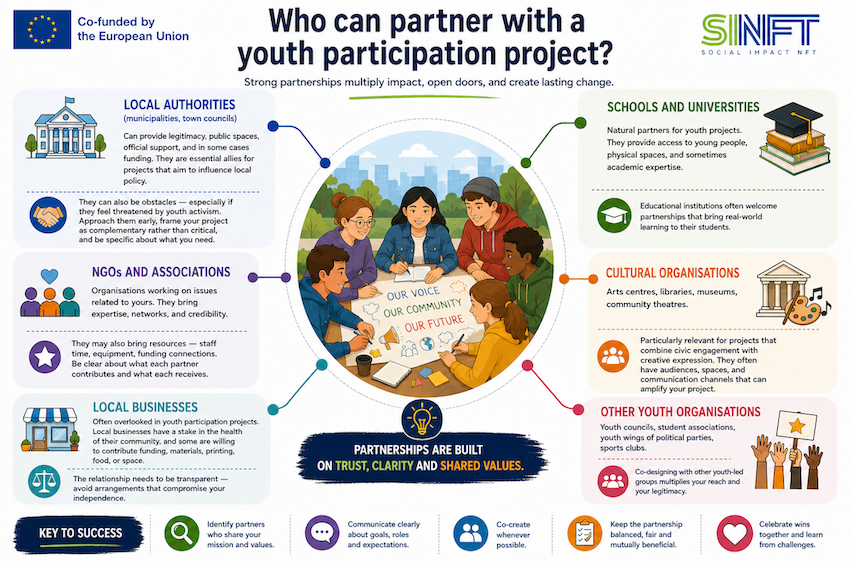
-
Students mustMark as done
How to approach a potential partner — step by step
1. Research first: understand the potential partner's mission, priorities, and current activities. Look for genuine overlap with your project. Approaching someone who has no interest in your cause wastes both your time and theirs.
2. Make the first contact human: send a short, personal message — not a generic template. Mention something specific about their work. Ask for a conversation, not a commitment.
3. Listen before you pitch: in the first meeting, ask about their work, their challenges, and their priorities. Show genuine interest. Find the intersection between what they care about and what you're building.
4. Propose something specific and mutual: be clear about what you're asking for and what you offer in return. Good partnerships are not about charity — they are about mutual benefit. What does your project give the partner: visibility, community connection, new audiences, shared learning?
5. Start small: before committing to a major collaboration, suggest a small joint activity. A shared event, a co-facilitated workshop, a contribution of space for one session. Small steps build the trust that larger partnerships require.
Document agreements: even informal partnerships benefit from a written summary of what each party commits to. A one-page partnership agreement that covers roles, timescale, and expectations prevents misunderstandings before they become conflicts.
-
Students mustMark as done
Mobilizing resources — beyond money
Many young project leaders assume that the main barrier to action is money. In practice, the most critical resources are often non-financial — and they are available if you know where to look.
Human resources — skills and time
Volunteers with specific skills (graphic design, facilitation, translation, legal advice, photography, IT) can contribute far more value than their equivalent in cash. Building a network of skilled volunteers begins with mapping the skills in your community — often in unexpected places.
Important principle: value volunteer contributions appropriately. Recognise them publicly, give them meaningful roles, and never exploit volunteer goodwill. An exploited volunteer is a lost ambassador.
In-kind resources — spaces, equipment, materials
Many organisations are willing to provide resources in kind — a meeting room, printing services, catering for events, equipment loans — even when they cannot provide cash. In-kind contributions can substantially reduce a project's financial needs.
Financial resources — where to find them
For small local projects, the most accessible financial resources are usually:
• Local authority small grants: many municipalities have small grant programmes specifically for youth and community initiatives. These are often under-subscribed.
• Community foundations: local foundations that distribute grants to community projects. Research what exists in your region.
• Crowdfunding: platforms like Ulule, Goteo, or local equivalents allow you to raise small amounts from large numbers of supporters. Works best when you have a compelling story and an active network to share it.
• European youth funding: Erasmus+ supports youth exchanges and participation projects. The amounts are modest but the eligibility criteria for small youth groups are accessible.
-
Students mustMark as done
💡 NFT connection
NFTs offer an additional, innovative fundraising channel that can complement traditional sources. A community project that creates NFTs from participant artwork or storytelling can raise funds while also building visibility and engagement beyond the local context. The key conditions: community members must consent to their contributions being used, the fund allocation must be transparent, and the NFT campaign must be presented as a complement to — not a substitute for — meaningful community relationships.
-

Shape the Future.
Mint the Change.