
Lesson 3 - Designing Local Participation Projects
Youth participation projects and co-operation at local level
Section outline
-
What you'll learn: How to turn a community need into a well-designed participation project — with clear objectives, realistic activities, and a structure that involves the community at every stage.
From observation to idea — the transition
Your community mapping has given you a picture of your community: its needs, its assets, its actors. Now comes the creative and strategic step: turning that picture into a project.
This transition is not as simple as it sounds. The gap between 'we identified a need' and 'we designed a project that addresses it well' is where many participation initiatives stumble. The most common mistakes are:
• Designing for the community instead of with it.
• Choosing activities before defining objectives.
• Setting objectives that are too vague to be measurable.
• Underestimating the time, resources, and relationships that implementation requires.
This lesson gives you the tools to avoid all four.
-
Students mustMark as done
Participatory design — the principle that changes everything
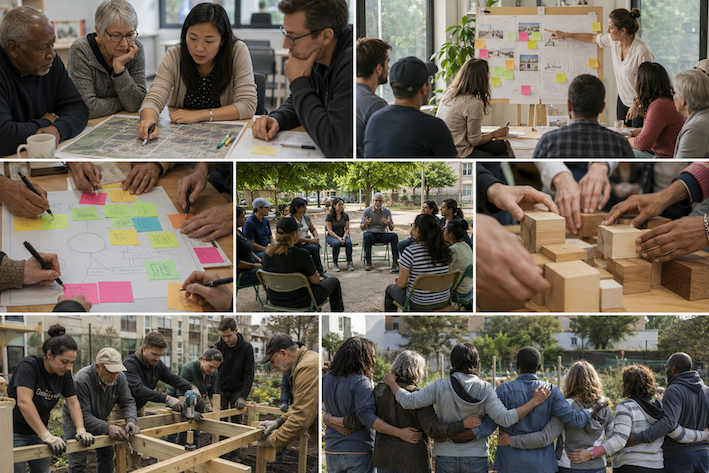
Participatory design is an approach to project development in which the people the project is designed to serve are actively involved in designing it. Not consulted at the end. Not asked to validate a plan already made. Genuinely involved from the beginning — in identifying priorities, generating ideas, making decisions, and taking responsibility for implementation.
Why does this matter?
• Better outcomes: projects designed with community members are more likely to address real needs and less likely to produce solutions that don't fit the context.
• Stronger ownership: when people have shaped a project, they feel ownership over it. They are more likely to participate, to spread the word, and to sustain the work when difficulties arise.
• Greater equity: participatory design actively counters the tendency of projects to reproduce existing power structures, by ensuring that usually-silent voices have genuine influence.
Participatory design is not the absence of structure. It requires skilled facilitation, clear processes, and honest management of expectations. Saying 'the community decides everything' is often a way of avoiding the responsibility of good facilitation. Genuine participation means giving people real power within a clear and honest framework.
-
Students mustMark as done
Defining your objectives — the SMART framework
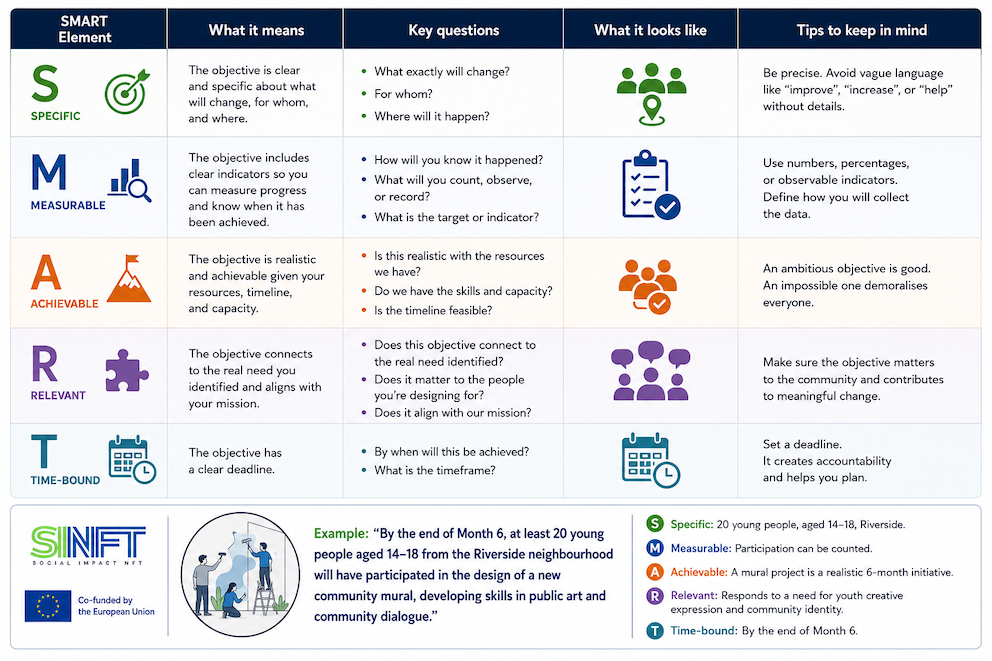
Before you design activities, you need to be clear about what you want to achieve. Objectives are the specific, defined changes you are aiming for. They are the standard against which you will later evaluate whether your project succeeded.
The SMART framework helps you write objectives that are useful — not just aspirational:
-
Students mustMark as done
Participatory methods — practical tools
Several structured methods support participatory project design:
World Café
A World Café is a structured conversation method in which participants rotate between small tables, each exploring a different question related to the project. After several rounds, the whole group reconvenes to share key insights. It is excellent for generating ideas and building shared understanding across a diverse group in a short time.
Future Workshop
Developed by Robert Jungk, the Future Workshop has three phases: a critique phase (what doesn't work in our community?), a fantasy phase (what would our ideal community look like?), and an implementation phase (how do we get there?). It is particularly powerful for engaging people who feel cynical or disillusioned about the possibility of change.
Participatory action research (PAR)
PAR combines research and action. Community members are not just subjects of research but co-researchers who investigate their own situation, analyse the findings, and use them to design collective action. PAR is especially powerful in contexts where the community's perspective has been consistently ignored by formal institutions.
Open Space Technology
Open Space Technology is a self-organising meeting format in which participants set the agenda themselves. Anyone can propose a topic for discussion; sessions happen in parallel; participants move freely between them. It works best with groups that have a shared sense of purpose and a complex challenge with no pre-determined solution.
-
Students mustMark as done
💡 NFT connection
A participatory design process can itself generate powerful material for a digital storytelling project. The ideas generated in a World Café, the visions drawn in a Future Workshop, the research findings of a PAR process — all of these could be the basis for a digital collection that documents the community's own vision for its future. Creating NFTs from this material is a way of giving that vision permanence and visibility beyond the local context.
-

Shape the Future.
Mint the Change.