
Lesson 1 - Understanding Your Community
Youth participation projects and co-operation at local level
Section outline
-
What you'll learn: What a community really is — beyond geography — and why deep understanding of your community is the starting point for any meaningful participation project.
-
Students mustMark as done
What is a community?
The word "community" is used so often that it can lose its meaning. We talk about the school community, the local community, the online community, the community of practice. But what does it actually mean?
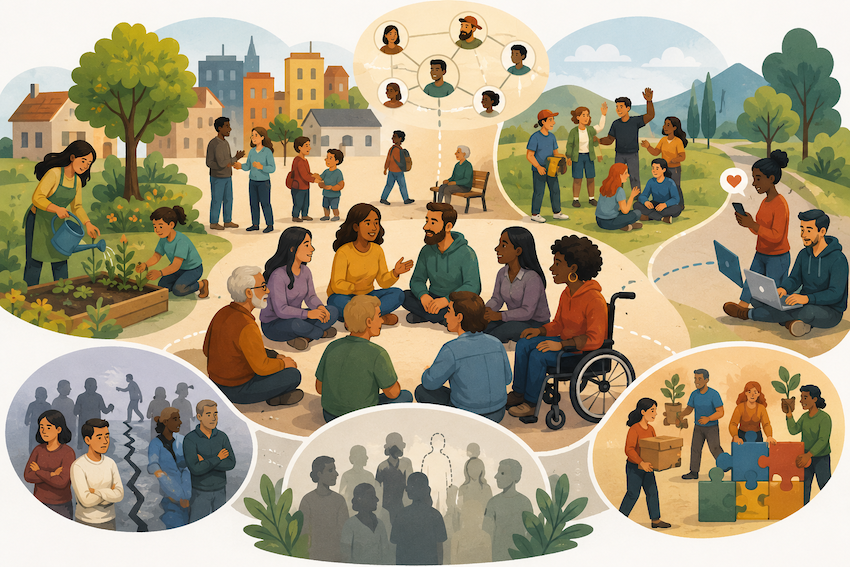
At its core, a community is a group of people who share something — a place, an interest, an identity, a set of experiences, a challenge. What makes a community more than just a crowd is a sense of belonging: the feeling that you are connected to others, that what happens to them matters to you, and that what you do matters to them.
Communities are not static. They evolve, they divide, they grow, they shrink. They contain disagreements and tensions as well as solidarity and shared purpose. Understanding a community means understanding all of this — the connections and the fractures, the visible actors and the invisible ones, the resources that are used and the needs that go unmet.
-
Students mustMark as done
Three dimensions of community
1. Physical community — place and belonging
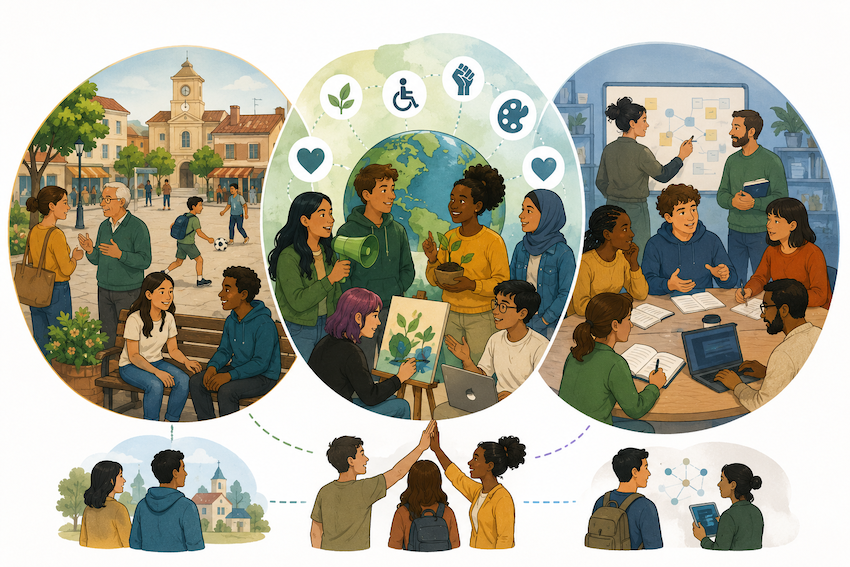
A physical community is defined by geography: a neighbourhood, a village, a district, a town. It is the most traditional understanding of community — the people who share the same streets, the same local institutions, the same public spaces.
Physical communities have visible structures: a town hall, local associations, schools, churches or mosques, markets. But they also have invisible structures: informal networks, unwritten rules about who belongs and who doesn't, histories of conflict or cooperation that shape how people interact today.
For a youth participation project, the physical community is your operating context.
You need to understand it before you can act within it.
2. Community of interest — shared concern
A community of interest brings people together around a shared concern, passion, or identity — regardless of where they live. Young people who care about climate change. People with disabilities who advocate for accessible public spaces. Artists who use their work for social commentary. Migrants navigating a new country.
Communities of interest often cross geographical boundaries — especially in the digital age. They can be the basis for powerful collective action, because the shared concern creates natural motivation and commitment.
Many effective youth participation projects are born at the intersection of a physical community and a community of interest: young people who live in the same neighbourhood and share a concern about the same local issue.
3. Community of practice — shared learning
A community of practice is a group of people who learn together by doing things together. They develop shared tools, language, and knowledge over time. Youth workers, social entrepreneurs, educators, and activists often form communities of practice — both within their organisations and across networks.
Understanding communities of practice matters for your project because they are often where the most useful knowledge and skills already exist. Connecting your project to existing communities of practice can accelerate your learning and strengthen your legitimacy.
-
Students mustMark as done
Identity, belonging, and diversity
No community is homogeneous. Every community contains people of different ages, genders, ethnic backgrounds, economic situations, beliefs, and abilities. This diversity is not a complication — it is one of the community's greatest assets. But it also means that no single voice speaks for the whole community.
When designing a participation project, one of the most important questions to ask is: whose voices are currently missing from local decision-making? Young people are often underrepresented. So are women, migrants, people with disabilities, and people from lower-income backgrounds. A participation project that only reaches the most visible or vocal community members risks reinforcing existing inequalities rather than challenging them.
-
Students mustMark as done
The role of young people in local change
Young people are often described as "the future" — which is another way of saying that their role in the present is secondary. This framing is both wrong and counterproductive.
Young people are active community members right now. They observe their communities with fresh eyes, unencumbered by the assumption that things have to be the way they are. They are often more connected across social divides — across neighbourhoods, across cultures, across digital and physical spaces — than older generations. And they bring energy, creativity, and a genuine stake in the long-term future of their communities.
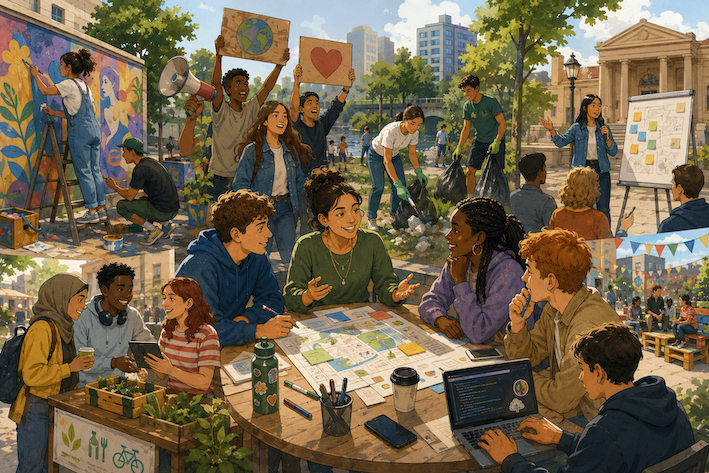
Across Europe and beyond, young people have led community initiatives that changed local policies, transformed public spaces, built services that institutions had failed to provide, and created cultures of participation where none had existed before.
-
Students mustMark as done
💡 NFT connection
Digital tools — including NFTs — can extend the reach and visibility of local community action. A neighbourhood mural, a youth-led campaign, a community archive — any of these could inspire a digital artwork that tells the story beyond the local context. NFTs created from community initiatives have been used to document local history, raise funds for neighbourhood projects, and connect local communities to global supporters. As you explore your own community, notice the stories and images that are worth preserving and amplifying.
-

Shape the Future.
Mint the Change.