
Social Media Marketing, Community and EMAIL
Social Media Marketing, Community and EMAIL
Section outline
-
-
Welcome to our Community Hub! 👋
This forum is the heartbeat of our course. Here is how to use this space:
💬 Discussion Corner: This is your open space to chat, ask questions, and share lightbulb moments or industry insights. Use this thread to connect with like-minded peers, network, and even find potential teammates for your future impact projects.
📌 Practice Zone: The other dedicated threads are for your practical tasks from the lessons. Jump into these to level up your hands-on skills, train your creative eye, and exchange valuable feedback with your peers.
Our Community Guidelines:
-
Be Active: The more you put into this community, the more you get out of it.
-
Be Respectful: Treat everyone with kindness. We are all here to learn and grow together.
-
Help Out: If you know the answer to someone's question, jump in!
Let’s build an inspiring and active space. Dive in!
-
-
In the modern digital landscape, having a powerful social impact project isn't enough — you need a loyal community to champion it. This comprehensive module guides you through the complete journey of digital engagement, showing you how to turn passive social media scrollers into active, dedicated advocates for your cause.
Across three focused lessons, you will learn how to capture attention, foster deep connections, and build a sustainable communication ecosystem that you completely control. Whether you are launching a Web3 initiative, an NFT collection, or a traditional social project, this module provides the exact blueprint you need to build a thriving digital movement.
-
-
Lesson 1: Social Media Strategy & Visibility 📱
-
Students mustMake a choice
-
Students mustMake a choice
-
Students mustMark as done
Why is Social Media One of the Best Ways to Engage an Audience?
Social Media by the Numbers
"Now that you've all voted in the poll, let's look at the real data provided by DataReportal's Digital 2025 Global Overview Report. These numbers help us understand why social media is so powerful on a global scale.
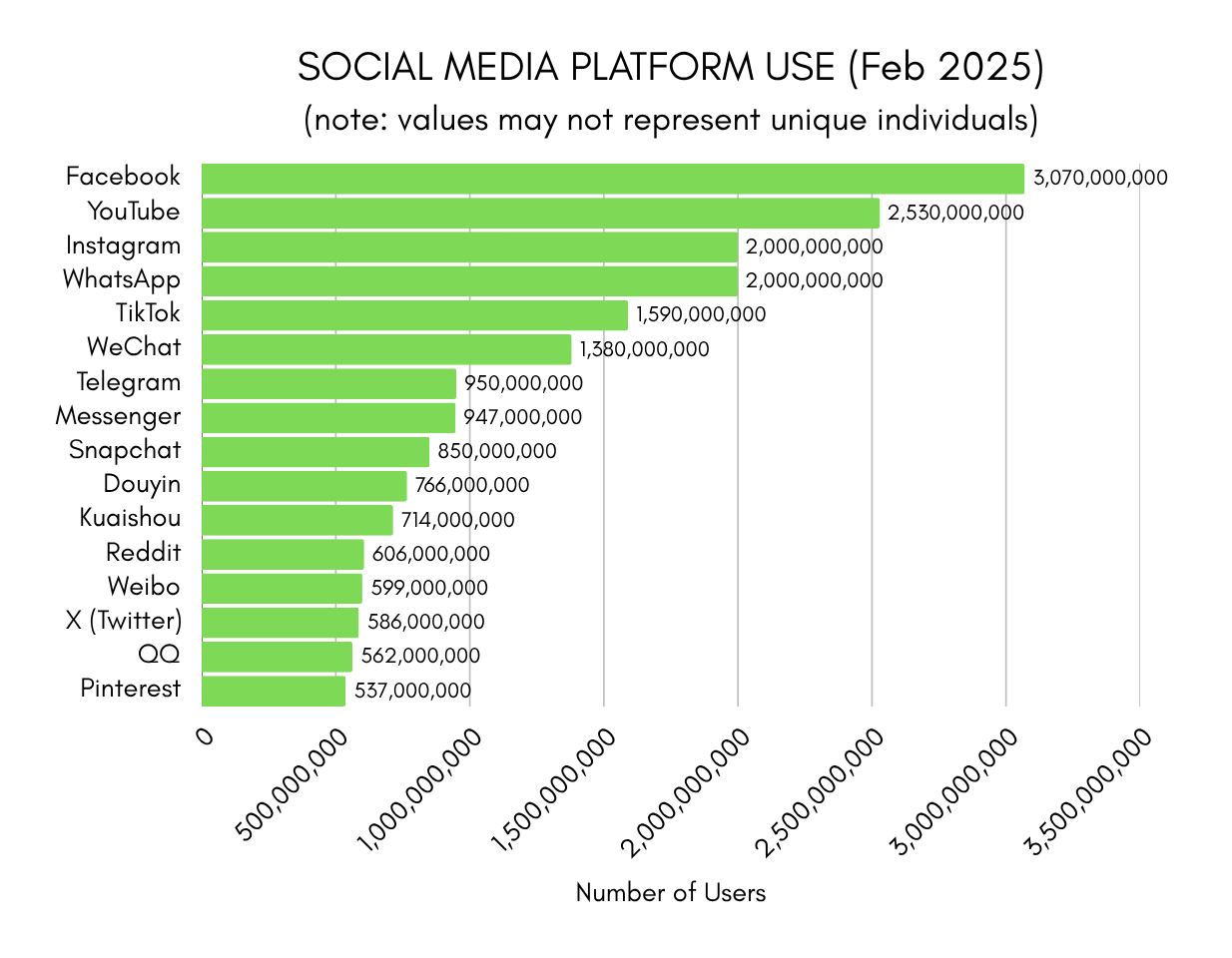
As you can see, the scale is massive. Facebook is still the largest 'digital nation' on Earth. But notice the mix: YouTube is right behind it, and platforms built on visuals (Instagram), messaging (WhatsApp, Telegram), and short video (TikTok) are all in the top tier. This data shows us that there isn't one 'social media' – there are many different worlds, each with billions of users.
This next chart is just as important. It shows the average time people are committing to social media every single day, broken down by age.
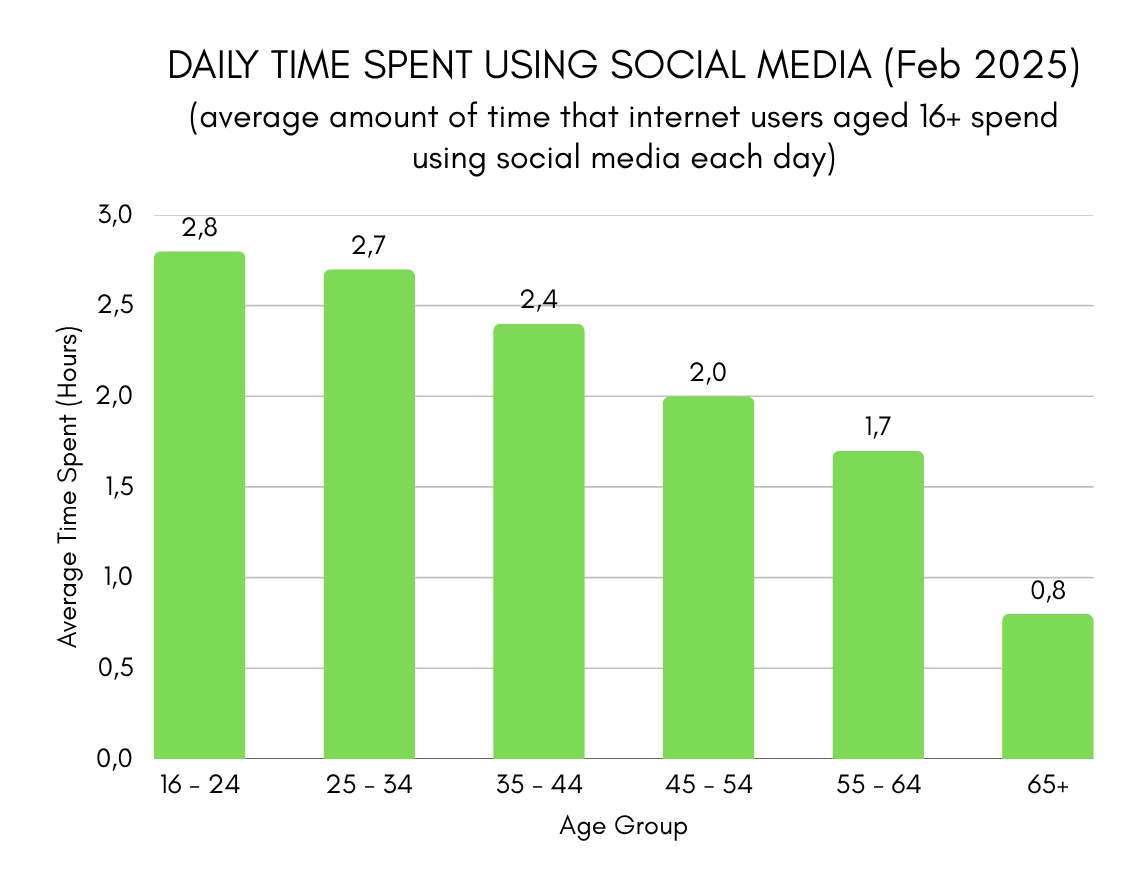
Look at the 16-34 age groups – they are spending well over 2.5 hours every day on these platforms. This isn't just a quick check; it's a huge part of their daily life. This tells us that if you can capture their attention, you have a deeply engaged audience, especially in these younger demographics.
In short, the data is clear: the audience is enormous, and they are deeply engaged for hours every day. This combination of massive reach and dedicated attention is precisely why social media is the most powerful environment to build a community and launch a social impact project today.
The Core Concept: Traditional Media vs. Social Media
We've seen the data on why people use social media – to connect, to be entertained, to discover. Now, we need to understand the single most important shift this causes for a project like yours. It's the fundamental difference between 'talking at an audience' and 'talking with a community'.
Now, let's look at two real case studies that successfully used the "Conversation" approach to build massive impact.
🌍OnChainMonkey
A historic NFT collection built on the motto
"Doing well and doing good."
They do not dictate charity goals top-down. Instead, they use X (Twitter) and Discord as open forums where the community takes the lead.
The founders regularly host live spaces asking: "Our treasury is growing. What global problem should we tackle next?"
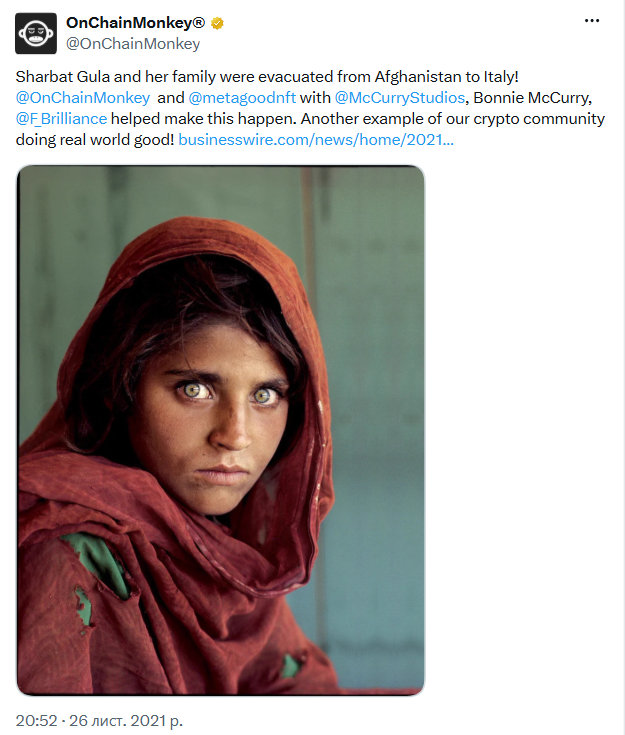
Because the community owned the conversation, they rapidly mobilized. Through social consensus, the community successfully proposed and funded real-world missions, including funding the evacuation of Sharbat Gula (the famous "Afghan Girl" from National Geographic) and rebuilding homes after natural disasters.
🐾Pawthereum
A Web3 project dedicated to supporting animal shelters worldwide.
Instead of posting generic "We donated!" graphics, they use their social platforms to shine a spotlight on the actual animal shelters.
Their content is designed to prompt replies and direct community action. A real post from their account looks like this:
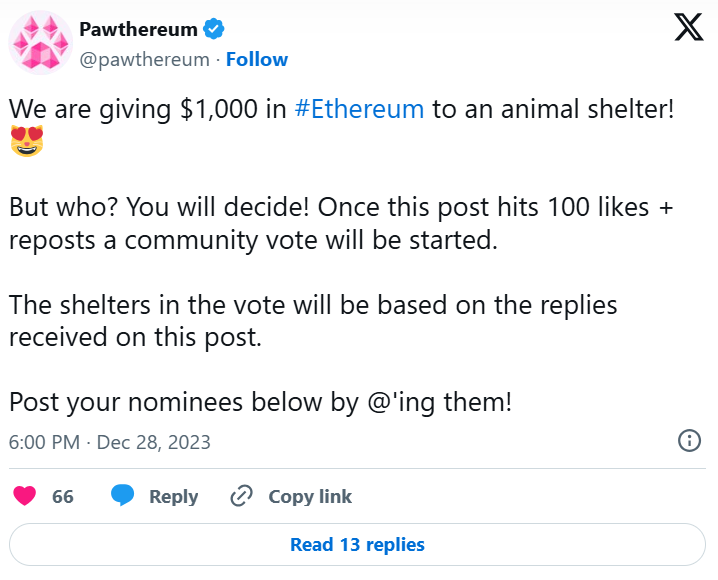
This strategy turns passive followers into active advocates for their local communities, creating viral engagement and high trust.
Successful social impact projects use social media to show proof, give credit to the community, and ask for their input. This is how you turn passive scrollers into passionate movement builders.
The 4 Key "Whys" for NFT & Social Impact
If you are launching an NFT project for a social cause, social media isn't just a marketing tool; it is the very foundation of your project. Here are the four reasons why:
- It Builds Your Community.
For many social impact NFTs, the primary "utility" (the benefit of holding the token) is the community itself. Social media platforms are the digital community halls where you gather true believers who are passionate about your specific mission. Without social media, your community has nowhere to exist. - It Provides Real-Time Transparency.
In the crypto world, skepticism is high. People want proof that their money is actually going to the cause. Social media allows you to provide radical transparency. You can post updates from the field, share links to blockchain transactions, and answer questions live. This builds the trust you need to succeed. - It Lets You Find Your Niche.
You don't need to convince all 4 billion internet users to buy your NFT. You only need to find the specific intersection of people who love digital art and care deeply about your specific cause (e.g., saving coral reefs). Social media algorithms and hashtags allow you to find and talk directly to those specific people. - It's Where Your Story Unfolds.
A social impact project is a journey, not a one-time product launch. Social media is the only place you can tell that story day by day. You can show the artist's initial sketches, document the struggles of building the project, and finally, celebrate the real-world impact together.
For an NFT & Social Impact project, social media is not a megaphone for broadcasting sales pitches. It is the foundation of your community, the proof of your transparency, and the stage for your story.
Now that we know why we must be on social media, we need a plan. In Part II, we will break down the key components of a Social Media Strategy, from defining your exact target audience to choosing the right platforms.
- It Builds Your Community.
-
Students mustMark as done
Key Components of a Social Media Promotion Strategy
Before you post your first update or record your first video, you need a strategy. A solid strategy answers four basic questions: Why are we doing this? (Goals), Who are we talking to? (Audience), What are we saying? (Content), and Where are we saying it? (Platform).
Goals: awareness, reputation, audience engagement, sales
Let's break down the first and most foundational component.
If you don't define your goal, you won't know if your strategy is actually working. In digital marketing, goals generally fall into four main pillars: Awareness, Reputation, Audience Engagement, and Sales.
However, for an NFT & Social Impact project, we must look at these pillars with a specific "Web3 twist":
1. Awareness
- The Goal: Getting people to know your project exists. You are trying to reach new eyes and expand your audience beyond your immediate circle of friends and existing supporters.
- What it looks like: A viral short-form video explaining the social problem you are solving, a widely shared infographic, or a shoutout/collaboration with a larger account.
2. Reputation — The Most Critical Goal
- The Goal: Making people believe your project is real, honest, and actually doing the work.
- What it looks like: Posting behind-the-scenes videos, introducing the real faces of your team, sharing on-chain transaction hashes of your donations, and publishing transparent roadmaps.
In the crypto space, scams are unfortunately common. For traditional businesses, "Sales" is often the only goal that matters. For you, Reputation is everything. If people know you exist (Awareness) but do not trust you, they will never support you.
3. Audience Engagement
- The Goal: Getting people to talk to you and to each other. This is the successful transition from a "Monologue" to a "Conversation."
- What it looks like: People answering your polls, asking thoughtful questions in the comments, joining your Telegram or Discord groups, and sharing their own stories related to your cause.
4. Sales (Action & Fundraising)
- The Goal: Getting people to take a definitive financial action, such as minting your NFT, buying your token, or making a direct donation to the cause.
- What it looks like: A clear "Call to Action" (CTA) post announcing that the mint is live, complete with official, safe links and a sense of urgency.
These four pillars are not isolated; they are an interconnected journey. Awareness brings people to your door, Reputation makes them trust you, Engagement invites them into your community, and Sales (Fundraising) is the natural result of doing the first three correctly. You cannot skip straight to asking for money without building the foundational trust and community first.
Defining the Target Audience
If you try to sell your NFT to "everyone", you will end up selling to no one. To be successful, you must divide the massive internet audience into smaller, specific groups. This is called segmentation.
When segmenting your audience for a Web3 project, you need to look at three main criteria:
1.Demographics: Who are they?
Age, income level, location. NFT Tie-in: Do they have the disposable income required to invest in digital assets?
2.Psychographics: What do they care about?
Values, hobbies, passions. NFT Tie-in: Do they appreciate digital art? Are they passionate about your specific social cause (e.g., planting trees, saving stray dogs)?
3.Web3 Experience: How much do they know about crypto?
NFT Tie-in: Do they already have a MetaMask wallet, or do you need to explain to them what a blockchain is?Creating Your "Ideal Holder Avatar"
Once you understand the criteria, you create an "Avatar". An avatar is a fictional character that represents your perfect community member. Instead of targeting a vague group like "Men 18-35," you create content specifically for "Alex."
For an NFT Social Impact project, you will usually need to build two distinct avatars. You must understand both, because they require completely different communication styles:


The "Crypto Native" (The Web3 Believer) The "Philanthropist" (The Traditional Supporter) Name & Age: Alex, 28 Sarah, 45 Background: Works in the tech industry. Highly digitally literate. Already owns a crypto wallet and actively trades NFTs on platforms like OpenSea. Donates regularly to traditional charities (like animal shelters or environmental funds). Loves art and community, but has never bought an NFT or used cryptocurrency. What They Care About: The quality and uniqueness of the art.
- The utility (what the NFT actually allows them to do).
- The strength and culture of the community.
- The project's future roadmap and tokenomics.
The real-world impact. They want to see exactly how their money helps the cause.
- Feeling an emotional connection to the mission and the people behind it.
- Trust and security.
How to Talk to Them: Speak their language. Focus your content on project transparency, smart contract details, and Web3 partnerships. You don't need to explain how to buy; you need to explain why your project is uniquely valuable. Avoid heavy crypto jargon (don't say "minting," say "buying digital art to support charity"). Tell emotional stories about your cause and, crucially, provide simple, step-by-step educational guides on how to safely buy their very first NFT using a credit card. The Golden Rule: A common mistake is treating these two avatars exactly the same. If you post a highly technical smart contract update on Instagram, "Sarah" will be confused and scroll past. If you post basic "how to use crypto" guides in a hardcore Telegram alpha group, "Alex" will be bored. Your strategy must tailor the message to the specific avatar you are trying to reach.
Types of content: What Are We Saying?
Now that you know who you are talking to, you need to decide what to say. A common mistake is using social media only to say "Buy my NFT." If every post is a sales pitch, people will unfollow you quickly.
To keep your audience engaged, you need a healthy mix of four content types. A great guideline is the 40/30/20/10 Rule:
1.Informational & Trust-Building (40% of your content)
Content that proves your project is real, active, and making an impact. It builds your Reputation. This includes behind-the-scenes updates, short raw videos, and proof of donations.
Let's break down a masterclass example from Women Rise NFT. This project focuses on funding girls' education globally. Instead of just posting their colorful NFT avatars, they use Instagram Reels to prove their real-world legitimacy.
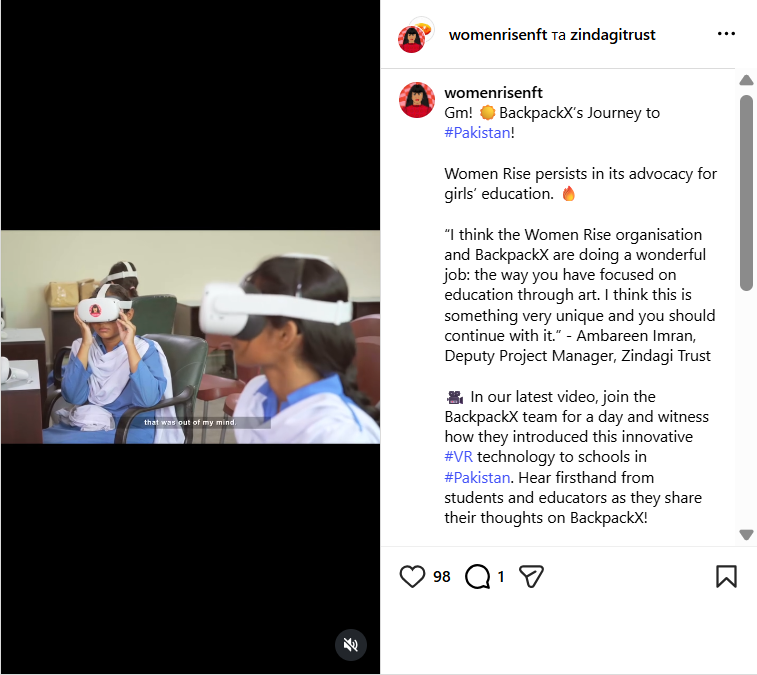
Why this is a perfect strategy:
1.Proof of Work (Show, Don't Tell): Instead of just typing "we donate to education," they visually prove it. They show the exact school, the exact technology they provided (VR headsets), and the actual girls benefiting from the Web3 funding.
2.Humanizing the Impact: Featuring authentic interviews with students (like Haniya) and local staff gives a human voice to the cause. It proves this is a real-world operation, instantly destroying the "crypto scam" stereotype and building deep trust with traditional donors.
3.Algorithmic Reach: Instagram pushes Reels to non-followers aggressively. This format is perfect for reaching "Sarah" (The Philanthropist) who might not actively search for NFTs, but will stop scrolling to watch an inspiring, well-produced documentary short about empowering young girls.
2.Educational (30% of your content)
Content that provides pure value to your audience by teaching them something new about your cause or about Web3. This establishes your project as a helpful authority.
Let's look at a masterclass in educational content from Replant World. They use the highly engaging "Instagram Carousel" format (swiping through multiple images) to teach traditional philanthropists about Web3 without overwhelming them.
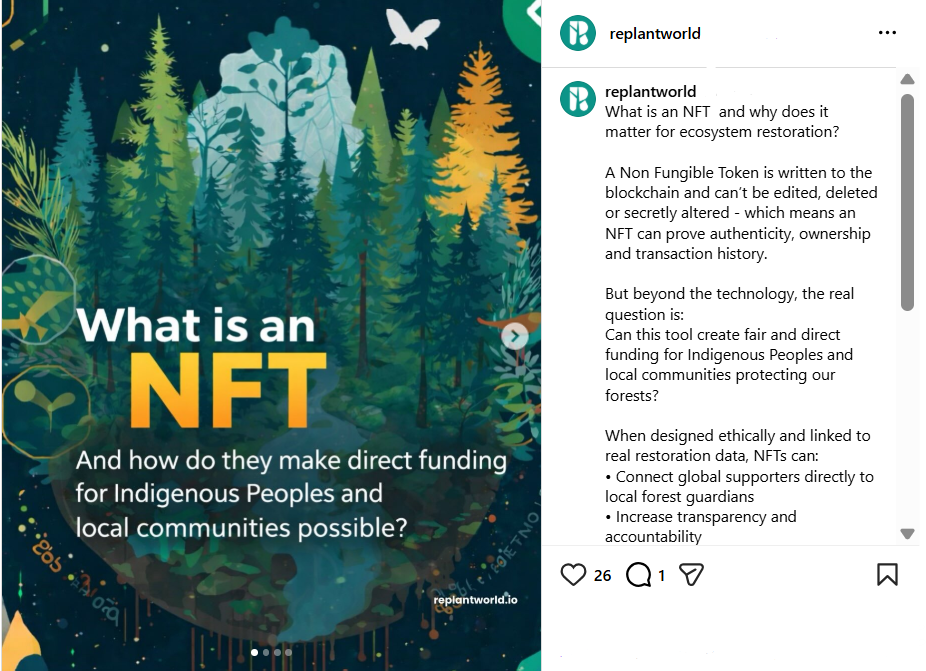
Why this is a perfect strategy:
1.Demystifies Web3 (For "Sarah"): It doesn't use confusing crypto slang like "smart contracts" or "nodes." It translates "blockchain" directly into benefits traditional donors care about deeply: total transparency and removing middlemen from charity.
2.Connects Tech to Tangible Good: By placing the definition of an NFT right next to a physical photo of a growing tree in the dirt, it visually bridges the gap between digital tokens and real-world environmental impact.
3.Highly Savable Format: Step-by-step carousels are among the most "saved" and "shared" content formats on Instagram. When followers save this to reference later, the algorithm pushes the post to even more people, generating free organic visibility.
3.Interactive (20% of your content)
Content explicitly designed to get replies, submissions, and build community. This includes polls, Q&A sessions, and User-Generated Content (UGC) campaigns (crowdsourcing).
Let's look at a highly emotional and powerful interactive post from Mom, I see war. Rather than just asking for a comment, they invite their audience to become co-creators of the project itself.
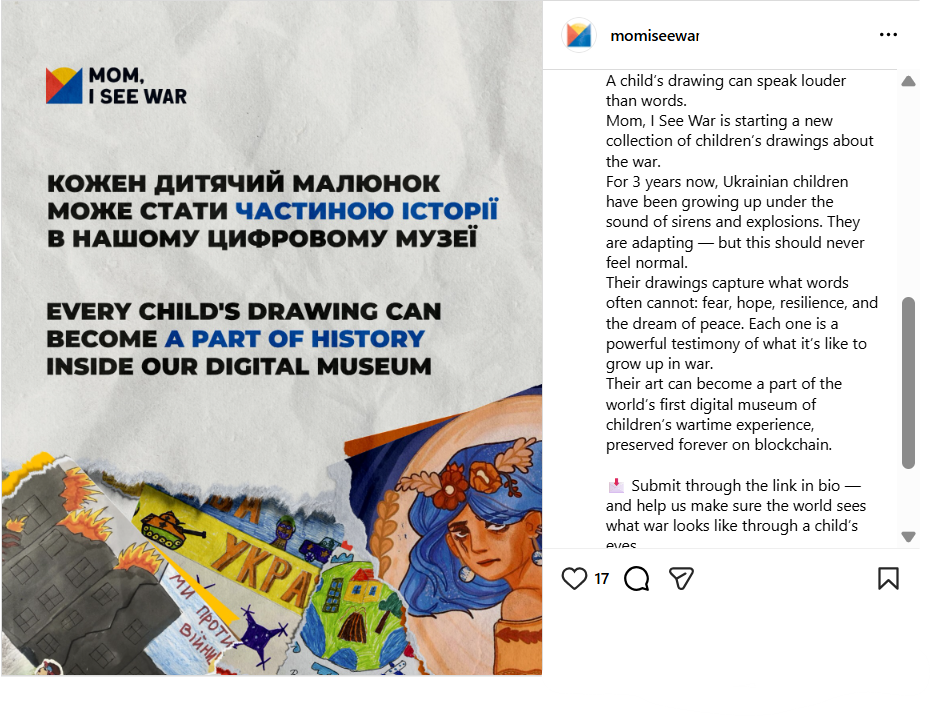
Why this is a perfect strategy:
1.Meaningful Participation (Crowdsourcing): This is the highest form of interactive content. They aren't just asking a simple poll question; they are asking their community to actively build the digital museum with them. This creates deep, emotional investment in the project's success.
2.Explaining Web3 Utility Naturally: They explain exactly why this is an NFT project without using confusing tech jargon. They highlight the core utility of blockchain: "preserved forever." It frames the technology as a tool for unerasable historical memory.
3.Clear Call to Action: The post provides a clear, actionable next step ("Submit through the link in bio"), smoothly moving people from passive scrollers on Instagram to active contributors on their platform.
4.Promotional (10% of your content)
The direct "Call to Action" (Sales/Fundraising). This is where you actually ask your audience to spend money, mint an NFT, or donate. It should only happen after you have provided value through the other three types of content.
Let's look at a highly effective fundraising post from Chatrity partnering with SOSD Singapore (a local dog shelter) on Facebook. This post perfectly balances emotional appeal with a direct sales push.
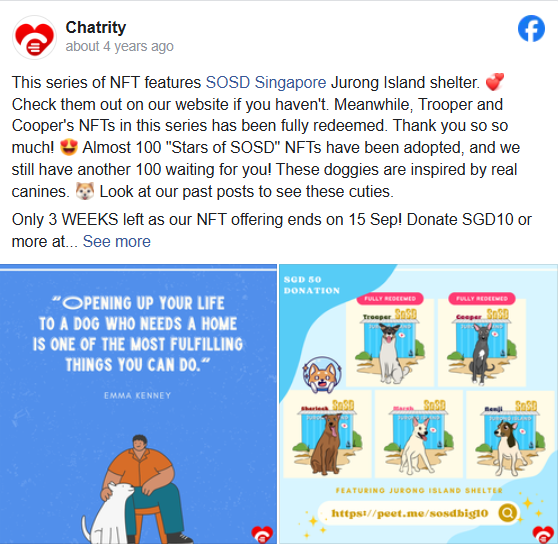
Why this is a perfect strategy:
1.Urgency & Scarcity (FOMO): By explicitly stating there are "Only 3 WEEKS left" and showing that specific NFTs (like 'Trooper' and 'Cooper') are already "FULLY REDEEMED," they create a strong psychological trigger. People act faster when they feel they might miss out.
2.Crystal Clear CTA (Call to Action): They don't just say "support us." They give an exact minimum price ("Donate SGD10 or more"), a clear deadline, and a direct link.
3.Tangible Connection: They remind the audience that "These doggies are inspired by real canines" at the Jurong Island shelter, grounding the digital NFT in physical reality and emotion.
4.Practical Benefits (For "Sarah"): For the Philanthropist audience, they include a crucial practical detail: "Donations made are TDR eligible" (tax-deductible). This removes a massive barrier for larger traditional donors.
The Takeaway: If you give value 80% of the time (Informational videos, Educational carousels, Interactive crowdsourcing), you earn the right to ask for support the other 20% of the time (Promotional mint posts).
Choosing the Right Platform for Promotion (Where Are We Saying It?)
A very common mistake for new projects is "Platform Burnout" – trying to be active on Instagram, TikTok, Facebook, X (Twitter), Discord, and Telegram all at the exact same time. If you have a small team (or if you are working alone), you will quickly burn out, and all your profiles will look average.
It is much better to be excellent on ONE platform than to be mediocre on five.
How do you pick your platforms? You base it on two things: Your Target Avatar (where do they live online?) and Your Content Type (what are you best at creating?).
Let's do a deep dive into the three major mainstream platforms and how they specifically fit into a Web3 Social Impact strategy:
Instagram Facebook TikTok "Visual Portfolio" & Trust Builder "Local Community" & Traditional Donor Hub "Viral Engine" & Movement Starter Audience Highly visual. Dominated by Millennials and Gen Z, but widely used by Gen X. It is the perfect home for Avatar 2: The Philanthropist. Skews older (Gen X, Boomers), which includes people who typically have the highest disposable income for traditional philanthropic donations. It is heavily focused on community groups and friends/family networks. Heavily Gen Z and young Millennials. They value authenticity, humor, and raw emotion over polished, "corporate" videos.
Best Formats 1.Carousels: Step-by-step guides to educate non-crypto users gently.
2.Reels: Short, emotional videos of your impact to capture new audiences (the algorithm pushes Reels to non-followers).
3.Stories: Daily, unpolished, behind-the-scenes updates to build a deep, personal connection with your existing followers.
Longer written posts with photos, links to detailed articles/fundraisers, and active community Groups. Vertical short-form video only. It must be fast-paced, use trending audio, or tell a highly engaging story in the first 3 seconds to stop the scroll.
Why pick it If your project relies heavily on visual art, stunning photography from the field, or emotional storytelling, Instagram is your best choice. Traditional donors and brand partners will often check your Instagram first to see if you look professional before deciding to support you. If your social impact is local (e.g., cleaning up a specific river in your city, funding a local animal shelter), Facebook is unmatched. You can join local community groups to spread the word. Furthermore, the Facebook audience is much more willing to stop, read a long, emotional text-based story, and click a direct donation link than users on fast-paced apps like TikTok. TikTok is the best platform in the world for Awareness. Its algorithm shows your content to people who do not follow you (the "For You Page"). If you need to raise massive global awareness for a lesser-known cause, and you are comfortable speaking directly to a camera or showing the "messy, raw" reality of your impact work, TikTok can help your mission go viral overnight. A Quick Note on X (Twitter): You might hear that X is the "Town Square" for the crypto world. While this is true for hardcore traders, it is incredibly noisy and very difficult for new social impact projects to grow there organically. Unless you already have a massive Web3 network, we highly recommend focusing your main efforts on Instagram, TikTok, or Facebook. These platforms are much better suited for reaching traditional philanthropists and building a genuine, supportive community around your cause first.
How to Make Your Choice: The "Hub and Spoke" Strategy
Instead of picking just one or trying to do all of them, successful projects use the Hub and Spoke method:
1.Choose Your Hub (80% of your effort):
Where does your primary Avatar spend their time? For most social impact projects, your Hub will be Instagram (for visual impact) or Facebook (for local/older donors). You create all your original, best content for this platform.
2.Choose 1-2 Spokes (20% of your effort):
These are secondary platforms where you simply repurpose content. If your Hub is Instagram, you can automatically post your Instagram Reels to TikTok (Spoke 1) and cross-post your images to Facebook (Spoke 2) with minimal extra effort.
The Decision Checklist
Before launching your accounts, ask yourself these two simple questions:
1.Who am I talking to mostly? (If General Donors/Art Lovers → Instagram/Facebook. If Young Activists → TikTok).
2.What am I actually good at making? (If writing long stories → Facebook. If photography/design → Instagram. If video editing/speaking → TikTok).Creating a content plan
What to keep in mind?
Now that you know who you are talking to, what to make, and where to post it, you need to organize this into a realistic schedule. A content plan prevents you from waking up every day wondering what to post. When building your plan, keep these crucial elements in mind.
First, prioritize consistency over frequency. It is much better to post three times a week for a full year than to post multiple times a day for a month and then disappear. In the Web3 space, a sudden disappearance is often viewed as a "rug pull" scam. Pick a posting frequency you can realistically maintain to build trust.
Second, remember that platform context matters. You can use the same core message across platforms, but you must adapt the format. For example, if you just planted 100 trees, you might post a beautiful photo carousel on Instagram, a long emotional story about the local farmers on Facebook, and a fast-paced raw video of your hands in the dirt on TikTok.
Third, consider timing and time zones. You want to post when your audience is awake and scrolling. If your NFT project is global, look at your platform analytics to find the optimal time. Often, posting mid-morning catches both the European evening and the American morning audiences.
Fourth, maintain flexibility through the 80/20 Rule. Plan 80% of your educational and informational content in advance, but leave 20% of your schedule open. This allows you to react organically to major news events or community questions without disrupting your entire calendar.
Finally, work smart by repurposing content. You don't need a brand new idea every single day. If you host a live AMA in your Telegram group, you can extract a powerful quote for Facebook, turn the top questions into an educational carousel for Instagram, and cut a short video highlight for TikTok, turning one big idea into multiple engaging posts.
Planning posts on Facebook, Instagram, TikTok
Having a content plan is only half the battle; executing it without burning out is the other half. You do not need to be glued to your phone 24/7 or set alarms to post manually. By using free, official scheduling tools, you can batch-create your content (for example, on a Sunday afternoon) and schedule your entire week in under 30 minutes.
Watch the video tutorial below to see exactly how to schedule your posts across Facebook, Instagram, and TikTok using their native desktop platforms.
Building a consistent content plan doesn't mean you have to be online 24/7. In fact, batch-scheduling gives you your time back. By prioritizing consistency, respecting the specific context of each platform, and using free automation tools like Meta Business Suite, you turn social media from a stressful daily chore into a reliable, automated engine for your mission. When your content runs on autopilot, you gain the most valuable asset in Web3: Time.
-
Students mustMark as done
Tracking Results
Once your scheduled posts go live, how do you know if your strategy is actually working?
We will dive deep into data and analytics in the upcoming SEO & Analytics Course, but for now, you need to understand the fundamental difference between "Vanity Metrics" and "Actionable Metrics."
1. Vanity Metrics. These are numbers like your total Follower Count and the number of Likes on a post. While they look nice and can make you feel good, they are often misleading. A massive follower count doesn't mean people trust you, and a simple "Like" takes zero effort. You cannot fund a social impact project with Likes alone.
2. Actionable Metrics.These are the numbers that prove your community is actually engaged and moving toward your goals:
-
Shares & Forwards:
If someone shares your post to their own Stories or friends, it means your content was so valuable they are vouching for it (Great for measuring Awareness). -
Saves (Instagram/TikTok):
If someone saves your educational carousel, it means you provided real value they want to keep (Great for measuring Reputation/Trust). -
Comments & Replies:
If people are debating a topic or answering your poll in the comments, you have successfully started a Conversation (Great for measuring Community Engagement). -
Click-Through Rate (CTR):
This is the ultimate test. Out of everyone who saw your promotional post, how many actually clicked the link to your website, mint page, or donation portal? (Great for measuring Sales/Action).
The Golden Rule of Tracking: Don't obsess over getting a million passive views. Focus on getting 100 deep, meaningful interactions. A small, highly engaged community that comments, shares, and clicks your links will fund an NFT project much faster than a massive, silent audience.
-
-
Students mustMark as done
We have covered a lot of ground in this lesson. We started by understanding the massive scale of social media and the critical shift from a one-way Monologue to a two-way Conversation. For an NFT and Social Impact project, this conversation is how you build trust, provide radical transparency, and tell the ongoing story of your mission.
Then, we broke down the mechanics of a real strategy. We learned that hoping for viral fame isn't a plan. A real plan requires knowing exactly who you are talking to, what value you are providing them, and where they spend their time online.Bonus for You 🎁
To help you put this all into practice, here is your step-by-step roadmap for building your project's social media strategy:
-
Ready to test your knowledge?
Take this quick 5-question quiz to review the key concepts covered in this lesson. This brief knowledge check will help you reinforce what you've learned and ensure you're ready to apply these new strategies to your own project.
-
-
-
Lesson 2: Building an Online Community & Engaging Your Audience
-
Students mustMark as done
Why Does Creating Online Communities Matter?
In traditional marketing, a business sells a product to a customer, and the transaction ends there. In the Web3 and social impact space, the community is not just a group of customers; it is the heartbeat of your entire project.
Without a community, your NFT is just a digital image sitting on a blockchain. With a community, it becomes a movement. A strong community provides immediate trust and validation to newcomers who visit your page and see an active, passionate group of people. More importantly, it provides longevity. When the initial "hype" around a new launch fades, or if the crypto market experiences a downturn, a passive audience will leave. A loyal community, however, stays with you because they believe in the shared mission. They transition from being consumers to co-creators — providing feedback, voting on charity decisions, and actively helping you improve the project.


The Audience (The Theater)
In a theater, you are the single speaker standing on a brightly lit stage, talking to a dark room full of people. An audience consists of people who consume your content. They watch your TikTok videos, read your Facebook stories, and double-tap your Instagram pictures. The communication flow here is strictly one-to-many. The critical flaw of an audience is that it relies entirely on the creator. If the speaker stops talking, the room goes completely silent. You absolutely need an audience to build Awareness, but an audience is fundamentally passive.
The Community (The Campfire)
Now imagine a group of people sitting in a circle around a campfire. Everyone is looking at each other, talking, sharing stories, and connecting over a shared cause. As the organizer, your job isn't to do all the talking; your job is simply to tend to the fire and keep it burning. The communication flow here is many-to-many. The superpower of a community is that members derive value from each other, not just from you. If the founder steps away for a day, the campfire keeps burning because the members are fueling it themselves. You need a community to drive Action and Loyalty.
Here is a quick breakdown of how people interact in these two different structures.
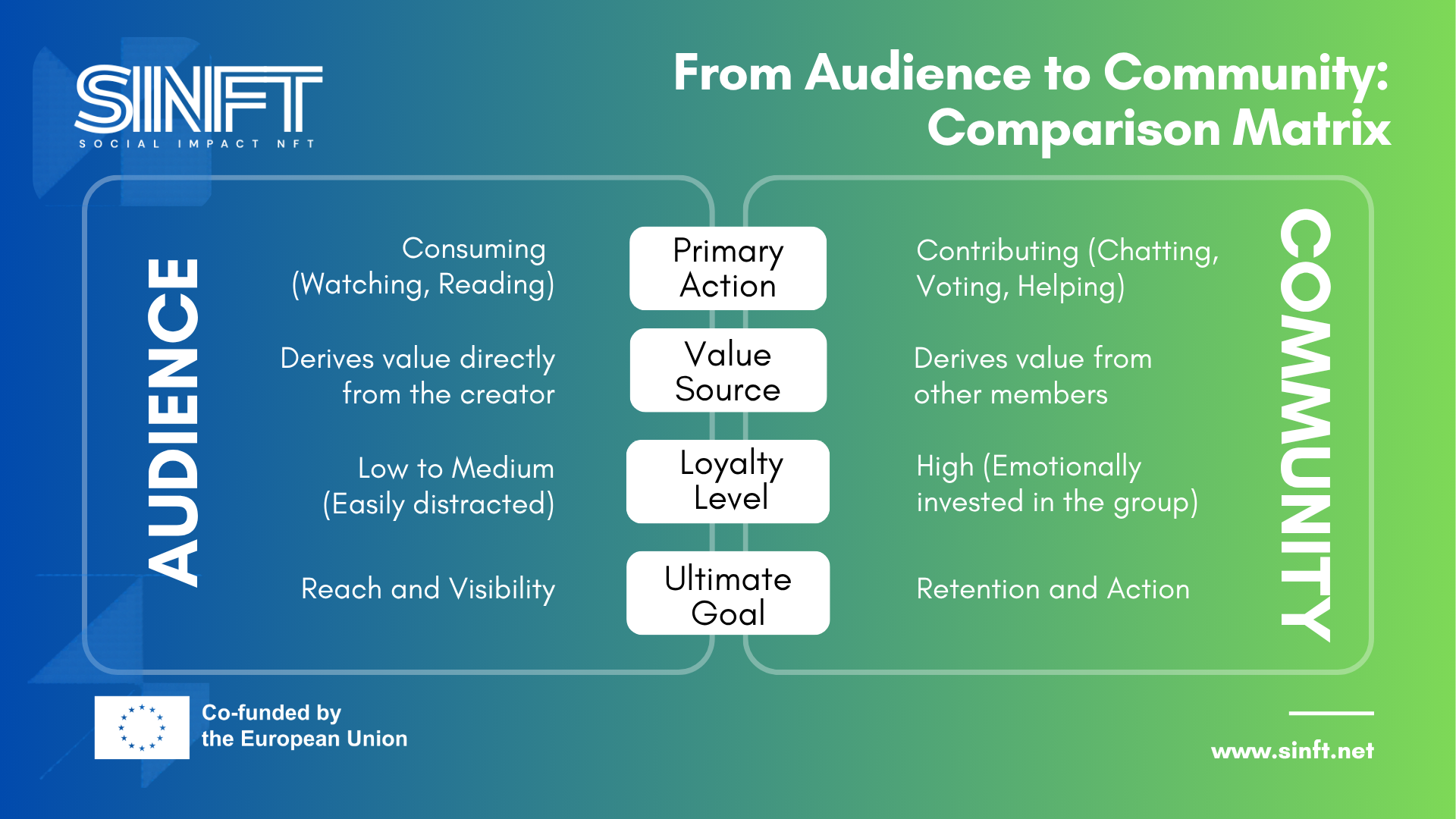
While you absolutely need an audience to get your project off the ground (Reach and Visibility), building a community is what keeps your project alive. An audience might "like" your social media posts, but a community will fund your mission, defend your reputation, and actively participate in your social impact goals. Your primary objective is to build a funnel that moves people from the "Theater" into your "Campfire."
-
Students mustMark as done
Choosing a Platform: Avoiding the "Ghost Town"
You cannot build an intimate campfire on a crowded, noisy highway. Platforms like TikTok or Instagram (your "Hubs" from Lesson 1) are digital highways. They are excellent for getting massive attention, but they are terrible places for deep, organized conversations. To build a true community, you need to invite your audience off the highway and into a dedicated "home."
However, building that home on the wrong platform leads to the "Ghost Town Effect." This happens when you choose a platform that your target audience doesn't naturally use. If you force a traditional philanthropist to download a complex crypto app, they simply won't do it. The chat will be empty. If you force a crypto-native trader to use a Facebook Group, they will assume your Web3 project is unprofessional, and the chat will be empty. You must build your home where your "Avatar" already lives.
Why Telegram is the "Golden Middle" for Impact NFTs
For most social impact projects trying to bridge the gap between complex Web3 technology and traditional philanthropy, Telegram is almost always the best choice. It solves multiple problems at once:
Low Friction & High Privacy
Your traditional donors ("Sarah") already have it on their phones, so there is no new software to learn. Meanwhile, your crypto users ("Alex") love it because they can hide their personal phone numbers and interact using only a username, preserving Web3 privacy.
The New "Topics" Feature
Historically, Telegram's weakness was that it only had one messy chat stream. Recently, Telegram introduced Topics (Forums). If your group has over 100 members, you can turn on Topics, which divides your group into specific chat rooms (e.g., "General Chat," "Charity Ideas," "Support"). This gives you the organizational power of Discord with the simplicity of Telegram.
The Hybrid Structure
As we will explore in the next section, Telegram allows you to cleanly separate official project news from daily community chatter.
-
Students mustMark as done
Setting Up Your Community: Building Telegram Headquarter
A professional community feels organized, safe, and welcoming from the very first second a user joins. A poorly structured community feels like a chaotic spam folder, causing new visitors to leave instantly.
The Architecture: Channel + Group + Topics
The golden rule of setting up a Telegram for a Web3 project is separating the "Signal" from the "Noise." Crypto chats move incredibly fast. If you post a crucial link for a charity donation or an NFT mint directly into a standard chat group, it will be buried under 100 random messages within ten minutes.
To fix this, you must always use the Three-Tier Architecture:
The Channel (The Notice Board)
Acts as your "Official Press." Only administrators can post here. It is a clean, read-only feed for your most important updates, sneak peeks, and mint links.
+
The Group (The Town Hall)
This is where everyone can talk. You link the Group to your Channel in Telegram's settings. Every time you post an official update in the Channel, it automatically creates a dedicated discussion thread in the Group.
+
Topics (The Rooms)
Once your Group grows, enable the "Topics" setting. Create specific rooms so people know where to post. (e.g., Introductions, General-Chat, Suggestions, etc).The "Welcome Mat": Your Pinned Message. Before you invite a single person, your room must be prepared. The most important piece of real estate in your community is the Pinned Message. When new people join, they are often disoriented. You must write a single, welcoming message and "Pin" it to the top of the chat so it is the first thing they see.
What makes a Pinned Message effective? A highly effective pinned message usually contains five key elements:
-
The Warm Welcome: Instantly make them feel they are in the right place.
-
The "Elevator Pitch" (Mission): A one-sentence reminder of what your project actually does so they don't immediately leave.
-
The "Safe Zone" (Official Links): Provide the only official links to your website or mint page. This protects your members from phishing scams.
-
House Rules & Safety: Set clear boundaries (no spam, no hate) and include a mandatory warning that admins will never DM them first.
-
The Icebreaker (Call to Action): Don't just leave them hanging! Tell them exactly what to do next to join the conversation.
Automated Security: Setting Up the "Bouncers". You cannot moderate a chat 24/7, and scammers will try to join your group to steal from your community. You must automate your safety using free Telegram bots like Shieldy, Rose Bot, or Safeguard.
Add the bot to your group, make it an Administrator, and configure these three critical settings:
-
The CAPTCHA: Force every new user to click a button proving they are human before they can type. This blocks 99% of automated spam bots.
-
Anti-Link Protection: Set a rule that automatically deletes any message containing an external URL sent by regular users. Scammers rely on tricking people into clicking fake mint links. If they can't post links, they can't scam.
-
Keyword Bans: Tell the bot to instantly delete messages and ban users who type words like "Support Desk," "Wallet Validation," or "Airdrop Claim."
The Human Element: Roles and Moderators. As your community grows, you will notice 2 or 3 people who are always online, always answering questions from newcomers, and deeply passionate about your cause.
Give them power. Promote them to "Community Moderators." Give them a custom title in the chat. Empowering your most active members not only takes the moderation workload off your shoulders, but it also creates fierce loyalty. It proves that your community is truly a collaborative space, not just a dictatorship run by the founders.
Building Telegram Headquarter
Theory is great, but execution is what actually builds a community. If you've ever felt like your community chat is just a chaotic stream of messages where important updates get lost in the void, you are in the right place.
We are going to ditch the unmoderated "group chat" vibe and build a robust, fully functioning Digital Headquarters on Telegram. Watch the explainer video below to understand the strategy in action, and then use the 5-phase blueprint to architect a space that is organized, scalable, and safe for everyone involved.
Setting up your community correctly from Day 1 will save you hundreds of hours of frustration later.
Once this architecture is in place and your automated bots are keeping the scammers out, you can stop worrying about technical chaos. With a safe, structured room ready, your only job now is to spark the conversation.
-
-
Students mustMark as done
Engaging Your Audience
Once the room is built and people are inside, the hardest work begins: getting them to talk. You cannot simply open the doors and expect a thriving community to magically appear. You have to actively guide the conversation.
How to respond to comments and messages
The way you respond sets the culture of your entire project. Speak like a passionate human, not a faceless corporation. Use "We" and "Our" to show that this is a team effort. Tone matters immensely — use appropriate emojis to convey warmth, as plain text can often sound cold or dismissive.
In the Web3 space, timing is critical. Silence breeds fear. Because crypto markets are volatile and scams are common, unanswered questions can quickly turn into doubt. If a community member asks a tough question about where the charity funds are going, do not ignore it. Answer it directly, publicly, and with utmost clarity, providing links to blockchain proof if possible. If you cannot be online 24/7, set clear expectations.
Put your "Work Hours" in the group description so people know when admins are actively answering questions.
Encouraging participation
Don't wait for your community to start the conversation. You must ignite the campfire by lowering the barrier to participation. The easiest way to do this is through Telegram's native Polls.
Instead of asking a broad question like
"What do you guys think?", give them simple options. For example, if you are building an NFT project to fund a school, post two architectural sketches and ask: "Which roof design should we fund for the new school? Vote A or B below!💬" This takes one second for a user to click, but it instantly makes them feel like an active co-creator in your mission.You can also use emoji reactions. Post a behind-the-scenes photo of your team working and say, "Drop a 🔥 reaction if you're excited for the next update!" It is a frictionless, fun way to measure engagement and keep the chat moving without forcing people to write long paragraphs.
-
Students mustMark as done
Keeping the Community Active
Communities die from boredom, not from a lack of major news. You cannot only talk to your community when you are trying to sell them an NFT. You must create a predictable rhythm that gives people a reason to check your chat every single week.
Planning simple weekly activities
Create a weekly schedule of rituals. When people know what to expect, they build habits around your community. Here are a few examples to get you started:
Motivation Monday
Start the week by sharing a short, inspiring story or a quote related to your real-world social impact. Remind them why they are here.WIP Wednesday (Work in Progress)
The Web3 space loves transparency. Share a rough, unfinished sketch of your upcoming NFT art, or a raw photo from the charity field. People love seeing how the project is being built behind closed doors.Feedback Friday
Open the floor specifically for constructive criticism. Ask, "What is one thing we could do better next month?" This requires vulnerability, but it builds unbreakable trust.Recognizing active members and celebrating milestones
People stay in communities where they feel seen, valued, and recognized. Make it a habit to publicly thank your most active members. If someone is always answering questions from newcomers, give them a public shoutout: "Huge thank you to @UserName for always helping out the new folks today!"
Celebrate every milestone together. Whether it is reaching 100 members in the chat, finalizing your first piece of art, or making your first real-world donation — celebrate it as a group victory, not just a founder's victory. In Web3, you can take this a step further by rewarding early and active supporters with guaranteed "Allowlist" spots (early access to mint your NFT), proving that their time and loyalty have real, tangible value in your ecosystem.
-
Ready to test your knowledge?
Take this quick 5-question quiz to review the key concepts covered in this lesson. This brief knowledge check will help you reinforce what you've learned and ensure you're ready to apply these new strategies to your own project.
-
-
-
Lesson 3: Email Essentials — Driving Action with Email
-
Students mustMark as done
When to Use Email vs. Social Media
To master digital marketing, you must understand that different channels serve entirely different psychological purposes. If you treat an email like a tweet, it will fail.
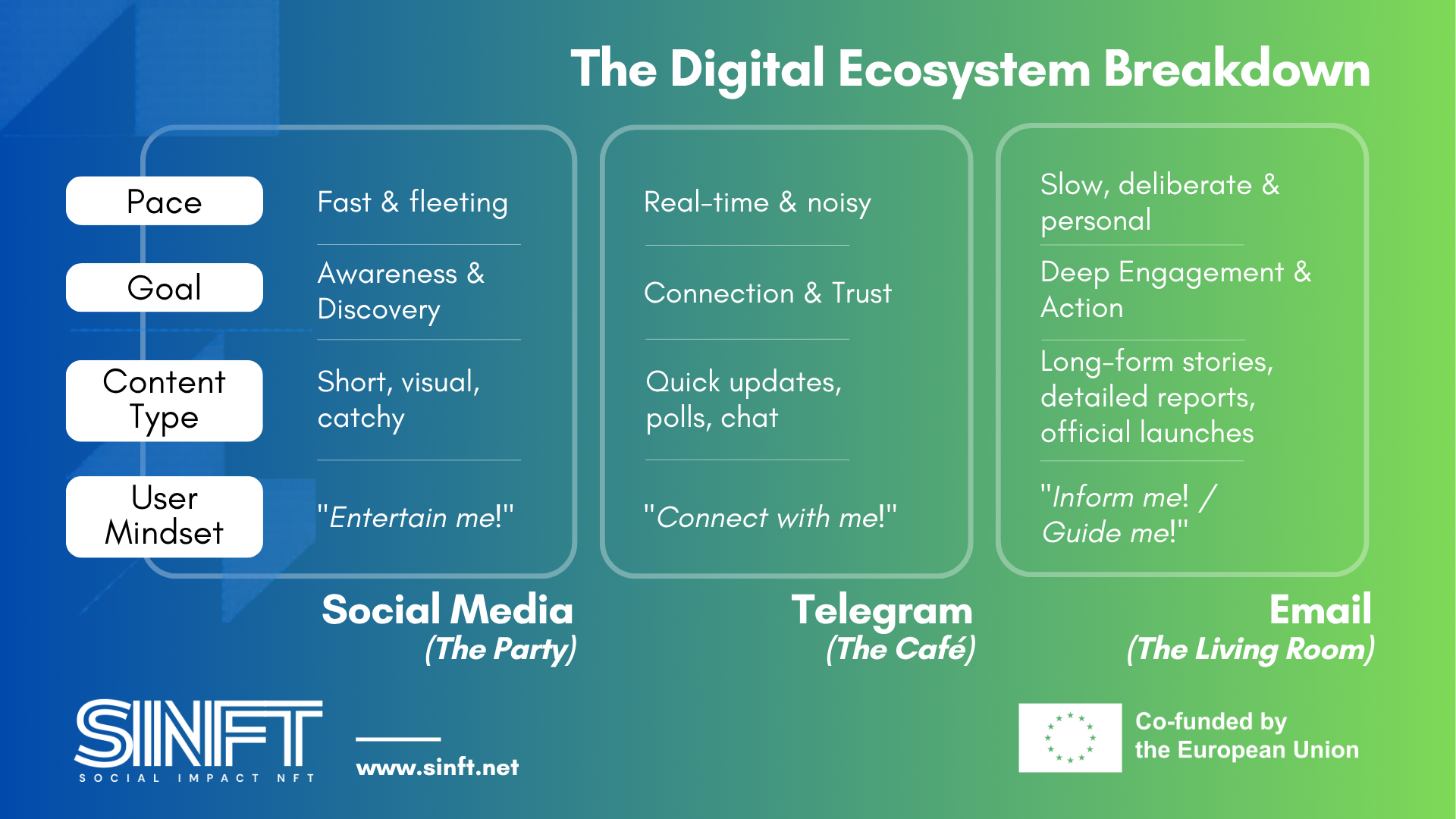
The Golden Rule: Use social media to find people. Use Telegram to talk with them. Use email to guide them towards a significant action.
Case in Point: The Fundraising Push
Imagine you need to raise $10,000 in 48 hours to fund an emergency clean-water well.
- On Instagram/Facebook: You post the link. It gets 5,000 views, but people are scrolling too fast. They "like" it and move on. (Conversion rate: 0.1%).
- On Telegram: You post the link. The community cheers, but 5 minutes later, 20 people start discussing a new crypto token, and your link is buried 100 messages up. (Conversion rate: 1%).
- Via Email: You send a dedicated, emotional story directly to 1,000 inboxes. There are no distractions. The only thing on their screen is your story and a big "Donate Now" button. (Conversion rate: 5-10%). -
Students mustMark as done
Email Basics: Crafting the Perfect Message
An email inbox is a fiercely competitive space. You are competing with their boss, their bank, and their favourite clothing brands. To stand out, your emails must be human-centred, beautifully structured, and completely free of corporate jargon.
The Subject Line: The Gatekeeper
Your subject line has one job: to get the email opened. It should spark curiosity or highlight a massive benefit without being "clickbait."
❌ Bad (Boring): Newsletter #14 - November Project Update
❌ Bad (Spammy): URGENT!!! MINT OPEN NOW TO CHANGE THE WORLD!!Winning Subject Line Formulas:
- The Curiosity Gap: "We didn't expect this to happen..." or "The surprising results of our latest clean-water initiative 💧"
- The Direct Benefit: "Your early access link for the new NFT drop" or "How your donation was spent this month."
- The Personal Question: "Quick question about the community, [First Name]?" (Research by Campaign Monitor shows that personalized subject lines boost open rates by 26%).
The Universal Email Structure (The "F" Pattern)
People do not read emails; they scan them. Eye-tracking studies by the Nielsen Norman Group show that we read digital content in an "F" shape – reading the top line fully, then scanning down the left side. Structure your email to fit this behaviour:
- The Hook (Introduction): A warm greeting and a compelling first sentence that immediately states why you are writing. Forget
"I hope this email finds you well."Start with action: "Today is a massive day for our community." - The Value (Main Message): The story, the impact report, or the exclusive insight. Show, don't just tell. Use short paragraphs (max 3 sentences) and bold text for key phrases.
- The Call to Action (CTA): A single, unmissable button or link telling the reader exactly what to do next. Do not confuse them with five different links.
- The P.S. (Postscript): This is a copywriter's secret weapon. According to direct marketing psychology, the P.S. is frequently the most read part of an email after the subject line. Use it to restate your main call to action or add a sense of urgency. (e.g., "P.S. The allowlist closes in exactly 12 hours. Grab your spot here.")
-
Students mustMark as done
Collecting Emails
People guard their email addresses closely. They will not give you their email just because you put a generic
"Subscribe to our newsletter"box on your website. You must offer a Lead Magnet – an incentive that provides immediate, tangible value in exchange for their contact details.- The Allowlist/Whitelist Spot: "Enter your email to guarantee early access to our upcoming NFT mint before the public." (Highly effective for crypto audiences).
- The Transparency Report: "Want to see exactly how blockchain is solving local poverty? Download our exclusive 5-page impact report." (Great for philanthropists).
- The Digital Toolkit/Art: "Sign up and get 3 high-resolution digital wallpapers from our lead artist, plus weekly project updates."
Below is the standard, high-converting pathway to turn a casual scroller into a subscriber:
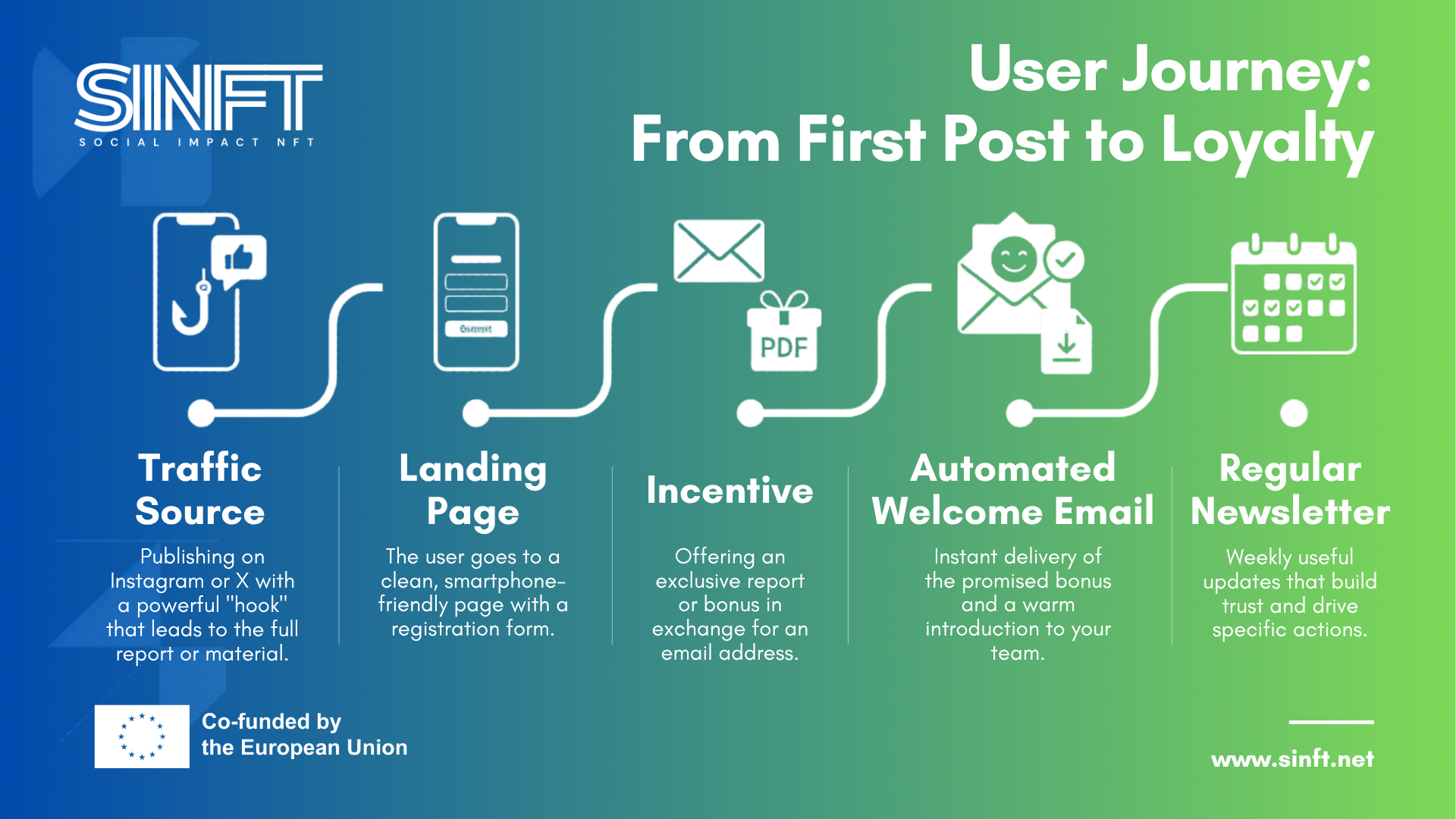
-
Students mustMark as done
Using eSputnik for Campaigns
To manage thousands of subscribers legally and efficiently, you need an Email Service Provider (ESP). While we don't strictly endorse just one single tool, eSputnik stands out as one of the best platforms for beginners that doesn't compromise on functionality. It is a powerful, professional-grade platform favoured for its intuitive interface, advanced segmentation, automated workflows, and multi-channel capabilities (allowing you to seamlessly combine Email, SMS and Web Push notifications as you grow).
The Automation Magic: The 3-Part Welcome Sequence
The biggest mistake beginners make is collecting an email and then staying silent for a month until they need to sell something.
When someone signs up, their interest is at its absolute peak. You must use eSputnik's workflow builder to set up an Automated Welcome Sequence. These emails trigger automatically while you sleep.
Email 1: The Delivery (Sent Immediately)
Subject: "Welcome! Here is your requested report 🎁"
Goal: Deliver the Lead Magnet you promised. Briefly introduce the project's core mission. Set expectations ("I will email you once a week").Email 2: The Story (Sent 2 Days Later)
Subject: "Why did we actually start this..."
Goal: Humanise the project. Share the "founder's story" or a highly emotional story about the social cause you are fighting for. No selling allowed here.Email 3: The Community Ask (Sent 4 Days Later)
Subject: "Come say hello!👋🏻"
Goal: Invite them to take a low-friction action. Ask them to join your Telegram group or follow you on Instagram. This integrates them into your daily ecosystem.The Technical Side of Segmentation & Avatars
Never send the exact same email to everyone. Segmentation means dividing your audience into distinct groups based on their behaviour and profile. In eSputnik, this is handled through Tags, Data Fields, and Dynamic Groups.
Let's look at how we technically segment our two core Avatars:


"Alex" (The Crypto Native) "Sarah" (The Traditional Philanthropist) The Setup: When Alex signs up via an Allowlist link, eSputnik automatically assigns him a tag (e.g., Tag: Web3_Interested). When Sarah signs up via your website's "Download Impact Report" form, eSputnik assigns her a tag (e.g., Tag: Charity_Focused).
The Content: You create a segment targeting this tag. You send Alex highly technical updates about smart contracts, tokenomics, and exclusive Discord AMA sessions. You send Sarah emotional storytelling, real-world photos of your social impact, and updates on how funds are being used. You exclude the heavy crypto jargon that might scare her away.
Step-by-Step Guide: Creating a Campaign in eSputnik
Theory is great, but execution is what drives results. Staring at a blank email editor can be intimidating for beginners. To help you overcome this, we have created the Email Campaign Blueprint – a visual, step-by-step guide.
Follow along with the visual guide and the steps below to transform a standard eSputnik template into a professional, branded newsletter for your project.
Once your test email looks perfect, it is time to share your message with the world:
- Save and Proceed: Save your message and navigate to the sending options in eSputnik.
- Choose your Segment: This is where your segmentation strategy comes into play. Select the specific contact group or tag you want to receive this email. For example, you might send a highly technical update to "Segment: Web3_Interested", or a general newsletter to "All Subscribers".
- Schedule or Send: Choose whether to blast the email immediately or schedule it for an optimal time (like a Tuesday morning). Hit Send!
💡 The Power of Visual Intuition
Congratulations, you've just built a professional campaign! Remember, the secret to great email design for beginners is observation – building your visual intuition (or "eye for design"). By consistently analyzing and using high-quality templates, you will naturally learn how to balance whitespace, typography, and imagery. With time and experience, you will graduate from modifying templates to building your own beautiful custom layouts completely from scratch. But for now, rely on proven templates, keep your design clean, and focus on delivering a powerful message. -
Students mustMark as done
Deliverability & Engaging Your Audience
Getting someone to open your email is only half the battle. Making sure the email actually reaches their inbox (and not the Spam folder) requires strategy.
The Deliverability Basics
Email providers like Gmail and Outlook have strict algorithms. If you look like a spammer, you will be filtered out.
- Avoid Spam Triggers: Do not use ALL CAPS in your subject line. Avoid excessive exclamation marks
(!!!). Limit words likeFREE, $$$, or URGENT. - Clean Your List: If someone hasn't opened your last 10 emails, remove them. Having a smaller list of highly engaged readers is vastly superior to a massive list of "ghosts" who drag down your sender reputation.
- Ask to be "Allowlisted": In your very first Welcome Email, ask the reader to drag your email from the "Promotions" tab to their "Primary" inbox.
The Rule of One
When writing, apply the "Rule of One": One Reader, One Idea, One Action. Do not write your email addressing a crowd (
"Hey guys!"). Write it as if you are sending a personal update to one specific person. Focus the email on one single idea (e.g., "Today we partnered with OceanSave"), and ask them to take one specific action at the end.Focus on "project-for-society" narratives. People connect with human resilience.
-
Share behind-the-scenes struggles and how your team overcame them.
-
Spotlight a specific community member who contributed a brilliant idea.
Encouraging Replies
Email does not have to be a one-way street. The algorithms of major email providers look at replies as the ultimate sign of a high-quality, trusted sender. If people reply to your newsletters, your emails will almost never go to Spam.
How to encourage replies:
- Ask a direct question at the end of the email: "Which of these two community initiatives should we fund next? Hit reply and let me know your thoughts!"
- Ditch the
noreply@yourproject.comaddress. Always send from a real person's name and address, like name@yourproject.com.
- Avoid Spam Triggers: Do not use ALL CAPS in your subject line. Avoid excessive exclamation marks
-
Ready to test your knowledge?
Take this quick 5-question quiz to review the key concepts covered in this lesson. This brief knowledge check will help you reinforce what you've learned and ensure you're ready to apply these new strategies to your own project.
-
-
📖 Key Readings/Resources
This section has the most important materials connected to the course.
Here you’ll find:
-
📖 Key readings
-
🎥 Helpful videos
-
🔗 Useful links and tools
Use these resources to go deeper, understand the topics better, and level up your knowledge.
If you want to explore more — this is the place to start.
Marketing Data, Insights & News-
DataReportal. Global Digital Insights. Accessed May 25, 2026. https://datareportal.com/
-
Sprout Social. Social Media Insights. Accessed May 25, 2026. https://sproutsocial.com/insights/
-
Morning Brew, Inc. Marketing Brew. Accessed May 25, 2026. https://www.marketingbrew.com/
-
Social Media Examiner. Social Media Marketing Podcast. YouTube Music. Accessed May 25, 2026. https://music.youtube.com/playlist?list=PLyqdnWmgSb_ZM5lBiO0zqd-oC8PAofmAe
-
CMX. Helping Community Professionals Thrive. CMX Hub. Accessed May 25, 2026. https://www.cmxhub.com/
-
FeverBee. The Beginner’s Guide To Community Management. Published August 16, 2023. Accessed May 25, 2026. https://www.feverbee.com/blog/
-
Pernice K. F-Shaped Pattern of Reading on the Web: Misunderstood, But Still Relevant (Even on Mobile). Nielsen Norman Group. Published February 2, 2024. Accessed May 25, 2026. https://www.nngroup.com/articles/f-shaped-pattern-reading-web-content/
-
AnswerThePublic. Keyword Research & Content Ideas. Accessed May 25, 2026. https://answerthepublic.com/en
-
Really Good Emails. Really Good Emails. Accessed May 25, 2026. https://reallygoodemails.com/
-
Meta Platforms, Inc. Meta Blueprint: Free online training for advertising on Facebook. Accessed May 25, 2026. https://www.facebook.com/business/learn
-
Meta Platforms, Inc. Find Inspiring Brand Success Stories. Accessed May 25, 2026. https://www.facebook.com/business/success
-
HubSpot, Inc. HubSpot Academy. HubSpot. Accessed May 25, 2026. https://academy.hubspot.com/
-
-
🎓 COURSE FINAL ASSIGMENT
It is time to bring it all together. As you reach the finish line of this course, take this final assessment to review the key concepts we’ve covered across our entire journey. This ultimate knowledge check will solidify your learning and ensure you are fully equipped to apply these new strategies to build and scale your own project.
Successfully completing this evaluation is your final milestone — it not only validates your hard work but also serves as your official stepping stone into the NFT Innovation Labs, where you will turn theory into real-world action.Upon completion of the course, the student receives the following certificates:
Certificate of Completion / Certificate of Achievement
Confirms that the student has engaged with the course content and completed all required assessments, including passing the final test.
Received Credits: 3
-
✅ COURSE FINAL ASSIGMENT Quiz
It is time to bring it all together. As you reach the finish line of this course, take this final assessment to review the key concepts we’ve covered across our entire journey. This ultimate knowledge check will solidify your learning and ensure you are fully equipped to apply these new strategies to build and scale your own project.
Successfully completing this evaluation is your final milestone — it not only validates your hard work but also serves as your official stepping stone into the NFT Innovation Labs, where you will turn theory into real-world action.Passing grade is required to earn certificate and credits.
Passing grade: 50% and more.
-

Shape the Future.
Mint the Change.