
Lesson 2: Building an Online Community & Engaging Your Audience
Social Media Marketing, Community and EMAIL
Section outline
-
Lesson 2: Building an Online Community & Engaging Your Audience
-
Students mustMark as done
Why Does Creating Online Communities Matter?
In traditional marketing, a business sells a product to a customer, and the transaction ends there. In the Web3 and social impact space, the community is not just a group of customers; it is the heartbeat of your entire project.
Without a community, your NFT is just a digital image sitting on a blockchain. With a community, it becomes a movement. A strong community provides immediate trust and validation to newcomers who visit your page and see an active, passionate group of people. More importantly, it provides longevity. When the initial "hype" around a new launch fades, or if the crypto market experiences a downturn, a passive audience will leave. A loyal community, however, stays with you because they believe in the shared mission. They transition from being consumers to co-creators — providing feedback, voting on charity decisions, and actively helping you improve the project.


The Audience (The Theater)
In a theater, you are the single speaker standing on a brightly lit stage, talking to a dark room full of people. An audience consists of people who consume your content. They watch your TikTok videos, read your Facebook stories, and double-tap your Instagram pictures. The communication flow here is strictly one-to-many. The critical flaw of an audience is that it relies entirely on the creator. If the speaker stops talking, the room goes completely silent. You absolutely need an audience to build Awareness, but an audience is fundamentally passive.
The Community (The Campfire)
Now imagine a group of people sitting in a circle around a campfire. Everyone is looking at each other, talking, sharing stories, and connecting over a shared cause. As the organizer, your job isn't to do all the talking; your job is simply to tend to the fire and keep it burning. The communication flow here is many-to-many. The superpower of a community is that members derive value from each other, not just from you. If the founder steps away for a day, the campfire keeps burning because the members are fueling it themselves. You need a community to drive Action and Loyalty.
Here is a quick breakdown of how people interact in these two different structures.
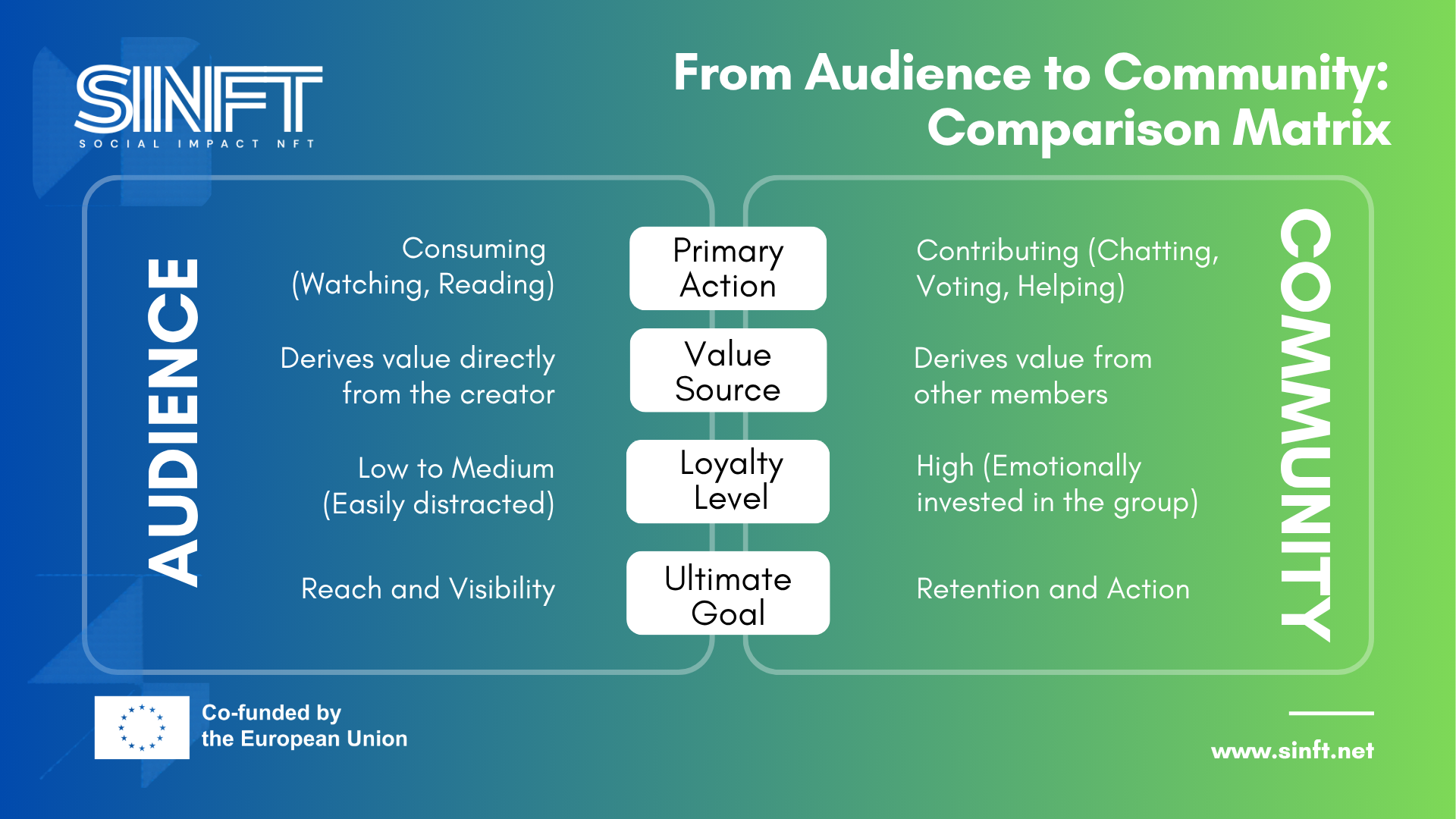
While you absolutely need an audience to get your project off the ground (Reach and Visibility), building a community is what keeps your project alive. An audience might "like" your social media posts, but a community will fund your mission, defend your reputation, and actively participate in your social impact goals. Your primary objective is to build a funnel that moves people from the "Theater" into your "Campfire."
-
Students mustMark as done
Choosing a Platform: Avoiding the "Ghost Town"
You cannot build an intimate campfire on a crowded, noisy highway. Platforms like TikTok or Instagram (your "Hubs" from Lesson 1) are digital highways. They are excellent for getting massive attention, but they are terrible places for deep, organized conversations. To build a true community, you need to invite your audience off the highway and into a dedicated "home."
However, building that home on the wrong platform leads to the "Ghost Town Effect." This happens when you choose a platform that your target audience doesn't naturally use. If you force a traditional philanthropist to download a complex crypto app, they simply won't do it. The chat will be empty. If you force a crypto-native trader to use a Facebook Group, they will assume your Web3 project is unprofessional, and the chat will be empty. You must build your home where your "Avatar" already lives.
Why Telegram is the "Golden Middle" for Impact NFTs
For most social impact projects trying to bridge the gap between complex Web3 technology and traditional philanthropy, Telegram is almost always the best choice. It solves multiple problems at once:
Low Friction & High Privacy
Your traditional donors ("Sarah") already have it on their phones, so there is no new software to learn. Meanwhile, your crypto users ("Alex") love it because they can hide their personal phone numbers and interact using only a username, preserving Web3 privacy.
The New "Topics" Feature
Historically, Telegram's weakness was that it only had one messy chat stream. Recently, Telegram introduced Topics (Forums). If your group has over 100 members, you can turn on Topics, which divides your group into specific chat rooms (e.g., "General Chat," "Charity Ideas," "Support"). This gives you the organizational power of Discord with the simplicity of Telegram.
The Hybrid Structure
As we will explore in the next section, Telegram allows you to cleanly separate official project news from daily community chatter.
-
Students mustMark as done
Setting Up Your Community: Building Telegram Headquarter
A professional community feels organized, safe, and welcoming from the very first second a user joins. A poorly structured community feels like a chaotic spam folder, causing new visitors to leave instantly.
The Architecture: Channel + Group + Topics
The golden rule of setting up a Telegram for a Web3 project is separating the "Signal" from the "Noise." Crypto chats move incredibly fast. If you post a crucial link for a charity donation or an NFT mint directly into a standard chat group, it will be buried under 100 random messages within ten minutes.
To fix this, you must always use the Three-Tier Architecture:
The Channel (The Notice Board)
Acts as your "Official Press." Only administrators can post here. It is a clean, read-only feed for your most important updates, sneak peeks, and mint links.
+
The Group (The Town Hall)
This is where everyone can talk. You link the Group to your Channel in Telegram's settings. Every time you post an official update in the Channel, it automatically creates a dedicated discussion thread in the Group.
+
Topics (The Rooms)
Once your Group grows, enable the "Topics" setting. Create specific rooms so people know where to post. (e.g., Introductions, General-Chat, Suggestions, etc).The "Welcome Mat": Your Pinned Message. Before you invite a single person, your room must be prepared. The most important piece of real estate in your community is the Pinned Message. When new people join, they are often disoriented. You must write a single, welcoming message and "Pin" it to the top of the chat so it is the first thing they see.
What makes a Pinned Message effective? A highly effective pinned message usually contains five key elements:
-
The Warm Welcome: Instantly make them feel they are in the right place.
-
The "Elevator Pitch" (Mission): A one-sentence reminder of what your project actually does so they don't immediately leave.
-
The "Safe Zone" (Official Links): Provide the only official links to your website or mint page. This protects your members from phishing scams.
-
House Rules & Safety: Set clear boundaries (no spam, no hate) and include a mandatory warning that admins will never DM them first.
-
The Icebreaker (Call to Action): Don't just leave them hanging! Tell them exactly what to do next to join the conversation.
Automated Security: Setting Up the "Bouncers". You cannot moderate a chat 24/7, and scammers will try to join your group to steal from your community. You must automate your safety using free Telegram bots like Shieldy, Rose Bot, or Safeguard.
Add the bot to your group, make it an Administrator, and configure these three critical settings:
-
The CAPTCHA: Force every new user to click a button proving they are human before they can type. This blocks 99% of automated spam bots.
-
Anti-Link Protection: Set a rule that automatically deletes any message containing an external URL sent by regular users. Scammers rely on tricking people into clicking fake mint links. If they can't post links, they can't scam.
-
Keyword Bans: Tell the bot to instantly delete messages and ban users who type words like "Support Desk," "Wallet Validation," or "Airdrop Claim."
The Human Element: Roles and Moderators. As your community grows, you will notice 2 or 3 people who are always online, always answering questions from newcomers, and deeply passionate about your cause.
Give them power. Promote them to "Community Moderators." Give them a custom title in the chat. Empowering your most active members not only takes the moderation workload off your shoulders, but it also creates fierce loyalty. It proves that your community is truly a collaborative space, not just a dictatorship run by the founders.
Building Telegram Headquarter
Theory is great, but execution is what actually builds a community. If you've ever felt like your community chat is just a chaotic stream of messages where important updates get lost in the void, you are in the right place.
We are going to ditch the unmoderated "group chat" vibe and build a robust, fully functioning Digital Headquarters on Telegram. Watch the explainer video below to understand the strategy in action, and then use the 5-phase blueprint to architect a space that is organized, scalable, and safe for everyone involved.
Setting up your community correctly from Day 1 will save you hundreds of hours of frustration later.
Once this architecture is in place and your automated bots are keeping the scammers out, you can stop worrying about technical chaos. With a safe, structured room ready, your only job now is to spark the conversation.
-
-
Students mustMark as done
Engaging Your Audience
Once the room is built and people are inside, the hardest work begins: getting them to talk. You cannot simply open the doors and expect a thriving community to magically appear. You have to actively guide the conversation.
How to respond to comments and messages
The way you respond sets the culture of your entire project. Speak like a passionate human, not a faceless corporation. Use "We" and "Our" to show that this is a team effort. Tone matters immensely — use appropriate emojis to convey warmth, as plain text can often sound cold or dismissive.
In the Web3 space, timing is critical. Silence breeds fear. Because crypto markets are volatile and scams are common, unanswered questions can quickly turn into doubt. If a community member asks a tough question about where the charity funds are going, do not ignore it. Answer it directly, publicly, and with utmost clarity, providing links to blockchain proof if possible. If you cannot be online 24/7, set clear expectations.
Put your "Work Hours" in the group description so people know when admins are actively answering questions.
Encouraging participation
Don't wait for your community to start the conversation. You must ignite the campfire by lowering the barrier to participation. The easiest way to do this is through Telegram's native Polls.
Instead of asking a broad question like
"What do you guys think?", give them simple options. For example, if you are building an NFT project to fund a school, post two architectural sketches and ask: "Which roof design should we fund for the new school? Vote A or B below!💬" This takes one second for a user to click, but it instantly makes them feel like an active co-creator in your mission.You can also use emoji reactions. Post a behind-the-scenes photo of your team working and say, "Drop a 🔥 reaction if you're excited for the next update!" It is a frictionless, fun way to measure engagement and keep the chat moving without forcing people to write long paragraphs.
-
Students mustMark as done
Keeping the Community Active
Communities die from boredom, not from a lack of major news. You cannot only talk to your community when you are trying to sell them an NFT. You must create a predictable rhythm that gives people a reason to check your chat every single week.
Planning simple weekly activities
Create a weekly schedule of rituals. When people know what to expect, they build habits around your community. Here are a few examples to get you started:
Motivation Monday
Start the week by sharing a short, inspiring story or a quote related to your real-world social impact. Remind them why they are here.WIP Wednesday (Work in Progress)
The Web3 space loves transparency. Share a rough, unfinished sketch of your upcoming NFT art, or a raw photo from the charity field. People love seeing how the project is being built behind closed doors.Feedback Friday
Open the floor specifically for constructive criticism. Ask, "What is one thing we could do better next month?" This requires vulnerability, but it builds unbreakable trust.Recognizing active members and celebrating milestones
People stay in communities where they feel seen, valued, and recognized. Make it a habit to publicly thank your most active members. If someone is always answering questions from newcomers, give them a public shoutout: "Huge thank you to @UserName for always helping out the new folks today!"
Celebrate every milestone together. Whether it is reaching 100 members in the chat, finalizing your first piece of art, or making your first real-world donation — celebrate it as a group victory, not just a founder's victory. In Web3, you can take this a step further by rewarding early and active supporters with guaranteed "Allowlist" spots (early access to mint your NFT), proving that their time and loyalty have real, tangible value in your ecosystem.
-
Ready to test your knowledge?
Take this quick 5-question quiz to review the key concepts covered in this lesson. This brief knowledge check will help you reinforce what you've learned and ensure you're ready to apply these new strategies to your own project.

Shape the Future.
Mint the Change.