
Partnerships & Long-Term Sustainability
Partnerships & Long-Term Sustainability
Section outline
-
-
This is your space to ask, share, and connect.
Got a question? Post it.
Have an idea? Share it.
Want to help someone? Jump in!Keep it respectful, stay on topic, and let’s make this space active and useful for everyone.
-
-
-
No social entrepreneur creates lasting change alone. Even the most innovative ideas need the support, knowledge, and resources of others to become successful and sustainable.
Partnerships are at the heart of social entrepreneurship. By collaborating with organisations that share your values or complement your expertise, you can reach more people, strengthen your impact, and access resources that would be difficult to obtain on your own.
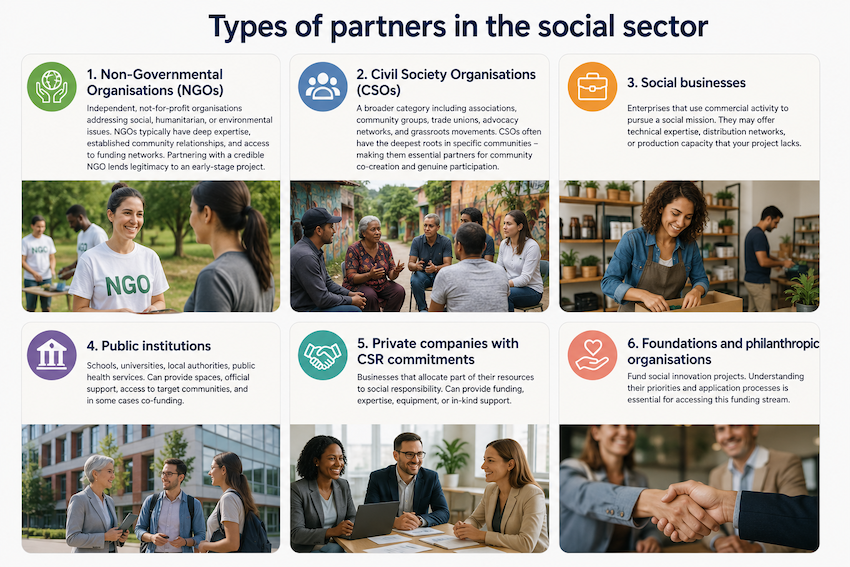
In this lesson, you will discover the main types of partners in the social sector, understand the unique value each can bring to your project, and learn how to identify the right organisations to support your social enterprise. Whether you are looking for funding, technical expertise, community connections, or strategic advice, building the right partnerships is an essential step towards creating meaningful and lasting social change.
-
Students mustMark as done
-
Students mustMark as done
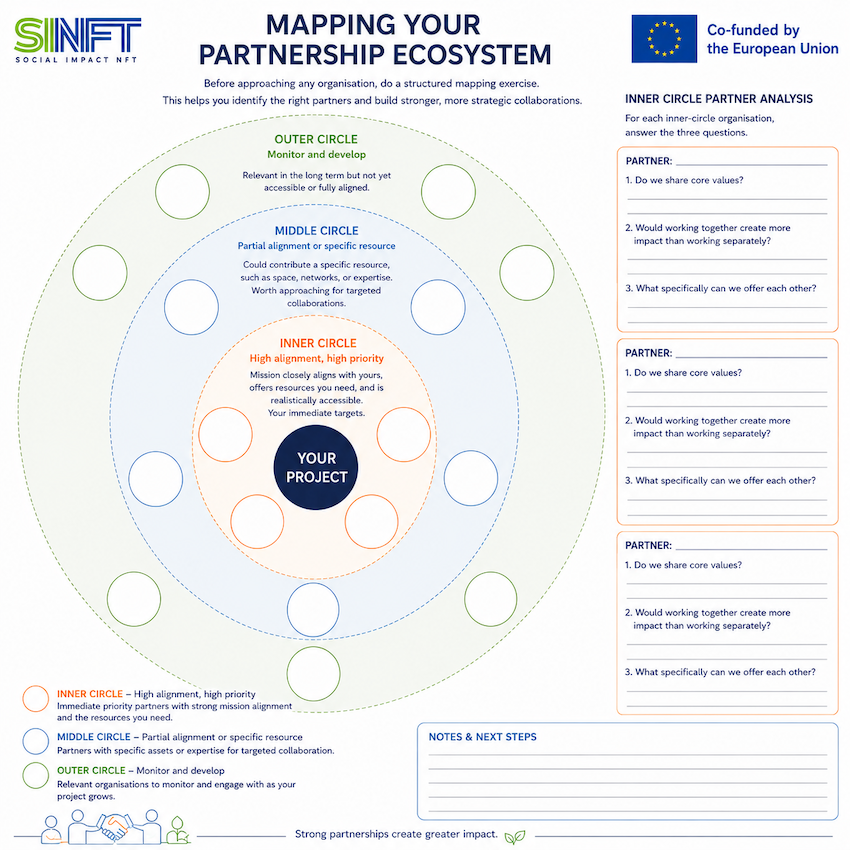
Mapping your partnership ecosystem
Before approaching any organisation, do a structured mapping exercise. This prevents you from pursuing partnerships based on name recognition or convenience rather than strategic fit.
Draw a diagram with your project at the centre. Place potential partners in three circles:
• Inner circle — High alignment, high priority: organisations whose mission closely overlaps with yours, who have resources or capacities you need, and who are realistically accessible to you. These are your immediate targets.
• Middle circle — Partial alignment or specific resource: organisations that don't share your full mission but could contribute something specific — a space, a network, an expertise. Worth approaching for targeted collaborations.
• Outer circle — Monitor and develop: organisations that are relevant in the long term but not yet accessible or aligned. Map them now; approach them later as your project grows.
For each inner-circle organisation, answer three questions: Do we share core values? Would working together create more impact than working separately? What specifically can we offer each other?
-
Students mustMark as done
-
Students mustMark as done
A partnership is a relationship. And like any relationship, it is built on trust — which takes time to develop and can be destroyed in a moment.
• Lead with listening. In any first conversation with a potential partner, your goal is to understand their mission, their challenges, and their priorities — not to pitch your project. Ask questions. Show genuine interest. Find the intersection between what they care about and what you're building.
• Start small. Before proposing a major collaboration, suggest a small joint activity — a shared event, a co-facilitated workshop, a resource exchange. Small steps build the mutual understanding and trust that make larger partnerships possible.
• Be honest about your stage. You don't need to be established and fully funded to attract partners. What you need is a clear mission, a genuine community need, and the honesty to say: 'We're early stage. Here's what we have. Here's what we're looking for. Here's what we can offer you.'
• Document agreements. Even informal partnerships benefit from a simple written summary of what each party commits to: roles, resources, timelines, and how decisions will be made. A one-page Memorandum of Understanding prevents misunderstandings before they become conflicts.
• Maintain the relationship. Partnerships need ongoing attention. Share updates, celebrate shared successes, acknowledge difficulties. Organisations that feel valued as partners stay engaged; those that are only contacted when you need something quickly disengage.

-
-
-
-
What you'll learn:
The main funding models for social enterprises, how to build a diversified income strategy, and how innovative tools — including NFTs — can complement traditional fundraising.
The funding challenge in social entrepreneurship
One of the most persistent challenges in social entrepreneurship is funding. Social enterprises address problems that the market hasn't solved — often because those problems don't generate profit. This means they can't rely on commercial revenue alone. But they also can't rely permanently on grants or donations — which are uncertain, competitive, and come with conditions.
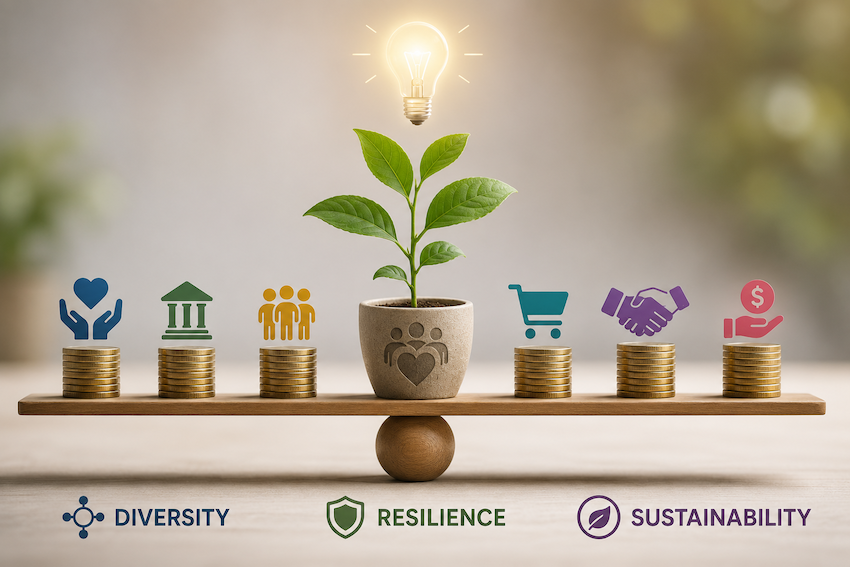
The most sustainable social enterprises are those that build diversified funding models: multiple income streams that complement each other, so that the loss or reduction of any one source doesn't threaten the project's survival.
-
Students mustMark as done
Funding is a journey, not a one-time event
Many first-time social entrepreneurs believe that once they secure funding, the challenge is over. In reality, fundraising is an ongoing process. As your organisation grows, your funding needs change. Early funding may help you test an idea, while later funding supports expansion, staffing, or long-term sustainability.
Successful organisations regularly review their funding strategy and adapt it to new opportunities and changing community needs.

-
Students mustMark as done
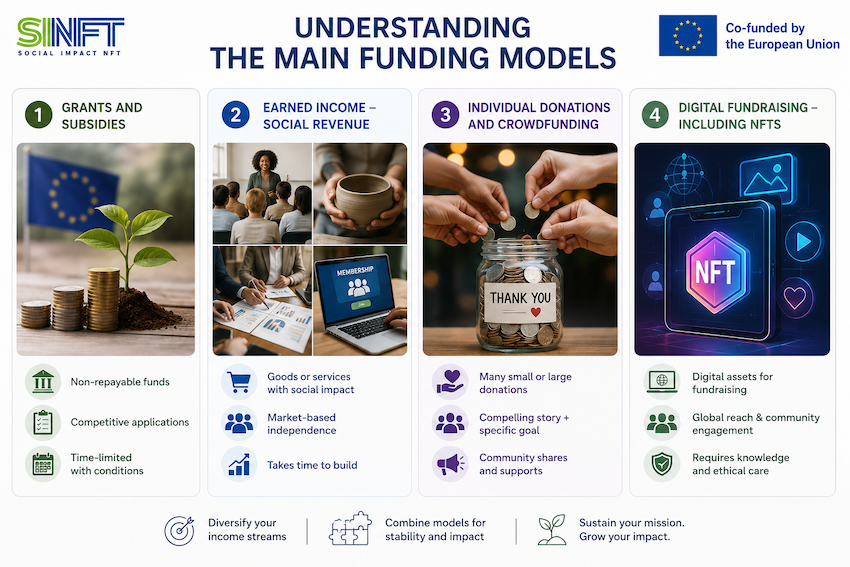
Understanding the main funding models
1. Grants and subsidies
Grants are funds provided by governments, foundations, or European institutions (such as Erasmus+, the European Social Fund, or Creative Europe) that do not need to be repaid. They are awarded competitively, usually based on a written application that describes the project, its objectives, its target group, and its expected impact.
Grants are often the first source of funding for early-stage social enterprises. They provide breathing space to develop and test a concept without commercial pressure. However, they come with reporting requirements, spending restrictions, and time limits — and they can end without warning if a programme closes or priorities change.
Key principle: never build a project that can only exist with one specific grant. If the grant ends, the project should be able to adapt.
2. Earned income — social revenue
Earned income is money generated by selling goods or services. For a social enterprise, the commercial activity is directly connected to the social mission — or at least supports it.
Examples of earned income in social enterprises:
• Training workshops offered to schools, companies, or community groups — with fees covering costs and contributing to the project.
• Products made by community members (crafts, food, clothing) sold in mainstream or online markets.
• Consulting or facilitation services offered to organisations that want to learn from your experience.
• Membership programmes that give supporters access to content, events, or community spaces.
Earned income gives a social enterprise the greatest independence and sustainability. But it requires building a market — which takes time and carries risk. It usually cannot be a significant income stream in the first year.
3. Individual donations and crowdfunding
Donations from individuals — small or large — are a vital income stream for many social enterprises. Crowdfunding platforms (Ulule, Goteo, GoFundMe, Miimosa) allow you to raise funds from a large number of small donors through a defined campaign with a specific goal and deadline.
Successful crowdfunding campaigns share three characteristics: a compelling human story, a specific and credible funding target, and an active community that shares the campaign before and during its launch. Without the third element, even the best story will struggle to reach its goal.
4. Digital fundraising — including NFTs
Digital tools have opened new possibilities for social enterprise fundraising. NFTs (Non-Fungible Tokens) are one example: digital assets — often artworks, stories, or community creations — that can be sold to raise funds for a cause.
When used responsibly, NFT campaigns can combine fundraising with storytelling, community engagement, and awareness-raising in ways that traditional fundraising cannot. They can reach global audiences, engage digital-native supporters, and give contributors a tangible connection to the cause they're supporting.
However, NFT campaigns also require technical knowledge, ethical care (see Course 4), and an existing community of potential supporters. They work best as part of a broader funding strategy — not as a standalone solution.
-
Students mustMark as done
Choosing the right funding mix
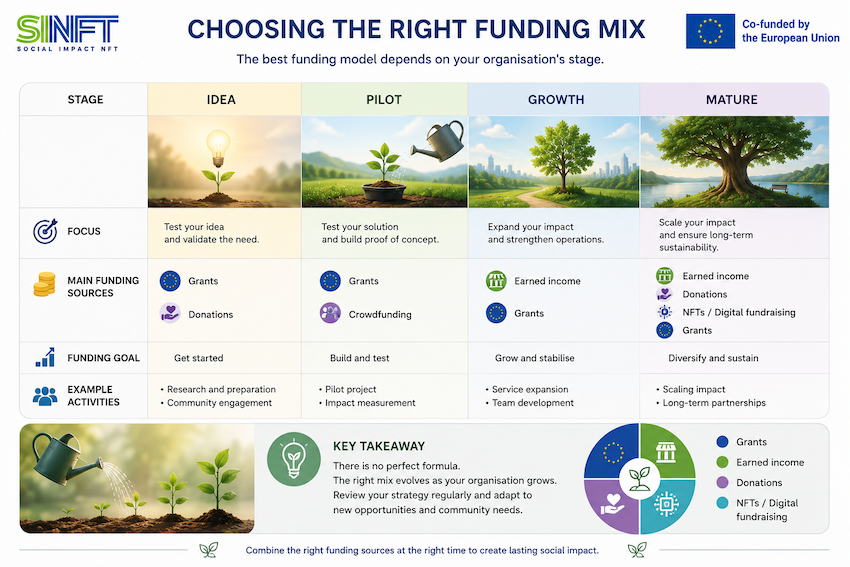
There is no single "best" funding model for every social enterprise. The most appropriate funding mix depends on your organisation's stage of development, its objectives, and its capacity.
In the early stages, grants and donations often provide the resources needed to test an idea and launch a pilot project. As your organisation grows, earned income becomes increasingly important, helping you build greater financial independence. More mature social enterprises typically combine several funding sources—including grants, earned income, donations, crowdfunding, and digital fundraising tools such as NFTs—to reduce risk and strengthen long-term sustainability.
Think of your funding strategy as something that evolves over time. Rather than relying on one source of income, aim to develop a balanced portfolio that supports both your social mission and your financial resilience.
Remember: the goal is not to replace one funding source with another, but to combine them in a way that allows your social enterprise to grow and create lasting impact.
-
Students mustMark as done
Common fundraising mistakes
Many promising social enterprises struggle not because their mission is weak, but because they make avoidable fundraising mistakes. Common pitfalls include:
- relying on a single funding source;
- applying for grants that don't match the project's mission;
- underestimating the time needed to prepare applications;
- failing to communicate impact clearly;
- treating fundraising as an occasional activity instead of an ongoing process.
Strong organisations view fundraising as relationship-building rather than simply asking for money.
-
Students mustMark as done
Designing your funding model — a practical exercise
A funding model is a plan that shows where your income will come from, in what proportions, over what timeframe. It doesn't need to be precise — especially at an early stage. But it needs to be honest and realistic.
For each income stream, ask:
• How much could realistically come from this source in Year 1? In Year 2?
• What conditions or effort does this stream require?
• What would happen to the project if this stream disappeared?
-
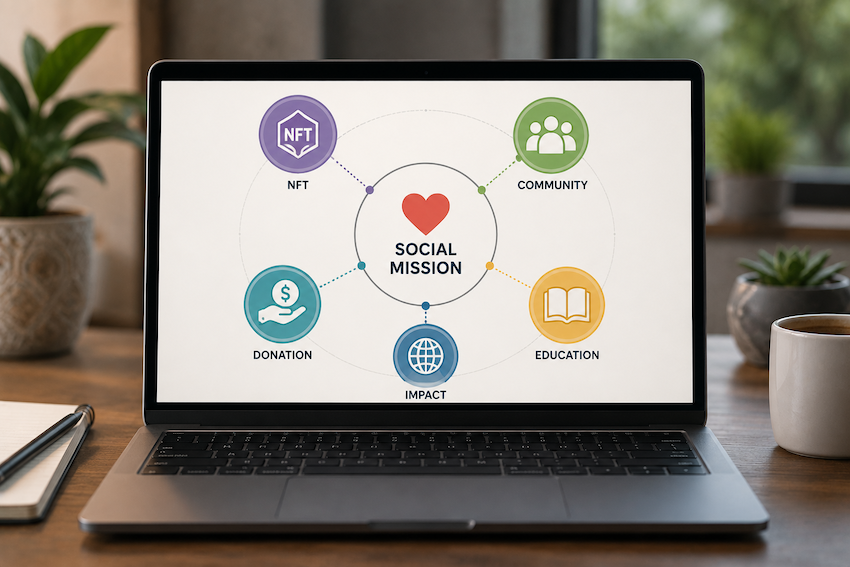
Technology is a tool—not an objective.
Whether you use NFTs, crowdfunding platforms, digital memberships, or blockchain, always begin with the same question:
How does this help the people we serve?
Digital innovation creates value only when it strengthens participation, transparency, accessibility, or long-term sustainability.
-
A healthy social enterprise combines several income streams.
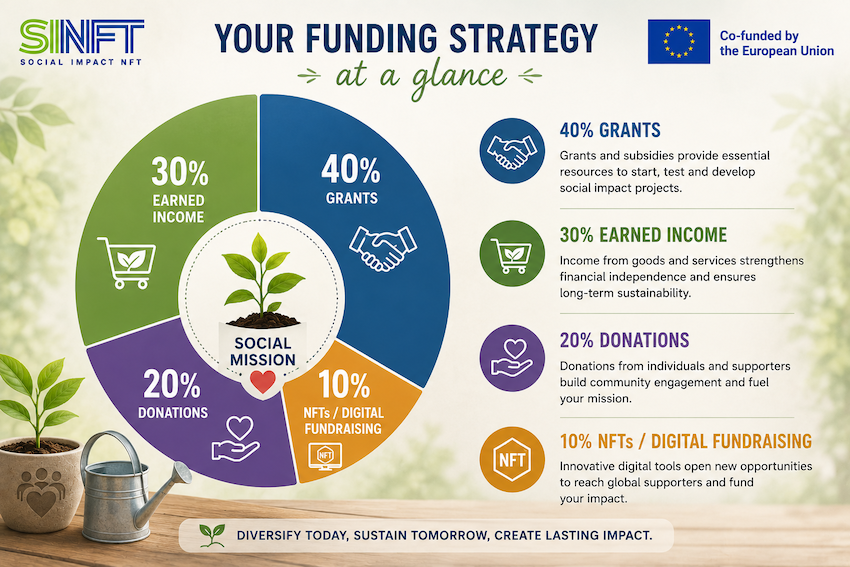
This is only one example.
The percentages will depend on your organisation.
-
-
-
-
What you'll learn:
How to identify the right funders for your project, communicate your social impact convincingly, and write a compelling donor pitch.
Understanding the funder's perspective
Before writing any funding application or approaching any donor, it helps to understand how funders think. A funder — whether a private foundation, a public institution, or an individual donor — is making a decision about where to invest limited resources for maximum social impact. They receive far more requests than they can fund. They look for projects that are credible, specific, well-managed, and genuinely impactful.
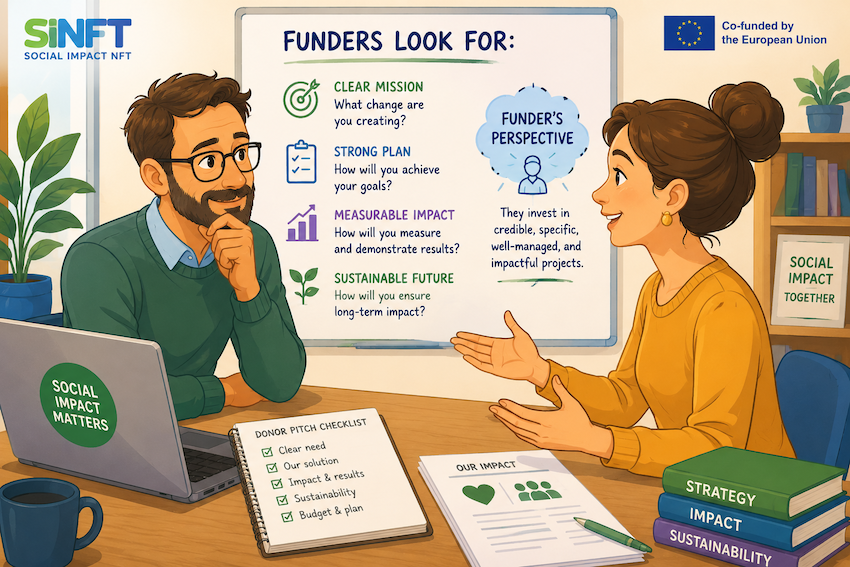
The most common reason funding applications are rejected is not that the project is bad — it's that the application doesn't clearly communicate the impact. The project team knows the work intimately; they forget that the funder knows nothing about it. The result is applications full of assumptions, jargon, and vague claims that leave funders unconvinced.
The antidote is simple: communicate from the funder's perspective, not your own. Answer their questions before they ask them.
-
Students mustMark as done
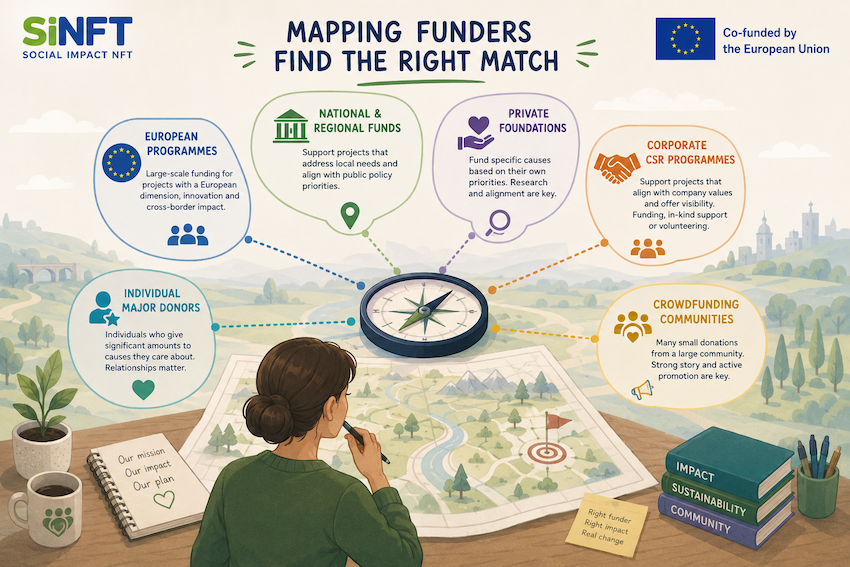
Mapping funders — find the right match
Type of funders and what they look for :
• European programmes (Erasmus+, ESF, Creative Europe, Horizon Europe): large-scale funding for projects with a European dimension, cross-border cooperation, and innovation. Highly competitive but significant amounts. Require detailed applications with measurable objectives and reporting.
• National and regional public funds: government departments, regional councils, local authorities. Often support projects addressing specific local needs. Require alignment with public policy priorities.
• Private foundations: independent organisations established to fund specific causes. Their priorities vary widely. Research each foundation carefully — applying to a foundation that doesn't fund your type of project wastes both your time and theirs.
• Corporate CSR programmes: companies allocating resources to social responsibility. Increasingly interested in projects that align with their sector or values, and that offer visibility. May provide funding, in-kind support, or employee volunteering.
• Individual major donors: individuals who give significant amounts to causes they care about. Require personal relationship-building and highly personalised communication.
• Crowdfunding communities: platforms like Ulule, Goteo, or Miimosa pool small donations from large numbers of individual supporters. Require a strong story and active promotion.
• European programmes (Erasmus+, ESF, Creative Europe, Horizon Europe): large-scale funding for projects with a European dimension, cross-border cooperation, and innovation. Highly competitive but significant amounts. Require detailed applications with measurable objectives and reporting.
• National and regional public funds: government departments, regional councils, local authorities. Often support projects addressing specific local needs. Require alignment with public policy priorities.
• Private foundations: independent organisations established to fund specific causes. Their priorities vary widely. Research each foundation carefully — applying to a foundation that doesn't fund your type of project wastes both your time and theirs.
• Corporate CSR programmes: companies allocating resources to social responsibility. Increasingly interested in projects that align with their sector or values, and that offer visibility. May provide funding, in-kind support, or employee volunteering.
• Individual major donors: individuals who give significant amounts to causes they care about. Require personal relationship-building and highly personalised communication.
• Crowdfunding communities: platforms like Ulule, Goteo, or Miimosa pool small donations from large numbers of individual supporters. Require a strong story and active promotion.
-
Students mustMark as done
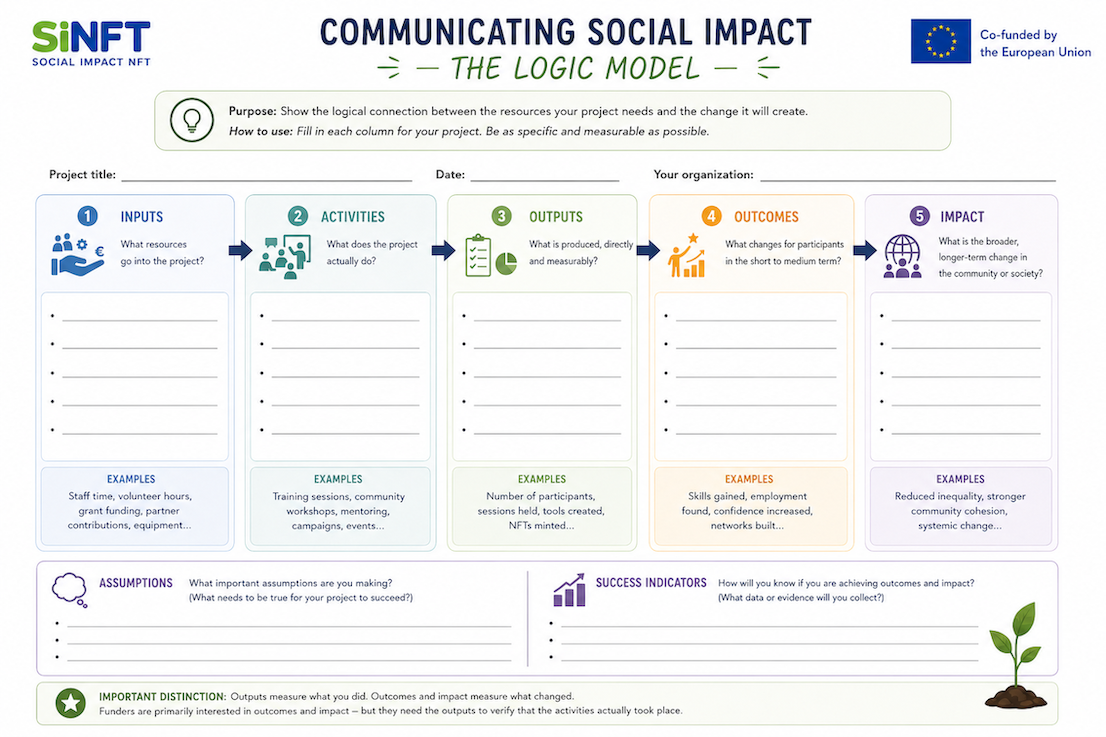
Communicating social impact — the logic model
Funders need to see a clear, logical connection between the resources they provide and the change that results. The most useful framework for this is the Logic Model — also called the impact chain.
1. Inputs: What resources go into the project? (Staff time, volunteer hours, grant funding, partner contributions, equipment)
2. Activities: What does the project actually do? (Training sessions, community workshops, mentoring, campaigns, events)
3. Outputs: What is produced, directly and measurably? (Number of participants, sessions held, tools created, NFTs minted)
4. Outcomes: What changes for participants in the short to medium term? (Skills gained, employment found, confidence increased, networks built)
5. Impact: What is the broader, longer-term change in the community or society? (Reduced inequality, stronger community cohesion, systemic change)
Important distinction: outputs measure what you did. Outcomes and impact measure what changed. Funders are primarily interested in outcomes and impact — but they need the outputs to verify that the activities actually took place.
-
Students mustMark as done
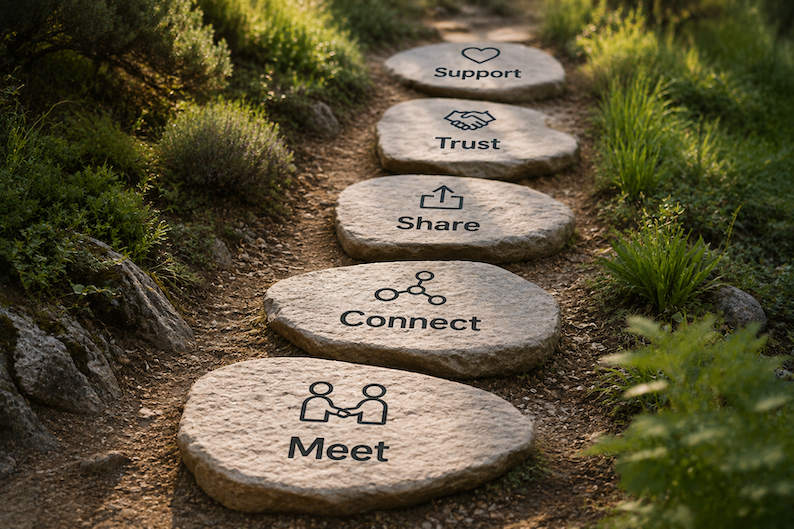
Build trust before asking for funding
Fundraising starts long before you submit an application. Many successful organisations build relationships with funders by:
- attending networking events;
- sharing project updates;
- inviting funders to visit activities;
- engaging on social media;
- asking for advice before asking for money.
People are more likely to support organisations they already know and trust.
-
Students mustMark as done
Writing a compelling donor pitch
A donor pitch is a short, clear, honest document — or conversation — that introduces your project, demonstrates your impact, and makes one specific ask. It should be under 250 words when written. It should be under two minutes when spoken.
1. The hook: one sentence or brief story that makes the problem feel real and urgent.
2. The mission: who you are, what you do, and for whom — in 2–3 sentences.
3. The evidence: what have you already done, learned, or achieved? Even early-stage evidence — interviews conducted, prototype tested, pilot completed — matters.
4. The impact: what changes for people as a result of your work? Use specific numbers wherever possible.
5. The ask: one clear, specific request. An amount, a partnership, a connection. Never leave the funder wondering what you need.
-
Students mustMark as done
💡 NFT connection
If your project includes an NFT campaign, mention it in your donor pitch as evidence of innovation and community engagement — not as your primary funding mechanism. 'We are also developing a digital fundraising campaign using NFTs, co-created with community members, to diversify our income and engage a wider audience' is a strong supporting detail. It shows creativity, community involvement, and awareness of digital tools.
-
-
-
-
What you'll learn: How to build a community around your social enterprise, manage resources sustainably, and plan for the future with a simple roadmap.
Sustainability is more than money
When social entrepreneurs talk about sustainability, they often mean financial sustainability — having enough income to keep the project running. This matters enormously. But it is not the whole picture.
A social enterprise that has funding but no community is fragile. A social enterprise that has community but no financial model is also fragile. Long-term sustainability requires both — and more: organisational health, clear governance, continuous learning, and the capacity to adapt when circumstances change.
This lesson addresses sustainability in its fullest sense.
Building a community of support
The most resilient social enterprises are surrounded by communities — people who believe in the mission, contribute their time and skills, spread the word, and sustain the project through difficult periods. This community is not built automatically. It requires deliberate, patient relationship-building.
-
Students mustMark as done
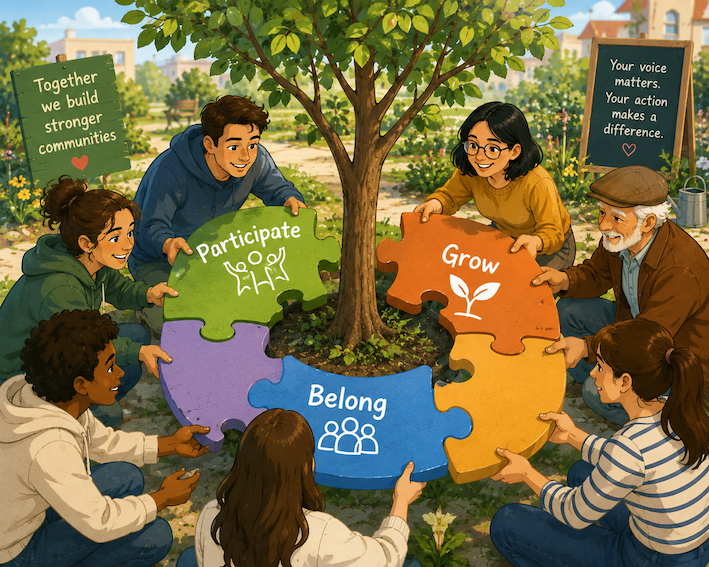
People rarely become long-term supporters after a single interaction. Communities grow when people feel they belong, contribute, and see that their voices matter.
Invite your community to participate by:
- sharing ideas;
- volunteering;
- attending events;
- giving feedback;
- celebrating achievements together.
The strongest communities are built through participation—not simply communication.
-
Students mustMark as done
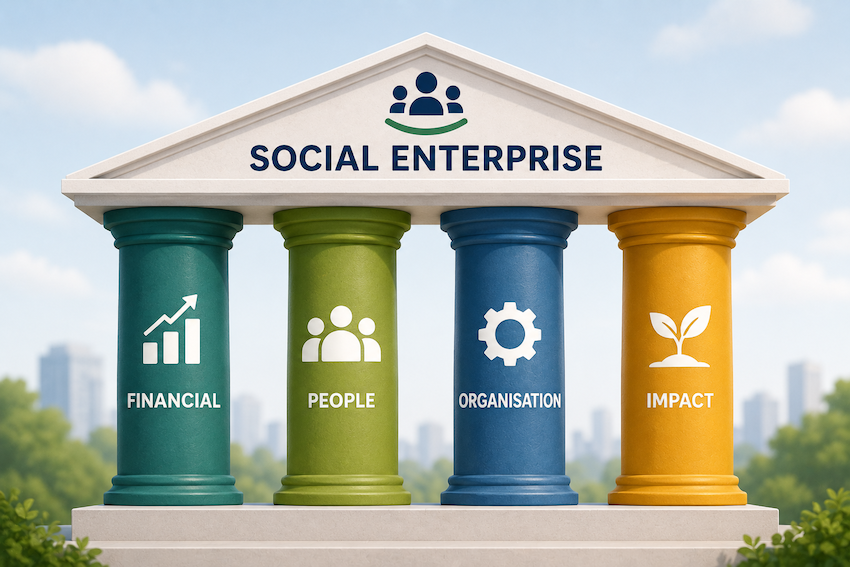
The four pillars of sustainability
Many organisations focus only on financial sustainability. In reality, long-term success depends on balancing four interconnected pillars:
- Financial – diversified income and good financial management.
- People – a motivated team, volunteers, and community supporters.
- Organisation – clear governance, processes, and leadership.
- Impact – continuously creating positive change that remains relevant to community needs.
Weakness in one pillar eventually affects all the others.
-
Students mustMark as done
Here are the key players in your support ecosystem:
• Community champions: people within your target community who believe in your project and advocate for it to others. They are your most credible ambassadors — precisely because they are not paid to speak.
• Volunteers: people who contribute time and skills. Managing volunteers well — with clear roles, meaningful tasks, and genuine recognition — is a skill in itself.
• Partner organisations: NGOs, CSOs, and social businesses that collaborate with you. Their ongoing commitment amplifies your reach and credibility.
• Loyal donors and supporters: people who give regularly — whether money, expertise, or networks. Maintaining relationships with them between campaigns is as important as the campaigns themselves.
• Alumni: people who have benefited from your project and now support it from a position of lived experience. Their voices are among the most powerful you have.
The fundamental principle: give before you ask. Show up for your community consistently, contribute before you request, and invest in relationships that have no immediate return. The organisations that build the deepest communities are not the ones with the best marketing — they are the ones that genuinely care about and listen to the people around them.
-
Students mustMark as done
Financial sustainability — practical management
Beyond designing a diversified funding model (Lesson 2), managing your finances well is what keeps a social enterprise alive in practice. Here are the foundational principles:
• Know your numbers. Even if you hate spreadsheets, you need to know your monthly income, your monthly costs, and the gap between them. This is not optional.
• Build a reserve. Aim to keep 2–3 months of operating costs in a reserve fund. This protects you when a grant is delayed, a campaign undershoots its target, or an unexpected cost arises.
• Reinvest strategically. When your project generates a surplus, decide in advance what proportion will go to the reserve, what to project development, and what to team development. Unplanned spending of surpluses is how well-intentioned projects build fragile financial structures.
• Review regularly. Once every quarter, review your financial situation. Are you on track? Is any income stream underperforming? Do you need to activate a contingency plan?
-
Students mustMark as done
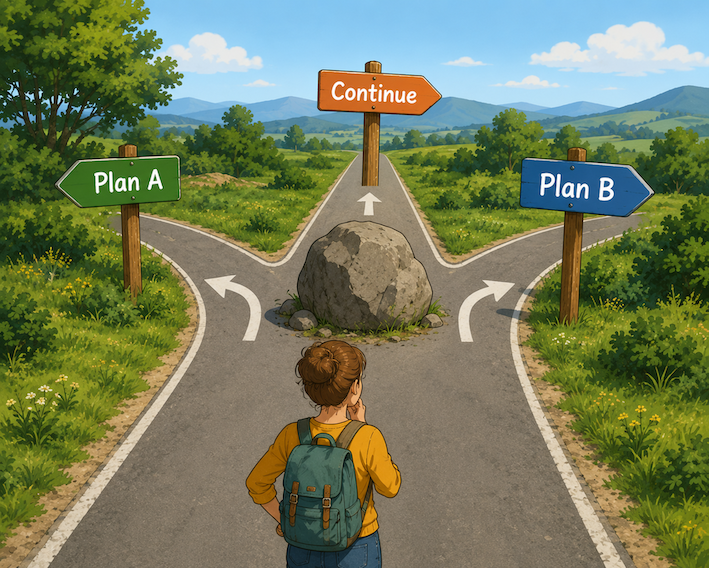
Prepare for uncertainty
Unexpected events happen. A grant may end. A partner may leave. Costs may increase. Successful organisations prepare before problems occur.
Simple contingency planning helps your organisation respond calmly rather than react under pressure.
Ask yourself:
- What are our biggest risks?
- What would we do if one income source disappeared?
- Who could support us in an emergency?
-
Students mustMark as done
Building a sustainability roadmap
A sustainability roadmap is a simple, honest plan — one or two pages — that shows where you are now, where you want to be in two years, and how you intend to get there. It is not a formal business plan. It is a thinking and navigation tool.
Your 5-part sustainability roadmap
• Where are you now? Current income sources, team structure, partnership base, number of people you serve.
• Where do you want to be in 2 years? Specific targets: How many people will you serve? What will your income mix look like? What new partnerships will you have? What new capacities will your team have?
• What is the gap? What is missing between your current situation and your 2-year target? Be honest.
• What actions will close the gap? 3–5 specific, time-bound actions. Not aspirations — actions. 'Apply to the X Foundation by Month 4', not 'Seek more funding.'
• What could go wrong — and what will you do? Name your top 1–2 risks and describe specifically how you will respond if they materialise.
-
Students mustMark as done
Digital communities need ongoing engagement
Building a digital community is not a one-time achievement—it is an ongoing commitment. Whether people discover your social enterprise through social media, a crowdfunding campaign, an online learning platform, or an NFT initiative, they need reasons to stay connected long after their first interaction.
Supporters are more likely to remain engaged when they feel informed, valued, and involved. Regular communication helps build trust and reinforces the sense that they are contributing to a meaningful mission rather than simply making a one-off donation or purchase.
Keep your community active by sharing project updates, celebrating milestones, inviting feedback, highlighting success stories, and showing how resources are being used. Encourage two-way communication rather than only broadcasting information. Ask questions, create opportunities for participation, and recognise the contributions of volunteers, donors, and community members.
For projects using NFTs or other digital fundraising tools, community engagement is especially important. The end of a fundraising campaign should be viewed as the beginning of a long-term relationship. Regular updates on project progress, transparent reporting on the use of funds, and opportunities for supporters to contribute ideas or participate in future initiatives help maintain confidence and strengthen loyalty.
Remember that people support people—not just projects. A thriving digital community is built on trust, transparency, and authentic relationships. Organisations that communicate consistently and listen carefully are far more likely to retain supporters and build sustainable communities over time.

Key takeaway: A successful digital community is not measured by the number of followers it has, but by the quality of the relationships it builds and maintains.
-
Students mustMark as done
Sustainability is a continuous journey
Many people imagine that sustainability is a destination—a point where a social enterprise has secured enough funding, built a strong team, and no longer faces uncertainty. In reality, sustainability is an ongoing process of learning, adapting, and improving.
Communities evolve, social needs change, funding priorities shift, and new challenges emerge. A social enterprise that succeeds today cannot assume that the same strategies will work tomorrow. Long-term sustainability comes from remaining flexible, listening carefully to stakeholders, and being willing to adjust when circumstances change.
This means regularly reviewing your goals, measuring your impact, strengthening your partnerships, and investing in your team and community. It also means recognising that setbacks are a normal part of the journey. A delayed grant, a partnership that does not work as expected, or changing community needs should not be seen as failures, but as opportunities to learn and improve.
Sustainable organisations develop habits rather than relying on one-off successes. They communicate openly, celebrate progress, plan ahead, and continuously seek feedback from the people they serve. They understand that resilience is built through many small decisions made consistently over time.
Above all, remember that sustainability is about creating lasting value for your community. Financial resources are important, but they are only one part of the equation. Strong relationships, shared ownership, continuous learning, and a clear social mission are what allow social enterprises to continue creating impact year after year.
The most successful social entrepreneurs are not those who avoid change—they are the ones who learn how to grow with it. By remaining true to your mission while adapting your methods, you can build an organisation that is not only effective today but resilient enough to meet the challenges of tomorrow.

Key takeaway: Sustainability is not about reaching a finish line. It is about building an organisation that can learn, adapt, and continue creating positive social impact for many years to come.
-
-
-
📖 Key Readings/Resources
This section has the most important materials connected to the course.
Here you’ll find:
-
📖 Key readings
-
🎥 Helpful videos
-
🔗 Useful links and tools
Use these resources to go deeper, understand the topics better, and level up your knowledge.
If you want to explore more — this is the place to start.
-
-
🎓 COURSE FINAL ASSIGMENT
It is time to bring it all together. As you reach the finish line of this course, take this final assessment to review the key concepts we’ve covered across our entire journey. This ultimate knowledge check will solidify your learning and ensure you are fully equipped to apply these new strategies to build and scale your own project.
Successfully completing this evaluation is your final milestone — it not only validates your hard work but also serves as your official stepping stone into the NFT Innovation Labs, where you will turn theory into real-world action.Upon completion of the course, the student receives the following certificates:
Certificate of Completion / Certificate of Achievement
Confirms that the student has engaged with the course content and completed all required assessments, including passing the final test.
Received Credits: 3
-
✅ COURSE FINAL ASSIGMENT Quiz
-

Shape the Future.
Mint the Change.