
Lesson 1 - Building Partnerships with NGOs, CSOs, and Social Businesses
Partnerships & Long-Term Sustainability
Section outline
-
No social entrepreneur creates lasting change alone. Even the most innovative ideas need the support, knowledge, and resources of others to become successful and sustainable.
Partnerships are at the heart of social entrepreneurship. By collaborating with organisations that share your values or complement your expertise, you can reach more people, strengthen your impact, and access resources that would be difficult to obtain on your own.
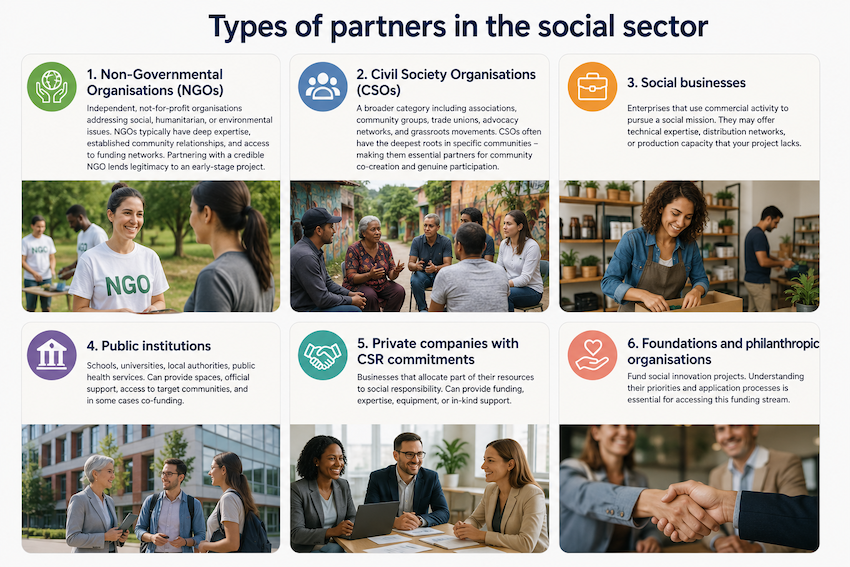
In this lesson, you will discover the main types of partners in the social sector, understand the unique value each can bring to your project, and learn how to identify the right organisations to support your social enterprise. Whether you are looking for funding, technical expertise, community connections, or strategic advice, building the right partnerships is an essential step towards creating meaningful and lasting social change.
-
Students mustMark as done
-
Students mustMark as done
Mapping your partnership ecosystem
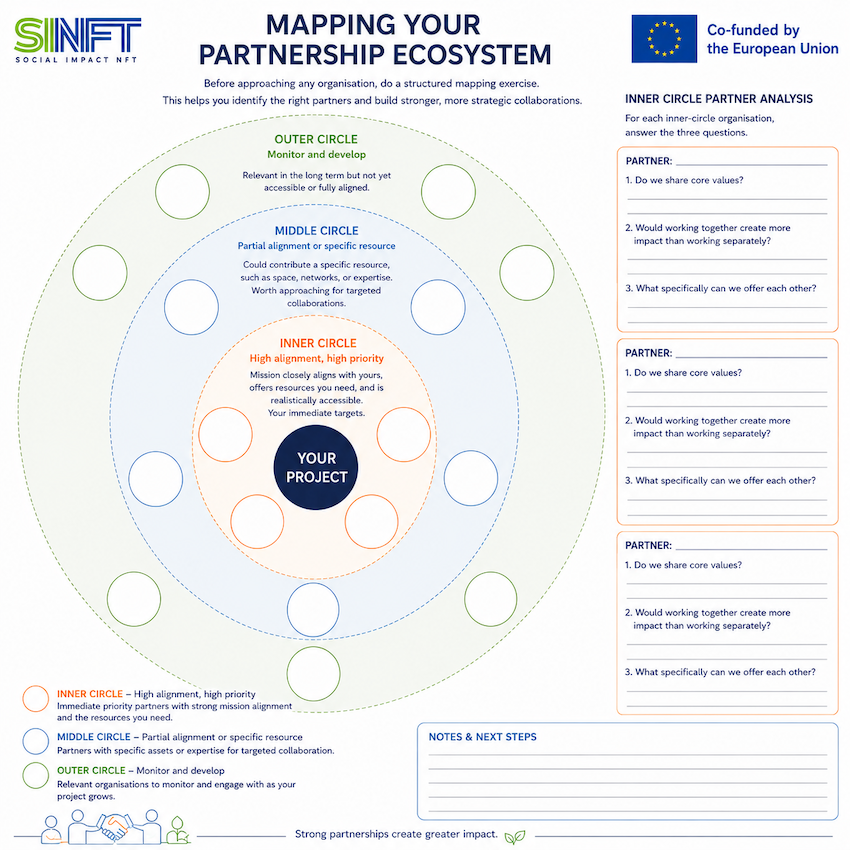
Before approaching any organisation, do a structured mapping exercise. This prevents you from pursuing partnerships based on name recognition or convenience rather than strategic fit.
Draw a diagram with your project at the centre. Place potential partners in three circles:
• Inner circle — High alignment, high priority: organisations whose mission closely overlaps with yours, who have resources or capacities you need, and who are realistically accessible to you. These are your immediate targets.
• Middle circle — Partial alignment or specific resource: organisations that don't share your full mission but could contribute something specific — a space, a network, an expertise. Worth approaching for targeted collaborations.
• Outer circle — Monitor and develop: organisations that are relevant in the long term but not yet accessible or aligned. Map them now; approach them later as your project grows.
For each inner-circle organisation, answer three questions: Do we share core values? Would working together create more impact than working separately? What specifically can we offer each other?
-
Students mustMark as done
-
Students mustMark as done
A partnership is a relationship. And like any relationship, it is built on trust — which takes time to develop and can be destroyed in a moment.
• Lead with listening. In any first conversation with a potential partner, your goal is to understand their mission, their challenges, and their priorities — not to pitch your project. Ask questions. Show genuine interest. Find the intersection between what they care about and what you're building.
• Start small. Before proposing a major collaboration, suggest a small joint activity — a shared event, a co-facilitated workshop, a resource exchange. Small steps build the mutual understanding and trust that make larger partnerships possible.
• Be honest about your stage. You don't need to be established and fully funded to attract partners. What you need is a clear mission, a genuine community need, and the honesty to say: 'We're early stage. Here's what we have. Here's what we're looking for. Here's what we can offer you.'
• Document agreements. Even informal partnerships benefit from a simple written summary of what each party commits to: roles, resources, timelines, and how decisions will be made. A one-page Memorandum of Understanding prevents misunderstandings before they become conflicts.
• Maintain the relationship. Partnerships need ongoing attention. Share updates, celebrate shared successes, acknowledge difficulties. Organisations that feel valued as partners stay engaged; those that are only contacted when you need something quickly disengage.

-

Shape the Future.
Mint the Change.