
Lesson 3 - Engaging Donors and Institutions
Partnerships & Long-Term Sustainability
Section outline
-
What you'll learn:
How to identify the right funders for your project, communicate your social impact convincingly, and write a compelling donor pitch.
Understanding the funder's perspective
Before writing any funding application or approaching any donor, it helps to understand how funders think. A funder — whether a private foundation, a public institution, or an individual donor — is making a decision about where to invest limited resources for maximum social impact. They receive far more requests than they can fund. They look for projects that are credible, specific, well-managed, and genuinely impactful.
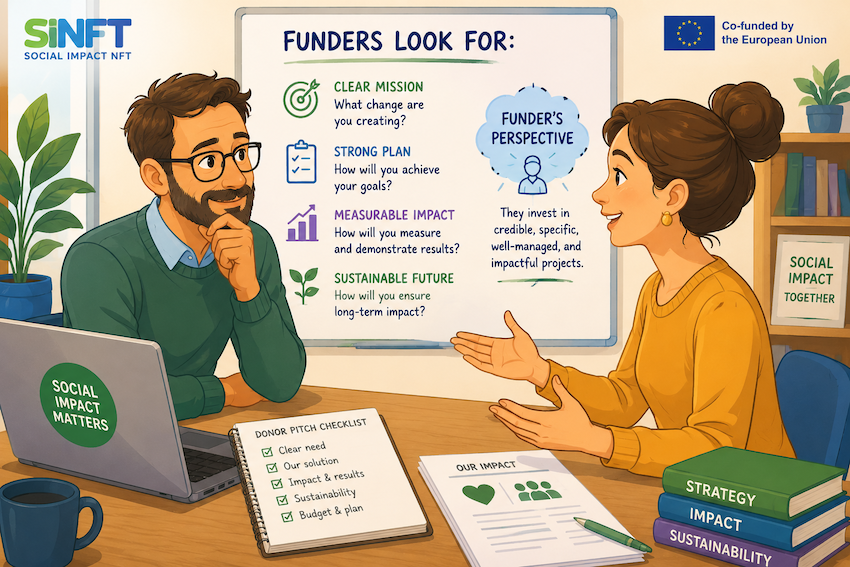
The most common reason funding applications are rejected is not that the project is bad — it's that the application doesn't clearly communicate the impact. The project team knows the work intimately; they forget that the funder knows nothing about it. The result is applications full of assumptions, jargon, and vague claims that leave funders unconvinced.
The antidote is simple: communicate from the funder's perspective, not your own. Answer their questions before they ask them.
-
Students mustMark as done
Mapping funders — find the right match
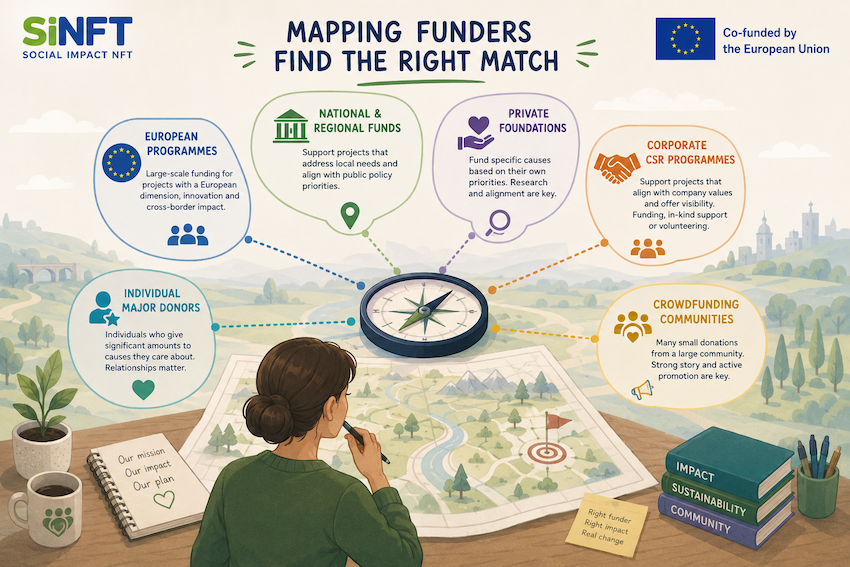
Type of funders and what they look for :
• European programmes (Erasmus+, ESF, Creative Europe, Horizon Europe): large-scale funding for projects with a European dimension, cross-border cooperation, and innovation. Highly competitive but significant amounts. Require detailed applications with measurable objectives and reporting.
• National and regional public funds: government departments, regional councils, local authorities. Often support projects addressing specific local needs. Require alignment with public policy priorities.
• Private foundations: independent organisations established to fund specific causes. Their priorities vary widely. Research each foundation carefully — applying to a foundation that doesn't fund your type of project wastes both your time and theirs.
• Corporate CSR programmes: companies allocating resources to social responsibility. Increasingly interested in projects that align with their sector or values, and that offer visibility. May provide funding, in-kind support, or employee volunteering.
• Individual major donors: individuals who give significant amounts to causes they care about. Require personal relationship-building and highly personalised communication.
• Crowdfunding communities: platforms like Ulule, Goteo, or Miimosa pool small donations from large numbers of individual supporters. Require a strong story and active promotion.
• European programmes (Erasmus+, ESF, Creative Europe, Horizon Europe): large-scale funding for projects with a European dimension, cross-border cooperation, and innovation. Highly competitive but significant amounts. Require detailed applications with measurable objectives and reporting.
• National and regional public funds: government departments, regional councils, local authorities. Often support projects addressing specific local needs. Require alignment with public policy priorities.
• Private foundations: independent organisations established to fund specific causes. Their priorities vary widely. Research each foundation carefully — applying to a foundation that doesn't fund your type of project wastes both your time and theirs.
• Corporate CSR programmes: companies allocating resources to social responsibility. Increasingly interested in projects that align with their sector or values, and that offer visibility. May provide funding, in-kind support, or employee volunteering.
• Individual major donors: individuals who give significant amounts to causes they care about. Require personal relationship-building and highly personalised communication.
• Crowdfunding communities: platforms like Ulule, Goteo, or Miimosa pool small donations from large numbers of individual supporters. Require a strong story and active promotion.
-
Students mustMark as done
Communicating social impact — the logic model
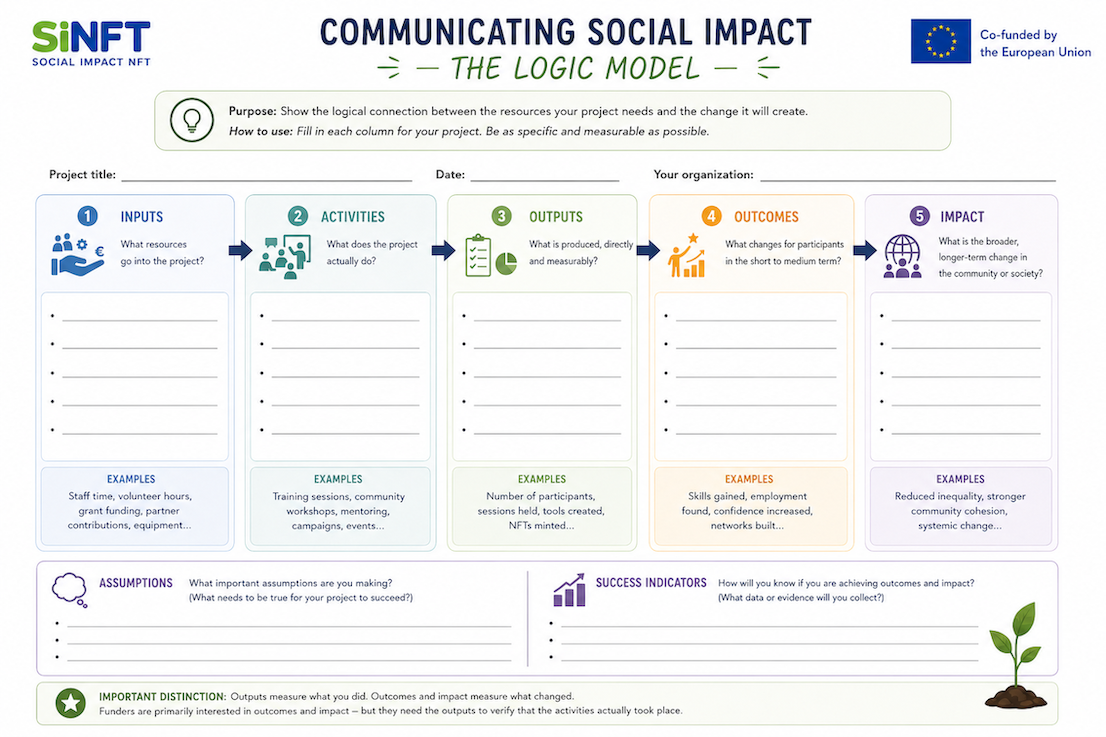
Funders need to see a clear, logical connection between the resources they provide and the change that results. The most useful framework for this is the Logic Model — also called the impact chain.
1. Inputs: What resources go into the project? (Staff time, volunteer hours, grant funding, partner contributions, equipment)
2. Activities: What does the project actually do? (Training sessions, community workshops, mentoring, campaigns, events)
3. Outputs: What is produced, directly and measurably? (Number of participants, sessions held, tools created, NFTs minted)
4. Outcomes: What changes for participants in the short to medium term? (Skills gained, employment found, confidence increased, networks built)
5. Impact: What is the broader, longer-term change in the community or society? (Reduced inequality, stronger community cohesion, systemic change)
Important distinction: outputs measure what you did. Outcomes and impact measure what changed. Funders are primarily interested in outcomes and impact — but they need the outputs to verify that the activities actually took place.
-
Students mustMark as done
Build trust before asking for funding
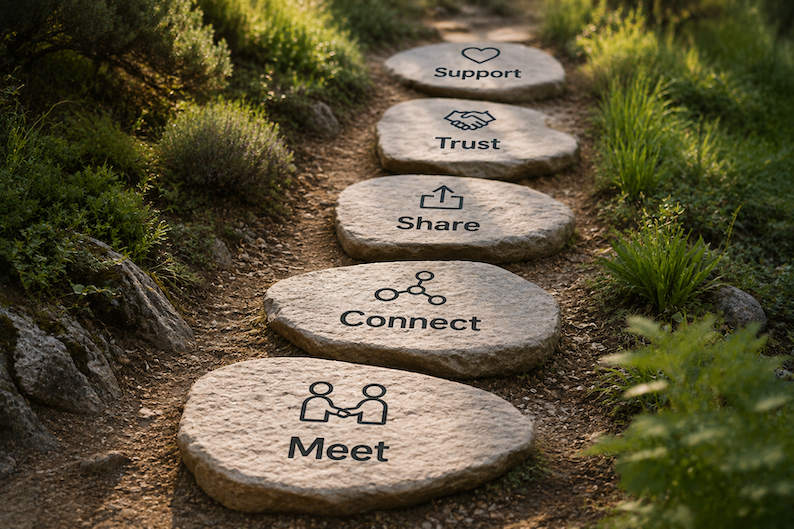
Fundraising starts long before you submit an application. Many successful organisations build relationships with funders by:
- attending networking events;
- sharing project updates;
- inviting funders to visit activities;
- engaging on social media;
- asking for advice before asking for money.
People are more likely to support organisations they already know and trust.
-
Students mustMark as done
Writing a compelling donor pitch
A donor pitch is a short, clear, honest document — or conversation — that introduces your project, demonstrates your impact, and makes one specific ask. It should be under 250 words when written. It should be under two minutes when spoken.
1. The hook: one sentence or brief story that makes the problem feel real and urgent.
2. The mission: who you are, what you do, and for whom — in 2–3 sentences.
3. The evidence: what have you already done, learned, or achieved? Even early-stage evidence — interviews conducted, prototype tested, pilot completed — matters.
4. The impact: what changes for people as a result of your work? Use specific numbers wherever possible.
5. The ask: one clear, specific request. An amount, a partnership, a connection. Never leave the funder wondering what you need.
-
Students mustMark as done
💡 NFT connection
If your project includes an NFT campaign, mention it in your donor pitch as evidence of innovation and community engagement — not as your primary funding mechanism. 'We are also developing a digital fundraising campaign using NFTs, co-created with community members, to diversify our income and engage a wider audience' is a strong supporting detail. It shows creativity, community involvement, and awareness of digital tools.
-

Shape the Future.
Mint the Change.