
Lesson 4 - Community Support and Long-Term Sustainability
Partnerships & Long-Term Sustainability
Section outline
-
What you'll learn: How to build a community around your social enterprise, manage resources sustainably, and plan for the future with a simple roadmap.
Sustainability is more than money
When social entrepreneurs talk about sustainability, they often mean financial sustainability — having enough income to keep the project running. This matters enormously. But it is not the whole picture.
A social enterprise that has funding but no community is fragile. A social enterprise that has community but no financial model is also fragile. Long-term sustainability requires both — and more: organisational health, clear governance, continuous learning, and the capacity to adapt when circumstances change.
This lesson addresses sustainability in its fullest sense.
Building a community of support
The most resilient social enterprises are surrounded by communities — people who believe in the mission, contribute their time and skills, spread the word, and sustain the project through difficult periods. This community is not built automatically. It requires deliberate, patient relationship-building.
-
Students mustMark as done
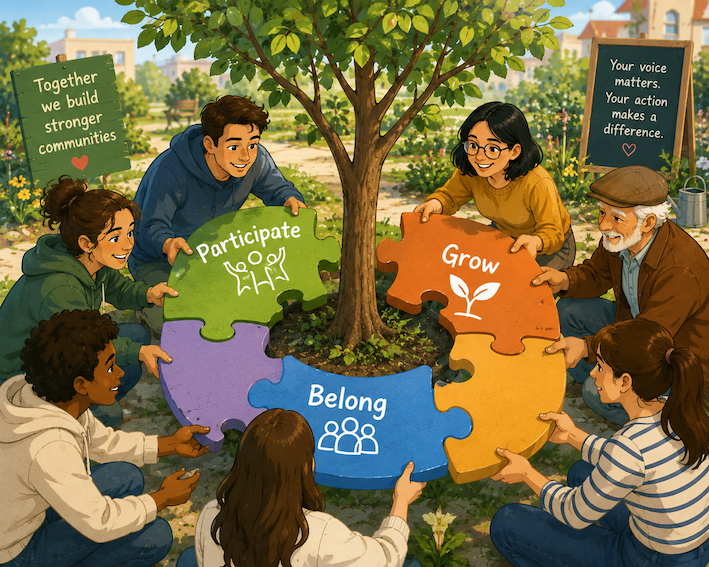
People rarely become long-term supporters after a single interaction. Communities grow when people feel they belong, contribute, and see that their voices matter.
Invite your community to participate by:
- sharing ideas;
- volunteering;
- attending events;
- giving feedback;
- celebrating achievements together.
The strongest communities are built through participation—not simply communication.
-
Students mustMark as done
The four pillars of sustainability
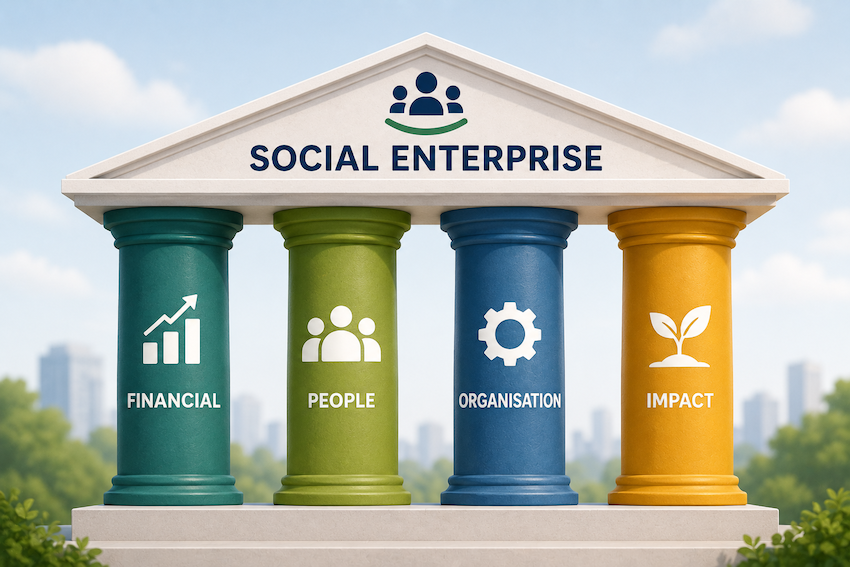
Many organisations focus only on financial sustainability. In reality, long-term success depends on balancing four interconnected pillars:
- Financial – diversified income and good financial management.
- People – a motivated team, volunteers, and community supporters.
- Organisation – clear governance, processes, and leadership.
- Impact – continuously creating positive change that remains relevant to community needs.
Weakness in one pillar eventually affects all the others.
-
Students mustMark as done
Here are the key players in your support ecosystem:
• Community champions: people within your target community who believe in your project and advocate for it to others. They are your most credible ambassadors — precisely because they are not paid to speak.
• Volunteers: people who contribute time and skills. Managing volunteers well — with clear roles, meaningful tasks, and genuine recognition — is a skill in itself.
• Partner organisations: NGOs, CSOs, and social businesses that collaborate with you. Their ongoing commitment amplifies your reach and credibility.
• Loyal donors and supporters: people who give regularly — whether money, expertise, or networks. Maintaining relationships with them between campaigns is as important as the campaigns themselves.
• Alumni: people who have benefited from your project and now support it from a position of lived experience. Their voices are among the most powerful you have.
The fundamental principle: give before you ask. Show up for your community consistently, contribute before you request, and invest in relationships that have no immediate return. The organisations that build the deepest communities are not the ones with the best marketing — they are the ones that genuinely care about and listen to the people around them.
-
Students mustMark as done
Financial sustainability — practical management
Beyond designing a diversified funding model (Lesson 2), managing your finances well is what keeps a social enterprise alive in practice. Here are the foundational principles:
• Know your numbers. Even if you hate spreadsheets, you need to know your monthly income, your monthly costs, and the gap between them. This is not optional.
• Build a reserve. Aim to keep 2–3 months of operating costs in a reserve fund. This protects you when a grant is delayed, a campaign undershoots its target, or an unexpected cost arises.
• Reinvest strategically. When your project generates a surplus, decide in advance what proportion will go to the reserve, what to project development, and what to team development. Unplanned spending of surpluses is how well-intentioned projects build fragile financial structures.
• Review regularly. Once every quarter, review your financial situation. Are you on track? Is any income stream underperforming? Do you need to activate a contingency plan?
-
Students mustMark as done
Prepare for uncertainty
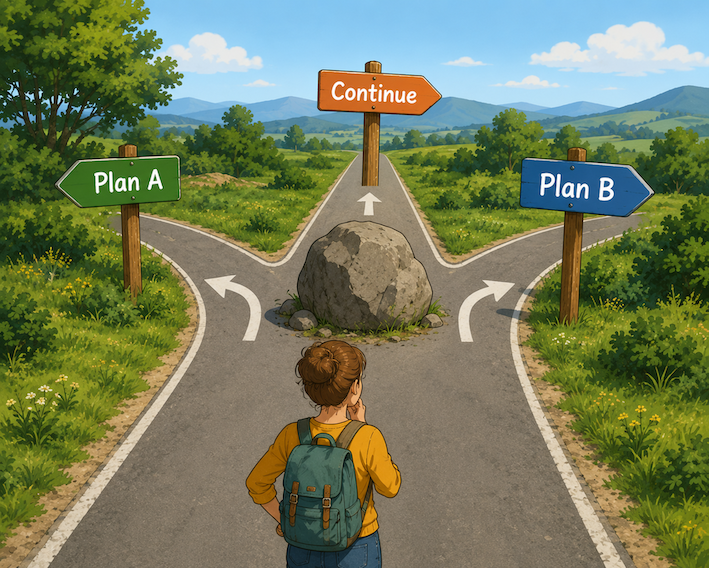
Unexpected events happen. A grant may end. A partner may leave. Costs may increase. Successful organisations prepare before problems occur.
Simple contingency planning helps your organisation respond calmly rather than react under pressure.
Ask yourself:
- What are our biggest risks?
- What would we do if one income source disappeared?
- Who could support us in an emergency?
-
Students mustMark as done
Building a sustainability roadmap
A sustainability roadmap is a simple, honest plan — one or two pages — that shows where you are now, where you want to be in two years, and how you intend to get there. It is not a formal business plan. It is a thinking and navigation tool.
Your 5-part sustainability roadmap
• Where are you now? Current income sources, team structure, partnership base, number of people you serve.
• Where do you want to be in 2 years? Specific targets: How many people will you serve? What will your income mix look like? What new partnerships will you have? What new capacities will your team have?
• What is the gap? What is missing between your current situation and your 2-year target? Be honest.
• What actions will close the gap? 3–5 specific, time-bound actions. Not aspirations — actions. 'Apply to the X Foundation by Month 4', not 'Seek more funding.'
• What could go wrong — and what will you do? Name your top 1–2 risks and describe specifically how you will respond if they materialise.
-
Students mustMark as done
Digital communities need ongoing engagement
Building a digital community is not a one-time achievement—it is an ongoing commitment. Whether people discover your social enterprise through social media, a crowdfunding campaign, an online learning platform, or an NFT initiative, they need reasons to stay connected long after their first interaction.
Supporters are more likely to remain engaged when they feel informed, valued, and involved. Regular communication helps build trust and reinforces the sense that they are contributing to a meaningful mission rather than simply making a one-off donation or purchase.
Keep your community active by sharing project updates, celebrating milestones, inviting feedback, highlighting success stories, and showing how resources are being used. Encourage two-way communication rather than only broadcasting information. Ask questions, create opportunities for participation, and recognise the contributions of volunteers, donors, and community members.
For projects using NFTs or other digital fundraising tools, community engagement is especially important. The end of a fundraising campaign should be viewed as the beginning of a long-term relationship. Regular updates on project progress, transparent reporting on the use of funds, and opportunities for supporters to contribute ideas or participate in future initiatives help maintain confidence and strengthen loyalty.
Remember that people support people—not just projects. A thriving digital community is built on trust, transparency, and authentic relationships. Organisations that communicate consistently and listen carefully are far more likely to retain supporters and build sustainable communities over time.
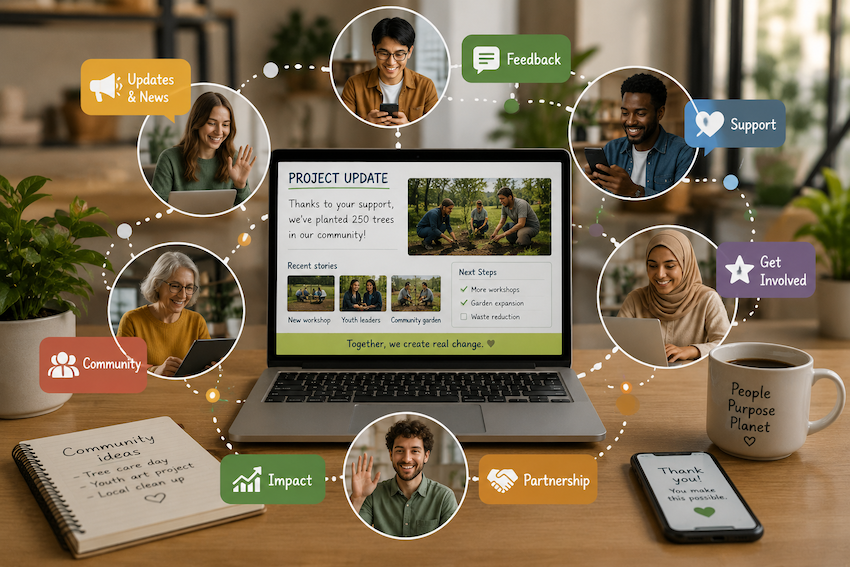
Key takeaway: A successful digital community is not measured by the number of followers it has, but by the quality of the relationships it builds and maintains.
-
Students mustMark as done
Sustainability is a continuous journey
Many people imagine that sustainability is a destination—a point where a social enterprise has secured enough funding, built a strong team, and no longer faces uncertainty. In reality, sustainability is an ongoing process of learning, adapting, and improving.
Communities evolve, social needs change, funding priorities shift, and new challenges emerge. A social enterprise that succeeds today cannot assume that the same strategies will work tomorrow. Long-term sustainability comes from remaining flexible, listening carefully to stakeholders, and being willing to adjust when circumstances change.
This means regularly reviewing your goals, measuring your impact, strengthening your partnerships, and investing in your team and community. It also means recognising that setbacks are a normal part of the journey. A delayed grant, a partnership that does not work as expected, or changing community needs should not be seen as failures, but as opportunities to learn and improve.
Sustainable organisations develop habits rather than relying on one-off successes. They communicate openly, celebrate progress, plan ahead, and continuously seek feedback from the people they serve. They understand that resilience is built through many small decisions made consistently over time.
Above all, remember that sustainability is about creating lasting value for your community. Financial resources are important, but they are only one part of the equation. Strong relationships, shared ownership, continuous learning, and a clear social mission are what allow social enterprises to continue creating impact year after year.
The most successful social entrepreneurs are not those who avoid change—they are the ones who learn how to grow with it. By remaining true to your mission while adapting your methods, you can build an organisation that is not only effective today but resilient enough to meet the challenges of tomorrow.
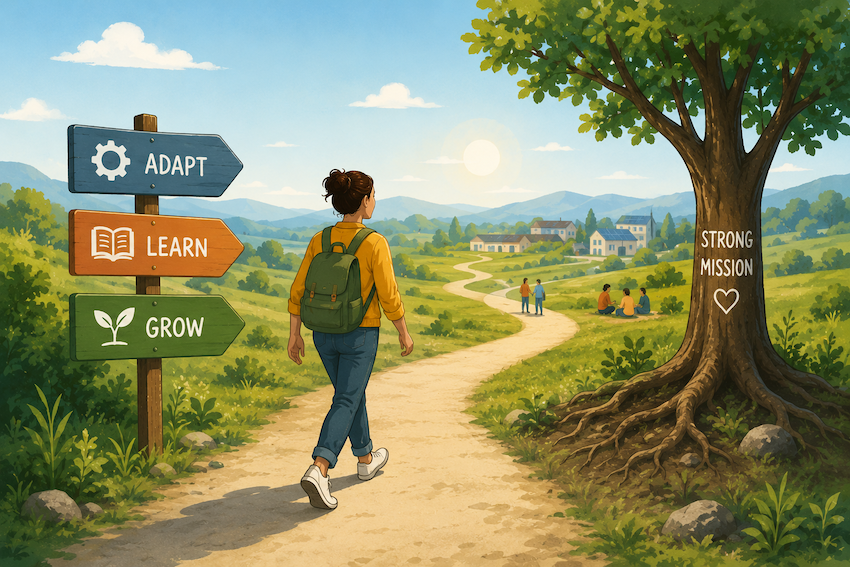
Key takeaway: Sustainability is not about reaching a finish line. It is about building an organisation that can learn, adapt, and continue creating positive social impact for many years to come.
-

Shape the Future.
Mint the Change.