
Validating and Prototyping Ideas
Validating and Prototyping Ideas
Section outline
-
You have a social cause you care about. Maybe it came from something you witnessed in your community — an injustice, a gap, a need that nobody was addressing. Maybe you've been thinking about a project for months. Either way, you're here — and that matters.
But here is something every experienced social entrepreneur will tell you: having a good idea is only the beginning. The projects that actually make a difference are the ones that were tested, challenged, and improved before they were launched. They're the ones built on real conversations with real people — not on assumptions.
This course takes you through the first and most critical phase of social entrepreneurship: validating your idea. You'll learn to define the problem you're solving, understand the people you're designing for, and build a simple prototype to test your concept before investing time and money in it. And throughout this course, you'll see how digital tools — including NFTs — can be used to give your project a voice and generate resources for your cause.
By the end of this course, you will be able to:
· Identify a real social problem and define it with precision using structured methods.
· Understand the needs of the people you want to help — through conversations, not assumptions.
· Build a simple prototype of your project concept and test it.
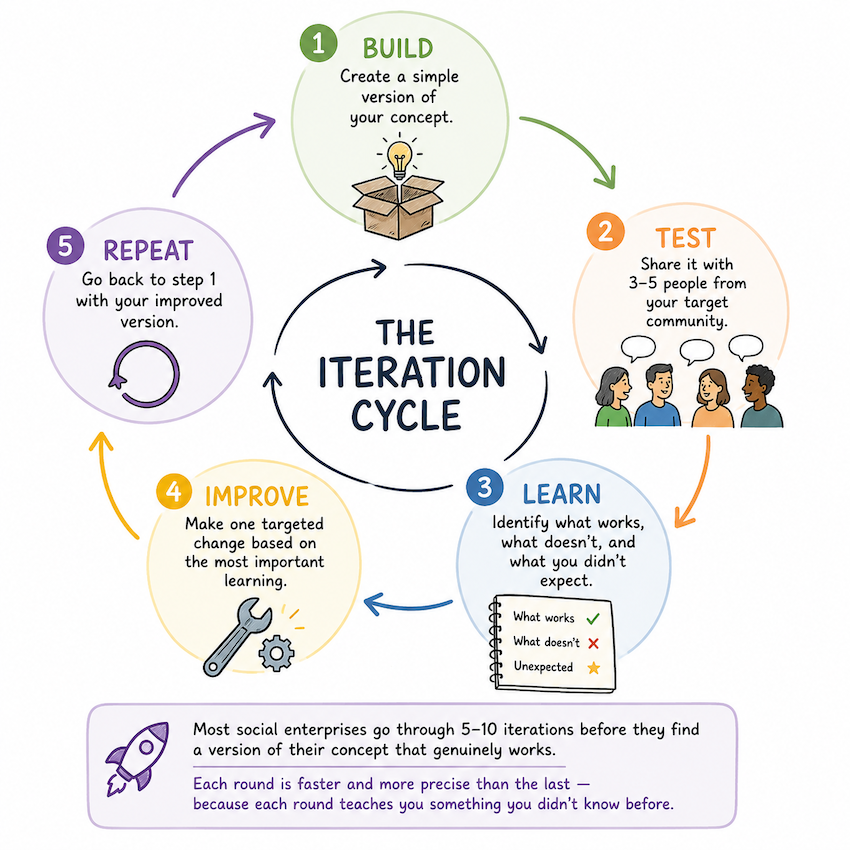
· Use feedback to improve your idea step by step.
· Present your concept clearly and persuasively to any audience.
-
-
-
Students mustMark as done
What is social entrepreneurship?
Social entrepreneurship is the practice of using entrepreneurial thinking and methods to create social change. A social entrepreneur identifies a social problem that existing systems are failing to solve — and builds a project, organisation, or enterprise to address it.
Social entrepreneurs are not defined by whether they make profit or not. Some social enterprises generate revenue. Others are non-profit. What defines them is their primary mission: creating positive change for a community, a cause, or society as a whole.
Social entrepreneurship is different from charity in one important way: it aims to be sustainable. Rather than relying permanently on donations or goodwill, a social enterprise tries to build structures — financial, organisational, community-based — that allow the work to continue and grow over time.
Here are some examples of famous social enterprises:
• Grameen Bank (Bangladesh): Muhammad Yunus created a bank that provides tiny loans to people too poor to access traditional banking. This model — called microcredit — has since spread worldwide and won the Nobel Peace Prize.
• Veja (France/Brazil): A shoe brand that pays fair wages to Brazilian farmers and producers, sells in mainstream markets, and uses its commercial success to demonstrate that ethical supply chains are possible.
-
Students mustMark as done
From idea to concept — why the difference matters
An idea is a starting point. A concept is a structured plan that answers three questions: What problem are you solving? For whom? And how?
This difference matters enormously. If you only have an idea, you can't test it, explain it, or attract support for it. If you have a concept, you can do all three.
Idea: "I want to help young people in my city find jobs."
Concept: "We provide free weekly digital skills training for unemployed young people aged 18–25 in rural areas, so they can access remote work opportunities and become economically independent."
-
Students mustMark as done
Step 1 — Dig into the real problem
The most common mistake in social entrepreneurship is solving the wrong problem. Teams invest months — sometimes years — building solutions to symptoms rather than root causes. The result: the problem persists, and the solution has no lasting impact.
The "5 Whys" is a simple but powerful technique borrowed from engineering and design thinking. You start with an observed problem and ask "why?" five times in a row. Each answer reveals a deeper layer of the problem, until you reach its root cause.
Observed problem: Young people in my region are unemployed.
• Why 1: There are few job opportunities locally.
• Why 2: Most businesses are small and don't recruit externally.
• Why 3: Young people lack the digital skills needed for remote work.
• Why 4: There is no accessible digital training in the region.
• Why 5: Existing training programmes are located in cities and require full-time attendance that rural young people can't manage.
Root cause: Young people in rural areas are excluded from digital skills training because existing programmes are designed for urban, mobile participants.
This root cause points directly to a specific, actionable solution — not just 'create jobs', but 'create accessible digital training for rural young people'. That's where a real social enterprise begins.
-
Students mustMark as done
Step 2 — Define your target community
"Young people" is not a target community. It's a category. A social entrepreneur needs to be far more specific — because the more precisely you understand who you are designing for, the more relevant and effective your solution will be.
Ask yourself:
• Who exactly experiences this problem? (Age, location, situation, identity)
• What makes their situation specific — different from the general population?
• What have they already tried? Why hasn't it worked?
• What barriers do they face that others don't?
• What are their strengths, networks, and assets — not just their needs?
That last question is important. Social entrepreneurship at its best is not about doing things for people — it's about doing things with them. Understanding the assets and agency of your community is as important as understanding their needs.
-
Students mustMark as done
Step 3 — The Problem–Solution–Impact model
Once you have defined the root problem and your target community, you can build your concept around three pillars:
• Problem: What specific challenge does your community face? What are the consequences of not solving it?
• Solution: What does your project offer? How does it work? Why is it better than what currently exists?
• Impact: What changes for people as a result? How will you know the solution is working? What will you measure?
This three-pillar model is the foundation of your concept — and the framework against which every decision you make in the coming weeks will be tested.
-
Students mustMark as done
Step 4 — The Lean Canvas
The Lean Canvas is a one-page planning tool that helps you structure your concept quickly without writing a 50-page business plan. It was developed by entrepreneur Ash Maurya, adapting the Business Model Canvas for early-stage projects. For a social enterprise, it is an especially useful tool because it forces you to be precise about the problem, the community, and the impact — before thinking about revenue or scale.
For now, focus on three sections:
• Problem: The top 2–3 challenges your target community faces, and why existing solutions don't work.
• Target Community: Who exactly are you serving? Who are your early adopters — the first people most likely to benefit and engage?
• Unique Value Proposition: In one sentence: what do you offer, and why is it meaningfully different from what already exists?
Fill in the three Lean Canvas sections above in a Word or Excel document.
As you develop your social enterprise concept, think about whether a digital dimension could amplify your project. NFTs — Non-Fungible Tokens — are digital assets that can represent artwork, stories, certificates, or community contributions. Several social enterprises use NFT campaigns to raise awareness and funds for their cause. In this MOOC, you'll learn how to integrate this tool responsibly into your project — but only once you have a strong concept underneath it. -
-
-
-
-
What you'll learn:
How to deeply understand the people you want to help — and why testing your assumptions before building anything is the most important skill in social entrepreneurship.
The trap of the solution looking for a problem
In social innovation, there is a well-known failure pattern called "the solution looking for a problem". It happens when a team falls in love with an idea — a digital app, a training programme, a community space — and then works backwards to justify it, without genuinely listening to the people they claim to serve.
The result is almost always the same: a project that doesn't work, a community that feels patronised, and resources that were wasted on something nobody asked for. Avoiding this trap requires one practice above all others: listening before building. Deeply, patiently, humbly listening — to the people who know their own situation better than any outsider can.
What is an assumption - and why is it dangerous?
Every social enterprise concept is built on assumptions: things you believe to be true about the problem, the community, or the solution — but haven't yet verified. Some assumptions are obvious. Others are invisible to you precisely because you believe them so strongly.
Here is why assumptions are dangerous: if your most important assumption is wrong and you don't discover it until after you've built your project, you've wasted time, money, and trust. If you discover it early — before you've built anything — it costs you almost nothing to change course.
-
Students mustMark as done
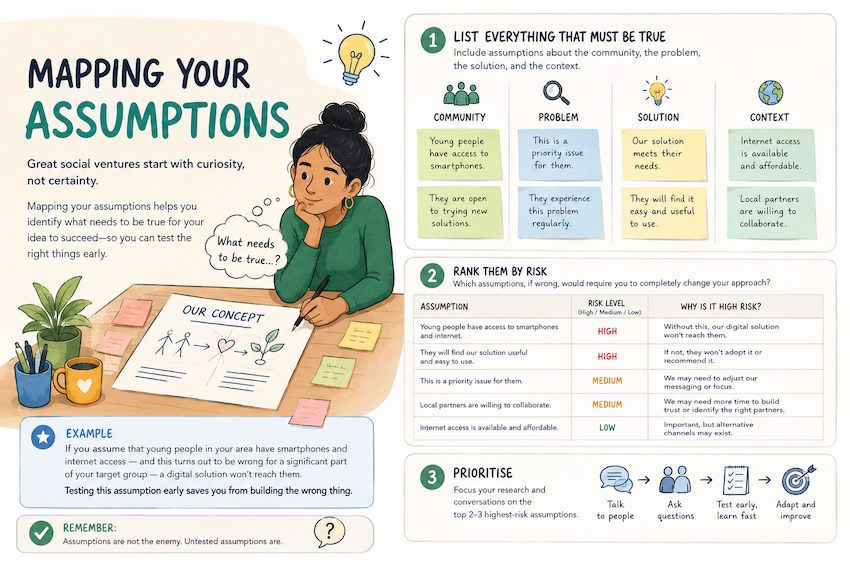
Mapping your assomption
For your current concept, complete:
1. List everything that must be true for your concept to work. Include assumptions about the community, the problem, the solution, and the context.
2. Rank them by risk: Which assumptions, if wrong, would require you to completely change your approach?
3. Prioritise: Focus your research and conversations on the top 2–3 highest-risk assumptions.
Example: If you assume that young people in your area have smartphones and internet access — and this turns out to be wrong for a significant part of your target group — a digital solution won't reach them. Testing this assumption early saves you from building the wrong thing.
-
Students mustMark as done
Empathy mapping - seeing the world through their eyes
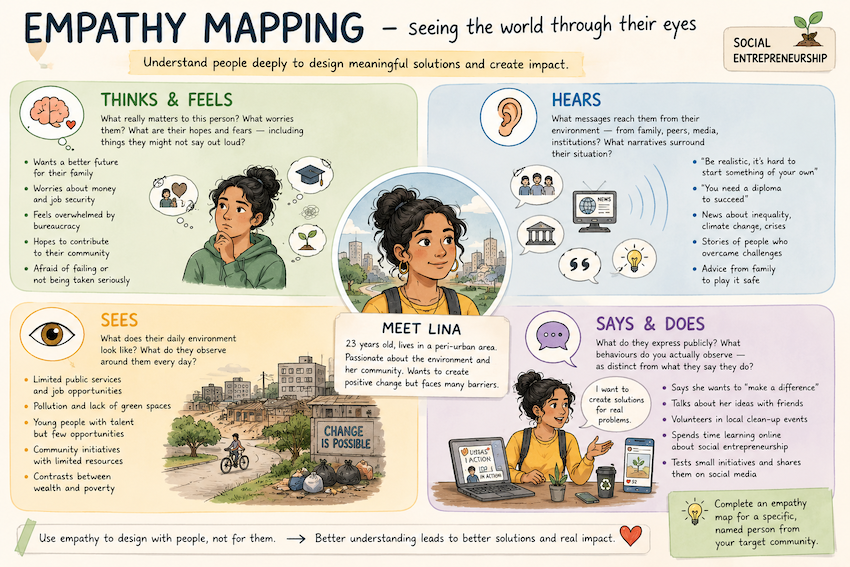
Before conducting interviews, it helps to practise perspective-taking. An empathy map is a simple tool that forces you to think about the full experience of the people you're designing for — not just their stated needs, but their emotions, their environment, and their behaviour.
The empathy map has four quadrants:
• Thinks & Feels: What really matters to this person? What worries them? What are their hopes and fears — including things they might not say out loud?
• Hears: What messages reach them from their environment — from family, peers, media, institutions? What narratives surround their situation?
• Sees: What does their daily environment look like? What do they observe around them every day?
• Says & Does: What do they express publicly? What behaviours do you actually observe — as distinct from what they say they do?
The empathy map is most powerful when you complete it for a specific, named person — real or constructed — who represents your target community. This practice develops the habit of designing for a real human being, not an abstract category.
-
Students mustMark as done
User interviews — the most important tool in your kit
A user interview is a structured conversation designed to understand someone's experience, needs, and behaviours. It is not a survey. It is not a pitch. It is not a validation exercise designed to confirm what you already think. It is an act of genuine inquiry.
The quality of a user interview depends almost entirely on the quality of the questions you ask — and your willingness to be surprised by the answers.
-
Students mustMark as done
Principles of a good user interview
• Ask open questions. Open questions begin with 'what', 'how', 'tell me about', or 'describe'. They cannot be answered with yes or no. They invite the person to speak in their own words and at their own pace.
• Follow the thread. When someone says something unexpected or interesting, follow it — even if it's not on your list of questions. The most valuable insights often come from unexpected directions.
• Ask about the past, not the hypothetical. 'Tell me about the last time you looked for a job' gives you real information. 'Would you use a digital tool to find work?' gives you a guess about a hypothetical future behaviour — which is far less reliable.
• Listen more than you speak. Aim for the other person to speak at least 70% of the time.
• Never suggest the answer. Avoid leading questions like 'Don't you think a mobile app would help?' — they push people toward the answer you want rather than the answer that's true.
Take notes on exact words. Write down what people actually say, not your interpretation of what they mean. The specific words people choose often reveal more than the content of what they say.

From conversations to insights
After conducting 3–5 interviews, look for patterns across the conversations. Ask yourself:
• What did multiple people say independently of each other? These are your strongest signals.
• What surprised you most? What challenged your assumptions?
• What did people say that you hadn't thought to ask about?
• Where did your assumptions turn out to be correct — and where were they wrong?
Organise your insights into three categories: what you now know (confirmed), what you now know differently (updated), and what you still don't know (questions for further research). This disciplined approach to learning transforms raw conversations into actionable intelligence.
-
Students mustMark as done
NFT Connection
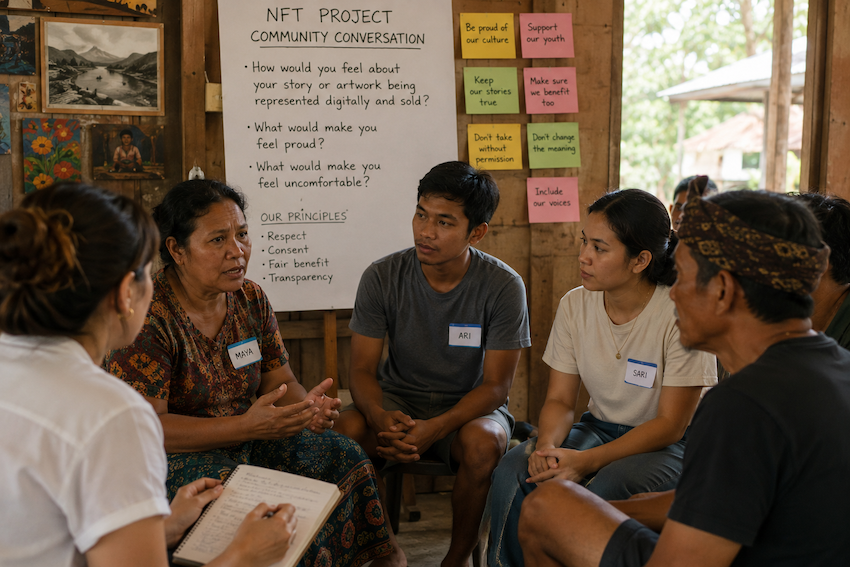
If you are considering an NFT project as part of your social enterprise, community conversations are even more critical.
An NFT campaign that represents a community without consulting them can cause real harm — making people feel exploited rather than empowered.
Use your interviews to ask directly: How would you feel about your story or artwork being represented digitally and sold? What would make you feel proud versus uncomfortable?
This input shapes not just your concept, but your ethics.
-
-
-
-
What you'll learn:
What prototyping is, why social entrepreneurs use it, and how to build a simple version of your concept that you can test with real people.
What is prototyping — and why does it matter?
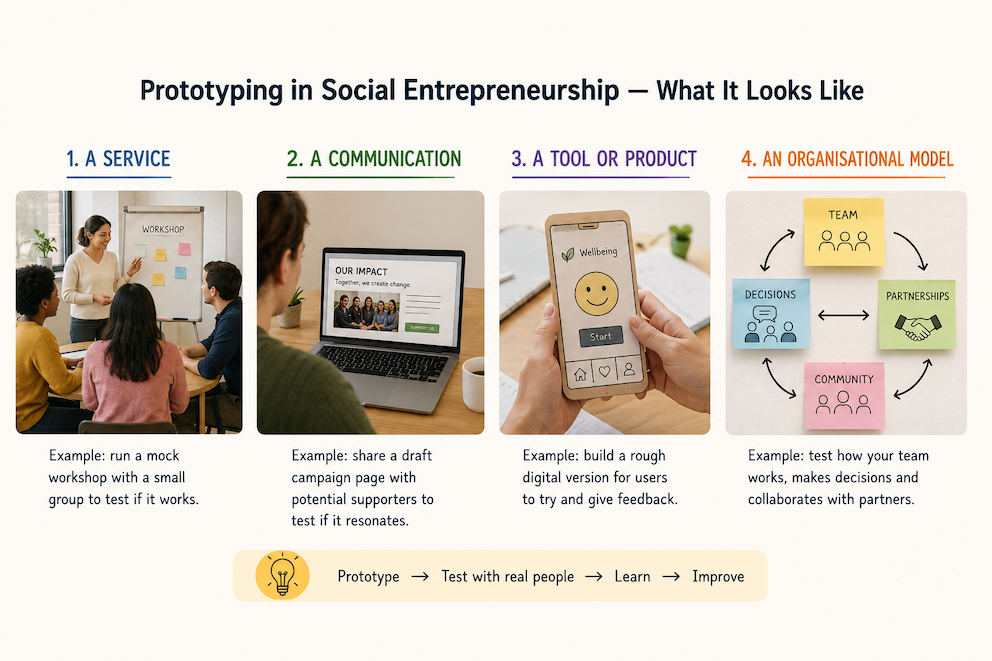
A prototype is an early, rough version of your idea — made with the specific purpose of learning. It is not a finished product. It is not a polished presentation. It is a thinking and testing tool.
The logic behind prototyping comes from a simple observation: the longer you wait before showing your idea to others, the more attached you become to it — and the harder it becomes to change it when you discover problems. By building a prototype early and cheaply, you force yourself to confront reality before you've invested too much.
In social entrepreneurship, this principle has a deeper dimension. You are not just designing a product — you are designing something that will affect people's lives. Getting it wrong has human consequences. Prototyping is how you reduce that risk.
-
Students mustMark as done
-
Students mustMark as done
Types of prototypes
1. Paper prototype
Sketch your concept on paper. Draw a process flow, a programme schedule, a service journey, or an interface. Paper prototyping is fast, costs nothing, and is always valid — regardless of how sophisticated your project is.
Best for: services, digital tools, communication materials, programme flows.
2. Storytelling prototype
Write a two-to-three-paragraph narrative describing your concept as if it already exists — including a specific person whose life has changed as a result. This 'future story' prototype tests whether your concept is emotionally compelling and whether your impact claim is believable.
Best for: fundraising campaigns, social impact narratives, community engagement strategies.
3. Role-play simulation
Act out the service experience with colleagues, friends, or community members. One person plays the social enterprise; others play the users or beneficiaries. Walk through the interaction step by step, out loud, in real time.
Best for: services, coaching programmes, training sessions, community events.
4. Digital mockup
Use free tools — Canva, Figma, Google Slides — to create a visual model of a digital product, campaign page, or communication. No coding or design skills required.
Best for: digital tools, websites, NFT campaign pages, social media campaigns.
5. Minimum Viable Product (MVP)
A real but minimal version of your service, delivered to a small group of users. For example: one workshop, delivered once, to five people. The MVP is the most advanced form of prototype — and the most revealing. It gives you real feedback from a real experience.
Best for: training programmes, community services, recurring events.
Note: the MVP requires more time and resources than other prototype types. Use it only once you've tested the concept with simpler prototypes first.
-
-
-
-
What you'll learn: How to collect honest, structured feedback on your prototype — and use it to improve your concept through deliberate iteration.
Why feedback is the social entrepreneur's most valuable resource
In social entrepreneurship, feedback is not just useful — it's essential. You're designing for people, not for a market. Whether your concept truly responds to real needs can only be determined by the people who have those needs.
This means developing a genuine openness to being wrong — and the discipline to act on what you learn. The most successful social enterprises are not the ones whose first idea was perfect. They're the ones that listened well, adapted quickly, and kept improving.

How to collect feedback effectively
The way you present your prototype determines the quality of the feedback you receive. If you over-explain before people respond, you'll get polite reactions rather than honest ones. If you ask closed questions, you'll confirm what you already believe. If you become defensive when someone raises a problem, people will stop telling you the truth.
-
Students mustMark as done
The 'I like / I wish / What if' method
This three-part feedback structure is used by design thinking practitioners worldwide. It is simple, generous, and effective:
• I like... What is working well? What resonates, connects, or feels right? Starting with what works creates a constructive atmosphere and helps the person giving feedback be more honest about what doesn't work.
• I wish... What could be improved, changed, or removed? What creates confusion, discomfort, or doubt? This is the most important part — and the hardest to hear.
• What if... What new directions, possibilities, or additions could strengthen the concept? This part invites creative thinking beyond the current prototype.
Ground rule: the person receiving feedback listens and takes notes. They do not explain, defend, or justify. There will be time for that later. Right now, the goal is to understand.
-
Students mustMark as done
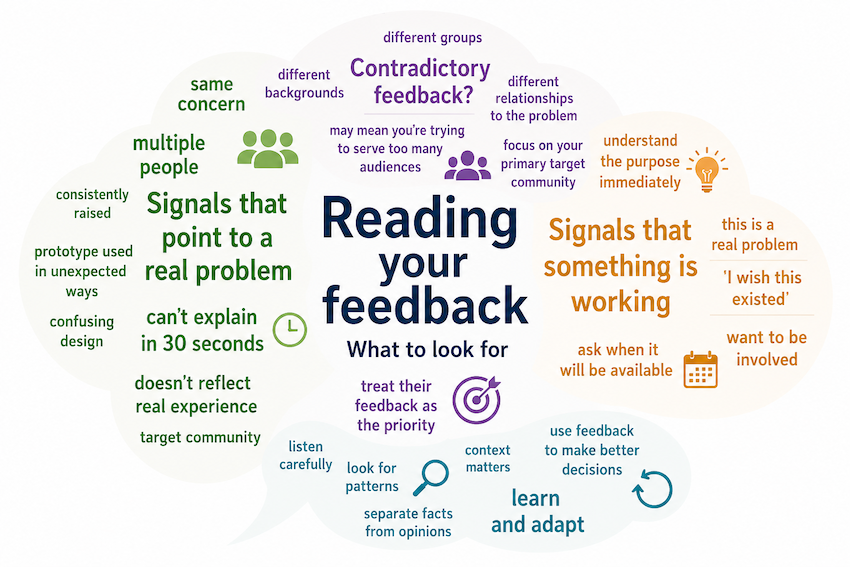
Reading your feedback — what to look for
Not all feedback is equally useful. Here is how to make sense of what you receive.
Signals that point to a real problem:
• Multiple people independently raise the same concern.
• People use your prototype in a way you didn't intend — which means something about the design is confusing.
• After 30 seconds, someone cannot explain what your concept is or does.
• People from your target community feel the concept doesn't reflect their actual experience.
Signals that something is working:
• People understand the purpose immediately, without explanation.
• People from your target community say: 'yes, this is a real problem' or 'I wish this existed.'
• People ask when it will be available, or express a desire to be involved.
What if feedback is contradictory? First, check whether people come from different groups — different backgrounds, different relationships to the problem. Contradictory feedback from different groups may mean you're trying to serve too many audiences at once. Focus on your primary target community and treat their feedback as the priority.
-
-
-
-
-
What you'll learn:
How to communicate your social enterprise concept clearly, honestly, and persuasively — to any audience.
Communication is a core social entrepreneurship skill
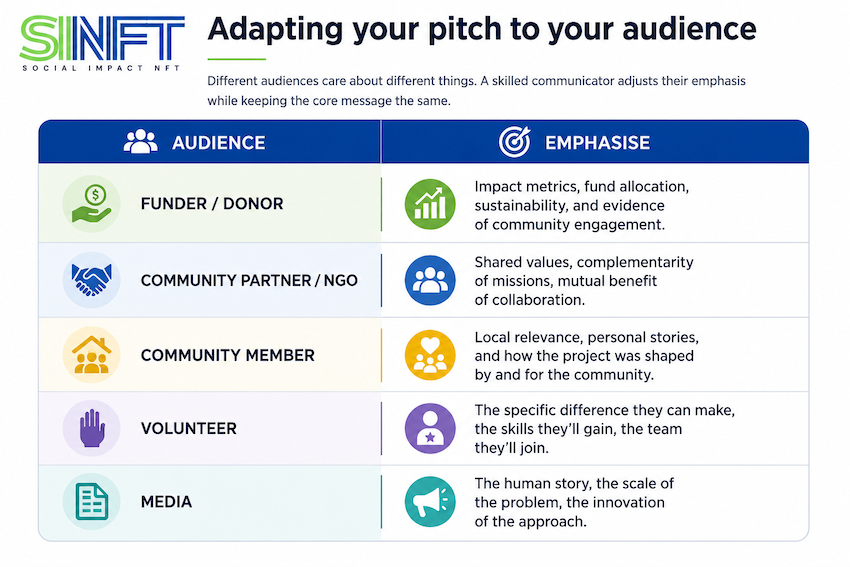
You can have the most carefully researched, well-designed social enterprise concept in the world. If you can't explain it clearly in two minutes, it will struggle to attract partners, funders, or community support.
The ability to communicate your concept — to articulate the problem, the solution, the impact, and the ask — is not a nice-to-have. It is a fundamental skill that social entrepreneurs use every single day: in funding applications, community meetings, partnership conversations, public presentations, and one-on-one conversations with potential supporters.
Pitching is not about being eloquent or charismatic. It's about clarity, honesty, and connection. And like all skills, it improves with practice.
The architecture of a strong pitch
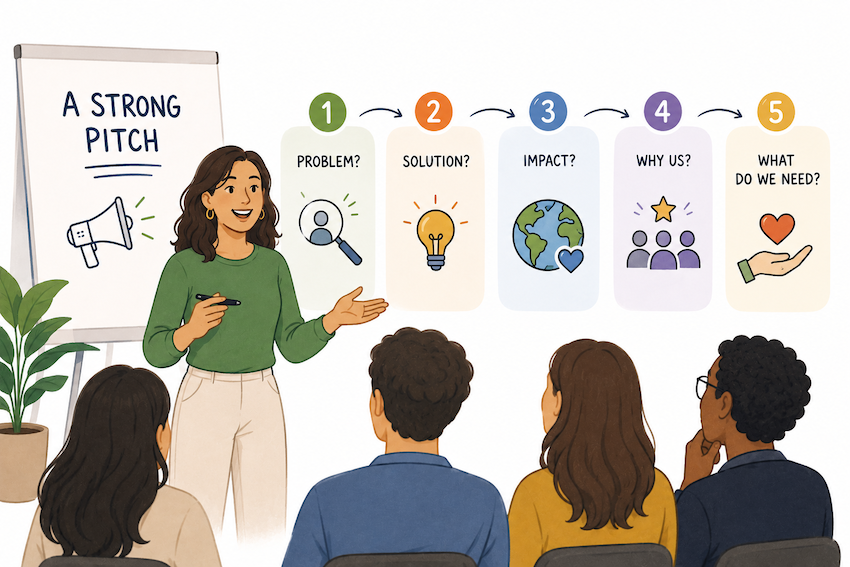
A strong pitch for a social enterprise concept answers five questions, in this order:
-
Students mustMark as done
The 5 questions every pitch must answer
1. What is the problem? Start with a real, concrete, human moment — not a statistic. A specific situation, a person, a place. Make the problem feel real before you say anything about your solution.
2. Who is affected? Name your target community with precision and dignity. Not 'young people' — but 'young women aged 18–24 in rural areas who left school without a qualification and have been unemployed for more than a year.'
3. What is your solution? Describe what you offer in clear, simple language. No jargon. No technical terms. If someone who knows nothing about your sector can't understand it in 30 seconds, simplify.
4. Why will it work? This is where your validation work pays off. Reference your community conversations, your testing, what you learned. Evidence of genuine engagement with the problem is far more persuasive than a polished slide deck.
5 What do you need? End with one specific, concrete ask. Funding? A partnership? A pilot space? A connection to a network? Never leave your audience wondering what to do next.
-
Students mustMark as done
Story first — data second
The most memorable social enterprise pitches open with a story. Not a headline. Not a statistic. A person, a moment, a detail that is specific and true.
"Last October, I visited a community centre in a small town two hours from here. I met Fatima, 22. She'd been coming to the employment office every Tuesday for eight months. She showed me her notebook — full of job applications she'd sent, and rejections she'd received. She said: 'I don't think they're actually reading them.' She was right. She didn't have a CV that translated her skills into language employers recognised. Nobody had ever taught her how.
From that story, you move naturally to the problem, the solution, and the impact. The story is not decoration — it is the argument. It makes the problem undeniable and the solution necessary.
-
Students mustMark as done
-
Students mustMark as done
💡 NFT connection
If your social enterprise uses an NFT campaign as a fundraising or awareness tool, adapt your pitch to explain the connection clearly: What story does the NFT collection tell? Who created it? Where do the funds go? How does the digital format amplify the social impact? For most audiences, you will need to briefly explain what an NFT is — in one sentence, without jargon — before moving on. Lead with the cause, not the technology.
-
Final activity - Validating and Prototyping Ideas
Submit in the forum for feedbacks a short slide presentation (4 slides):

The best pitches are not the most polished. They are the most honest. Show what you've learned — including what surprised you.
-
-
-

Shape the Future.
Mint the Change.