
Lesson 2 - Understanding Needs & Testing Assumptions
Validating and Prototyping Ideas
Section outline
-
What you'll learn:
How to deeply understand the people you want to help — and why testing your assumptions before building anything is the most important skill in social entrepreneurship.
The trap of the solution looking for a problem
In social innovation, there is a well-known failure pattern called "the solution looking for a problem". It happens when a team falls in love with an idea — a digital app, a training programme, a community space — and then works backwards to justify it, without genuinely listening to the people they claim to serve.
The result is almost always the same: a project that doesn't work, a community that feels patronised, and resources that were wasted on something nobody asked for. Avoiding this trap requires one practice above all others: listening before building. Deeply, patiently, humbly listening — to the people who know their own situation better than any outsider can.
What is an assumption - and why is it dangerous?
Every social enterprise concept is built on assumptions: things you believe to be true about the problem, the community, or the solution — but haven't yet verified. Some assumptions are obvious. Others are invisible to you precisely because you believe them so strongly.
Here is why assumptions are dangerous: if your most important assumption is wrong and you don't discover it until after you've built your project, you've wasted time, money, and trust. If you discover it early — before you've built anything — it costs you almost nothing to change course.
-
Students mustMark as done
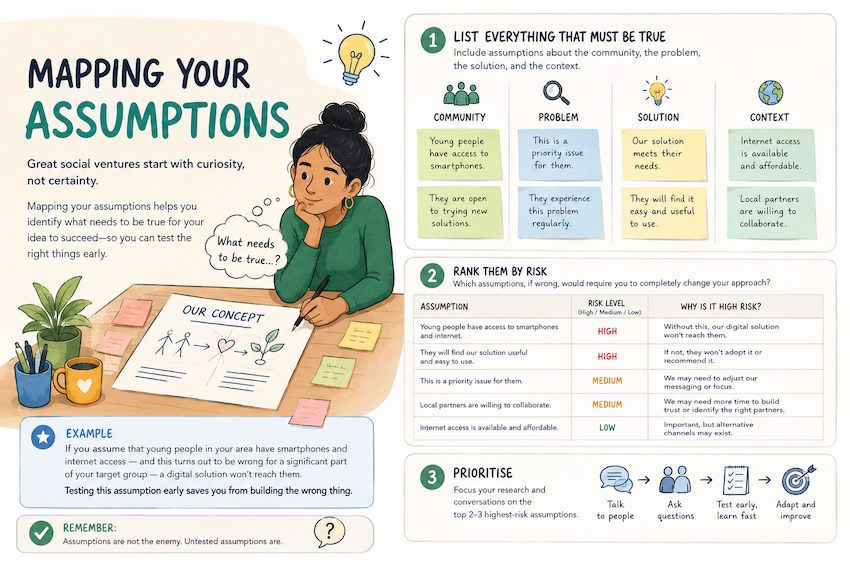
Mapping your assomption
For your current concept, complete:
1. List everything that must be true for your concept to work. Include assumptions about the community, the problem, the solution, and the context.
2. Rank them by risk: Which assumptions, if wrong, would require you to completely change your approach?
3. Prioritise: Focus your research and conversations on the top 2–3 highest-risk assumptions.
Example: If you assume that young people in your area have smartphones and internet access — and this turns out to be wrong for a significant part of your target group — a digital solution won't reach them. Testing this assumption early saves you from building the wrong thing.
-
Students mustMark as done
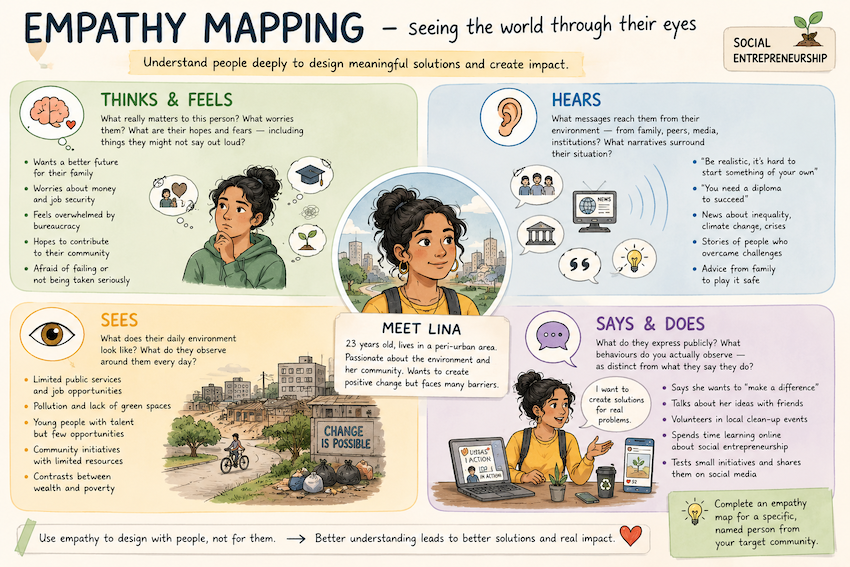
Empathy mapping - seeing the world through their eyes
Before conducting interviews, it helps to practise perspective-taking. An empathy map is a simple tool that forces you to think about the full experience of the people you're designing for — not just their stated needs, but their emotions, their environment, and their behaviour.
The empathy map has four quadrants:
• Thinks & Feels: What really matters to this person? What worries them? What are their hopes and fears — including things they might not say out loud?
• Hears: What messages reach them from their environment — from family, peers, media, institutions? What narratives surround their situation?
• Sees: What does their daily environment look like? What do they observe around them every day?
• Says & Does: What do they express publicly? What behaviours do you actually observe — as distinct from what they say they do?
The empathy map is most powerful when you complete it for a specific, named person — real or constructed — who represents your target community. This practice develops the habit of designing for a real human being, not an abstract category.
-
Students mustMark as done
User interviews — the most important tool in your kit
A user interview is a structured conversation designed to understand someone's experience, needs, and behaviours. It is not a survey. It is not a pitch. It is not a validation exercise designed to confirm what you already think. It is an act of genuine inquiry.
The quality of a user interview depends almost entirely on the quality of the questions you ask — and your willingness to be surprised by the answers.
-
Students mustMark as done
Principles of a good user interview
• Ask open questions. Open questions begin with 'what', 'how', 'tell me about', or 'describe'. They cannot be answered with yes or no. They invite the person to speak in their own words and at their own pace.
• Follow the thread. When someone says something unexpected or interesting, follow it — even if it's not on your list of questions. The most valuable insights often come from unexpected directions.
• Ask about the past, not the hypothetical. 'Tell me about the last time you looked for a job' gives you real information. 'Would you use a digital tool to find work?' gives you a guess about a hypothetical future behaviour — which is far less reliable.
• Listen more than you speak. Aim for the other person to speak at least 70% of the time.
• Never suggest the answer. Avoid leading questions like 'Don't you think a mobile app would help?' — they push people toward the answer you want rather than the answer that's true.
Take notes on exact words. Write down what people actually say, not your interpretation of what they mean. The specific words people choose often reveal more than the content of what they say.

From conversations to insights
After conducting 3–5 interviews, look for patterns across the conversations. Ask yourself:
• What did multiple people say independently of each other? These are your strongest signals.
• What surprised you most? What challenged your assumptions?
• What did people say that you hadn't thought to ask about?
• Where did your assumptions turn out to be correct — and where were they wrong?
Organise your insights into three categories: what you now know (confirmed), what you now know differently (updated), and what you still don't know (questions for further research). This disciplined approach to learning transforms raw conversations into actionable intelligence.
-
Students mustMark as done
NFT Connection
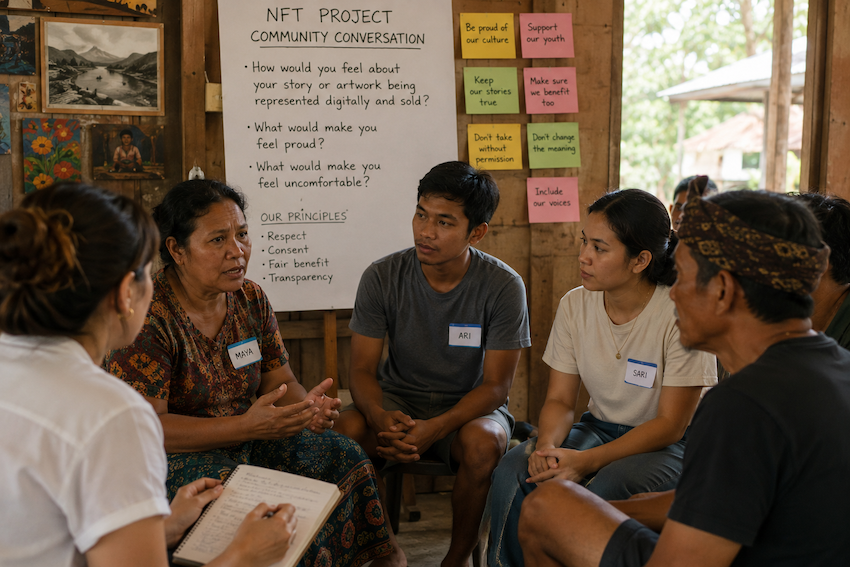
If you are considering an NFT project as part of your social enterprise, community conversations are even more critical.
An NFT campaign that represents a community without consulting them can cause real harm — making people feel exploited rather than empowered.
Use your interviews to ask directly: How would you feel about your story or artwork being represented digitally and sold? What would make you feel proud versus uncomfortable?
This input shapes not just your concept, but your ethics.
-

Shape the Future.
Mint the Change.