
Lesson 4 - Getting Feedback & Iterating
Validating and Prototyping Ideas
Section outline
-
What you'll learn: How to collect honest, structured feedback on your prototype — and use it to improve your concept through deliberate iteration.
Why feedback is the social entrepreneur's most valuable resource
In social entrepreneurship, feedback is not just useful — it's essential. You're designing for people, not for a market. Whether your concept truly responds to real needs can only be determined by the people who have those needs.
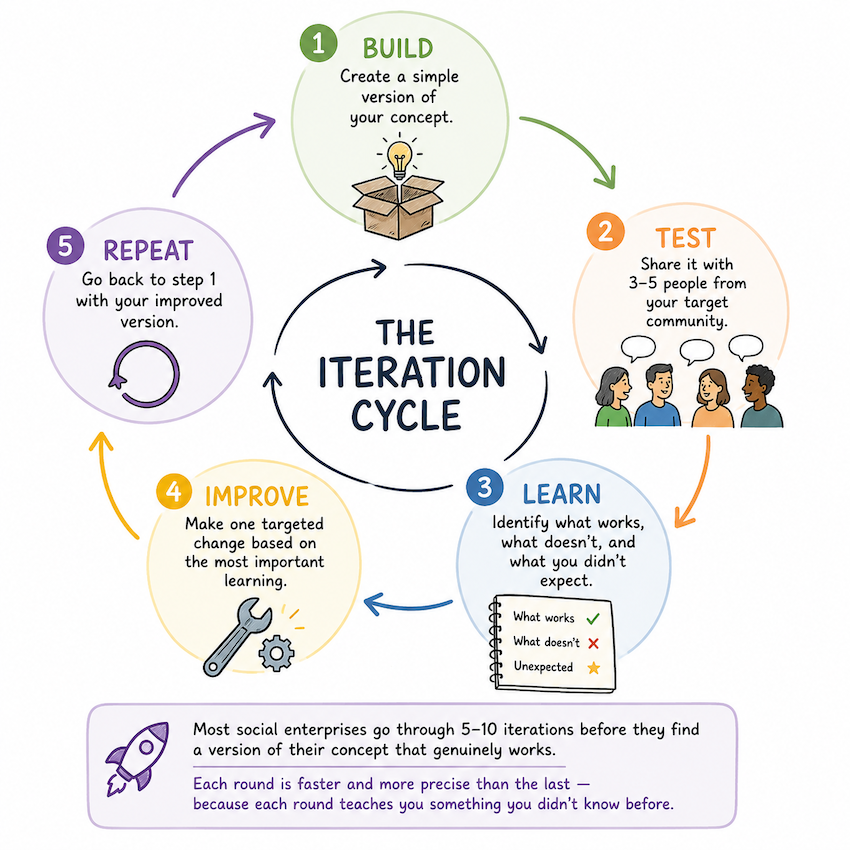
This means developing a genuine openness to being wrong — and the discipline to act on what you learn. The most successful social enterprises are not the ones whose first idea was perfect. They're the ones that listened well, adapted quickly, and kept improving.

How to collect feedback effectively
The way you present your prototype determines the quality of the feedback you receive. If you over-explain before people respond, you'll get polite reactions rather than honest ones. If you ask closed questions, you'll confirm what you already believe. If you become defensive when someone raises a problem, people will stop telling you the truth.
-
Students mustMark as done
The 'I like / I wish / What if' method
This three-part feedback structure is used by design thinking practitioners worldwide. It is simple, generous, and effective:
• I like... What is working well? What resonates, connects, or feels right? Starting with what works creates a constructive atmosphere and helps the person giving feedback be more honest about what doesn't work.
• I wish... What could be improved, changed, or removed? What creates confusion, discomfort, or doubt? This is the most important part — and the hardest to hear.
• What if... What new directions, possibilities, or additions could strengthen the concept? This part invites creative thinking beyond the current prototype.
Ground rule: the person receiving feedback listens and takes notes. They do not explain, defend, or justify. There will be time for that later. Right now, the goal is to understand.
-
Students mustMark as done
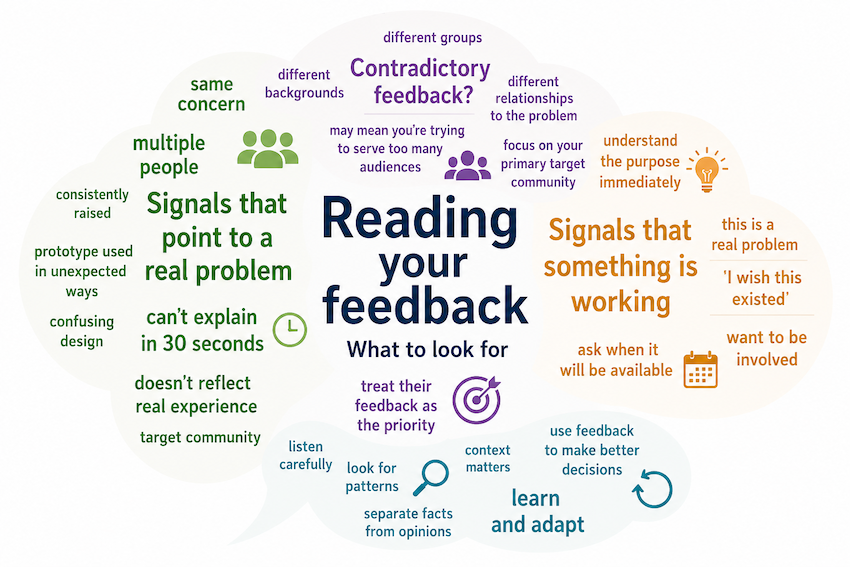
Reading your feedback — what to look for
Not all feedback is equally useful. Here is how to make sense of what you receive.
Signals that point to a real problem:
• Multiple people independently raise the same concern.
• People use your prototype in a way you didn't intend — which means something about the design is confusing.
• After 30 seconds, someone cannot explain what your concept is or does.
• People from your target community feel the concept doesn't reflect their actual experience.
Signals that something is working:
• People understand the purpose immediately, without explanation.
• People from your target community say: 'yes, this is a real problem' or 'I wish this existed.'
• People ask when it will be available, or express a desire to be involved.
What if feedback is contradictory? First, check whether people come from different groups — different backgrounds, different relationships to the problem. Contradictory feedback from different groups may mean you're trying to serve too many audiences at once. Focus on your primary target community and treat their feedback as the priority.
-
-

Shape the Future.
Mint the Change.