
Lesson 3 - Creating a Prototype
Validating and Prototyping Ideas
Section outline
-
What you'll learn:
What prototyping is, why social entrepreneurs use it, and how to build a simple version of your concept that you can test with real people.
What is prototyping — and why does it matter?
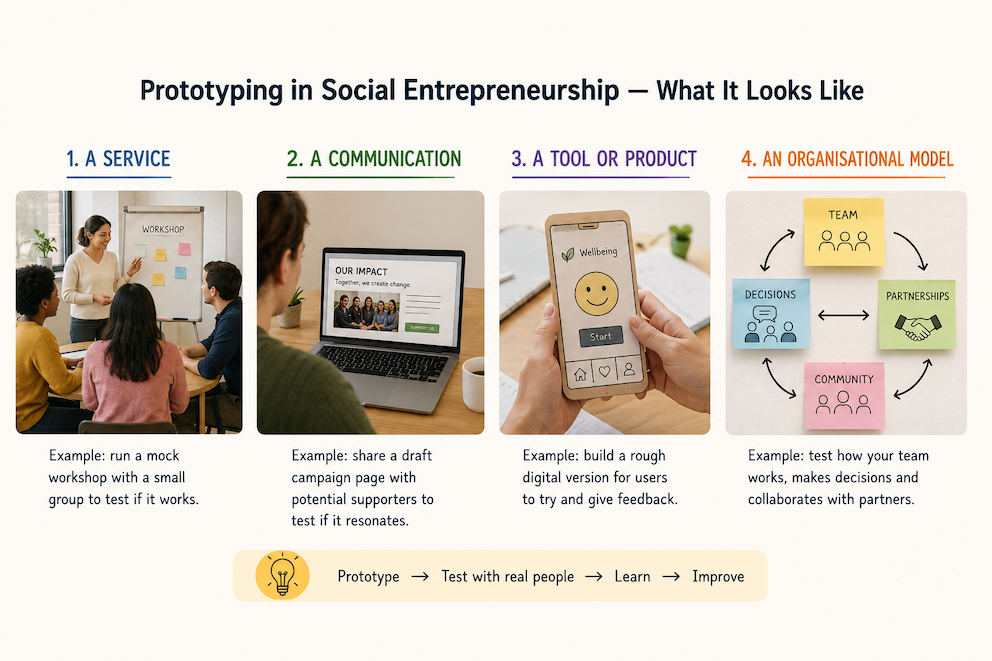
A prototype is an early, rough version of your idea — made with the specific purpose of learning. It is not a finished product. It is not a polished presentation. It is a thinking and testing tool.
The logic behind prototyping comes from a simple observation: the longer you wait before showing your idea to others, the more attached you become to it — and the harder it becomes to change it when you discover problems. By building a prototype early and cheaply, you force yourself to confront reality before you've invested too much.
In social entrepreneurship, this principle has a deeper dimension. You are not just designing a product — you are designing something that will affect people's lives. Getting it wrong has human consequences. Prototyping is how you reduce that risk.
-
Students mustMark as done
-
Students mustMark as done
Types of prototypes
1. Paper prototype
Sketch your concept on paper. Draw a process flow, a programme schedule, a service journey, or an interface. Paper prototyping is fast, costs nothing, and is always valid — regardless of how sophisticated your project is.
Best for: services, digital tools, communication materials, programme flows.
2. Storytelling prototype
Write a two-to-three-paragraph narrative describing your concept as if it already exists — including a specific person whose life has changed as a result. This 'future story' prototype tests whether your concept is emotionally compelling and whether your impact claim is believable.
Best for: fundraising campaigns, social impact narratives, community engagement strategies.
3. Role-play simulation
Act out the service experience with colleagues, friends, or community members. One person plays the social enterprise; others play the users or beneficiaries. Walk through the interaction step by step, out loud, in real time.
Best for: services, coaching programmes, training sessions, community events.
4. Digital mockup
Use free tools — Canva, Figma, Google Slides — to create a visual model of a digital product, campaign page, or communication. No coding or design skills required.
Best for: digital tools, websites, NFT campaign pages, social media campaigns.
5. Minimum Viable Product (MVP)
A real but minimal version of your service, delivered to a small group of users. For example: one workshop, delivered once, to five people. The MVP is the most advanced form of prototype — and the most revealing. It gives you real feedback from a real experience.
Best for: training programmes, community services, recurring events.
Note: the MVP requires more time and resources than other prototype types. Use it only once you've tested the concept with simpler prototypes first.
-
Shape the Future.
Mint the Change.