
Lesson 5 - Presenting Your Prototype
Validating and Prototyping Ideas
Section outline
-
What you'll learn:
How to communicate your social enterprise concept clearly, honestly, and persuasively — to any audience.
Communication is a core social entrepreneurship skill
You can have the most carefully researched, well-designed social enterprise concept in the world. If you can't explain it clearly in two minutes, it will struggle to attract partners, funders, or community support.
The ability to communicate your concept — to articulate the problem, the solution, the impact, and the ask — is not a nice-to-have. It is a fundamental skill that social entrepreneurs use every single day: in funding applications, community meetings, partnership conversations, public presentations, and one-on-one conversations with potential supporters.
Pitching is not about being eloquent or charismatic. It's about clarity, honesty, and connection. And like all skills, it improves with practice.
The architecture of a strong pitch
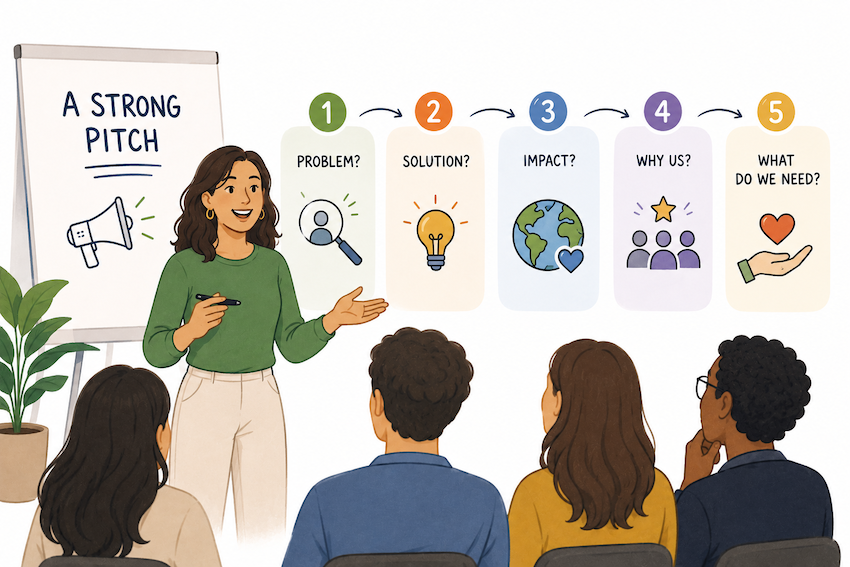
A strong pitch for a social enterprise concept answers five questions, in this order:
-
Students mustMark as done
The 5 questions every pitch must answer
1. What is the problem? Start with a real, concrete, human moment — not a statistic. A specific situation, a person, a place. Make the problem feel real before you say anything about your solution.
2. Who is affected? Name your target community with precision and dignity. Not 'young people' — but 'young women aged 18–24 in rural areas who left school without a qualification and have been unemployed for more than a year.'
3. What is your solution? Describe what you offer in clear, simple language. No jargon. No technical terms. If someone who knows nothing about your sector can't understand it in 30 seconds, simplify.
4. Why will it work? This is where your validation work pays off. Reference your community conversations, your testing, what you learned. Evidence of genuine engagement with the problem is far more persuasive than a polished slide deck.
5 What do you need? End with one specific, concrete ask. Funding? A partnership? A pilot space? A connection to a network? Never leave your audience wondering what to do next.
-
Students mustMark as done
Story first — data second
The most memorable social enterprise pitches open with a story. Not a headline. Not a statistic. A person, a moment, a detail that is specific and true.
"Last October, I visited a community centre in a small town two hours from here. I met Fatima, 22. She'd been coming to the employment office every Tuesday for eight months. She showed me her notebook — full of job applications she'd sent, and rejections she'd received. She said: 'I don't think they're actually reading them.' She was right. She didn't have a CV that translated her skills into language employers recognised. Nobody had ever taught her how.
From that story, you move naturally to the problem, the solution, and the impact. The story is not decoration — it is the argument. It makes the problem undeniable and the solution necessary.
-
Students mustMark as done
-
Students mustMark as done
💡 NFT connection
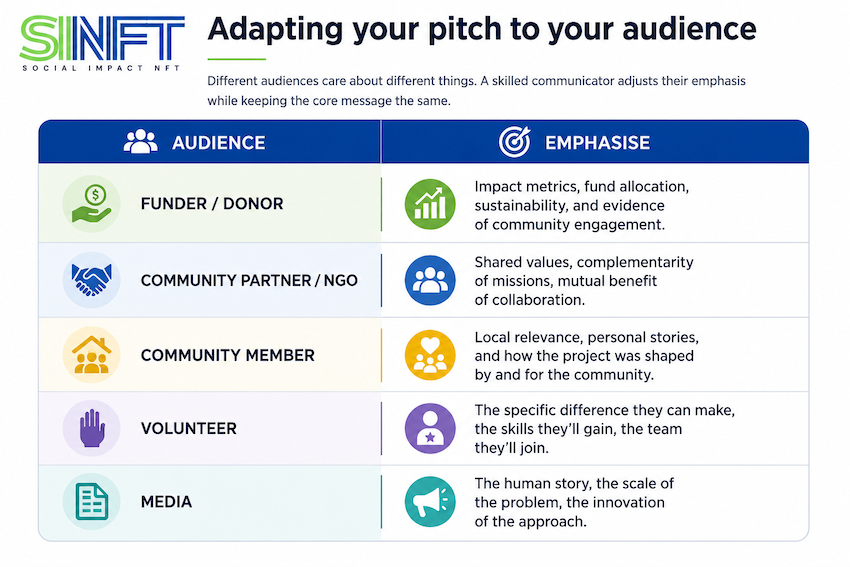
If your social enterprise uses an NFT campaign as a fundraising or awareness tool, adapt your pitch to explain the connection clearly: What story does the NFT collection tell? Who created it? Where do the funds go? How does the digital format amplify the social impact? For most audiences, you will need to briefly explain what an NFT is — in one sentence, without jargon — before moving on. Lead with the cause, not the technology.
-
Final activity - Validating and Prototyping Ideas
Submit in the forum for feedbacks a short slide presentation (4 slides):

The best pitches are not the most polished. They are the most honest. Show what you've learned — including what surprised you.
-

Shape the Future.
Mint the Change.