
MODULE: Legal and Ethical Principles in Social Innovation
Legal & Ethical Foundations
Section outline
-
What you'll learn: The difference between legal and ethical, and the core principles that guide responsible social innovation in Europe.
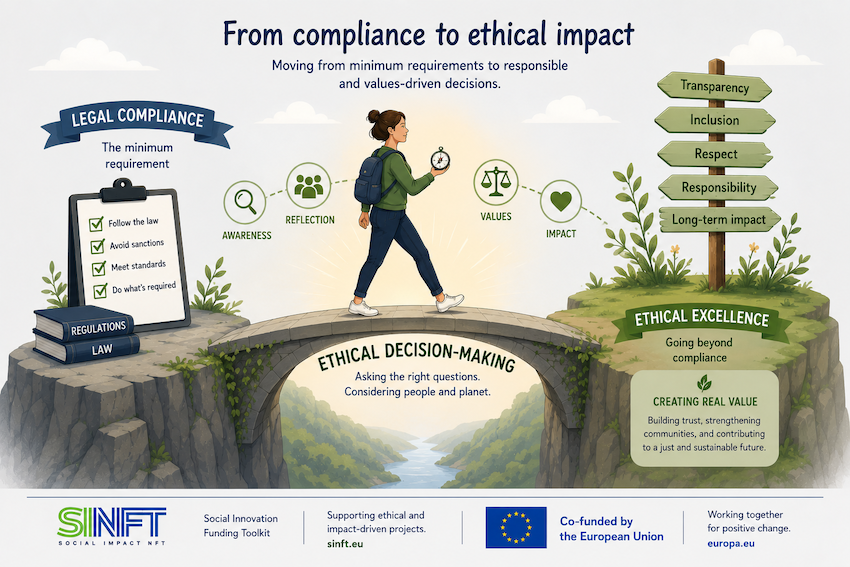
Legal and ethical — not the same thing
The first distinction to understand — and one that matters enormously in social entrepreneurship — is the difference between what is legal and what is ethical.
• Legal means what the law permits. Acting legally means complying with applicable rules and regulations. If something is legal, you won't face legal consequences for it.
• Ethical means what is morally right — especially in relation to the people affected by your actions. Something can be legal and still cause harm. Something can feel right and still break a rule.
-
-
-
Students mustMark as done
Ethics is not about avoiding mistakes
Many people believe that ethics means following rules or avoiding legal problems. In reality, ethical decision-making is much broader.
Social entrepreneurs constantly face situations where there is no perfect answer. Resources are limited, different groups may have conflicting needs, and every decision creates both opportunities and consequences.
Being ethical means asking good questions before acting:
- Who benefits from this decision?
- Could anyone be unintentionally excluded?
- Have the people concerned had the opportunity to express their views?
- Would I be comfortable explaining this decision publicly?
Ethics is therefore not a checklist. It is a way of thinking that guides every stage of a social innovation project—from identifying a problem to evaluating its impact.

Key message: Good social entrepreneurs don't just ask "Can we do this?" They also ask "Should we do this?"
-
Students mustMark as done
Ethics begins with the people you serve
Every social innovation starts with people. This means respecting not only their needs, but also their dignity, privacy, culture, and ability to make their own decisions. Communities should never be treated as "beneficiaries" who simply receive help. Instead, they should be recognised as partners who contribute knowledge, experience, and ideas. When people participate in shaping solutions, projects become more relevant, more inclusive, and more sustainable.
Ask yourself:
- Have we listened before designing?
- Have we included different voices?
- Are people represented fairly?
-
Students mustMark as done
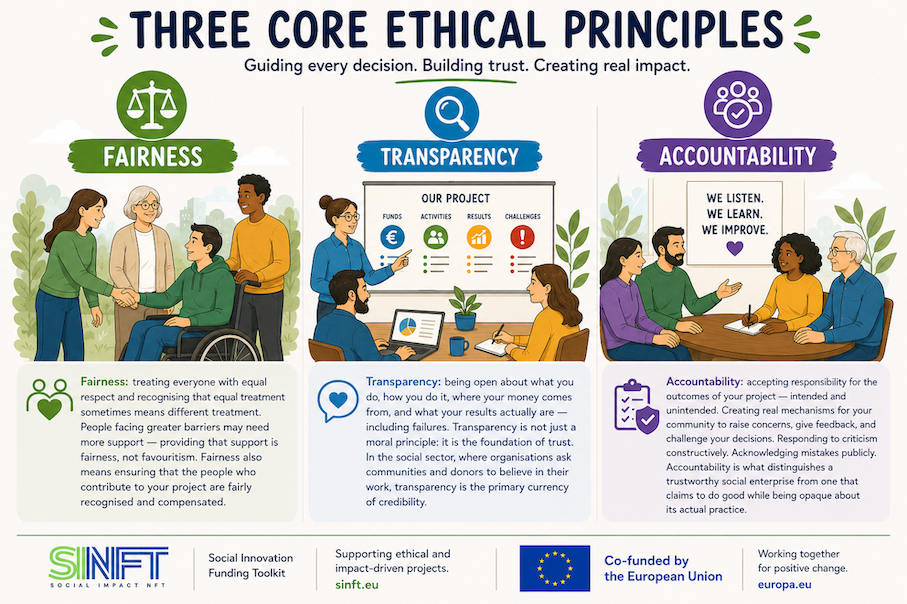
Three core ethical principles
Across all the frameworks you'll encounter — European legal instruments, social innovation codes of practice, funding ethics requirements — three principles appear consistently. Understanding them deeply will help you navigate almost any ethical question you face.
-
Students mustMark as done
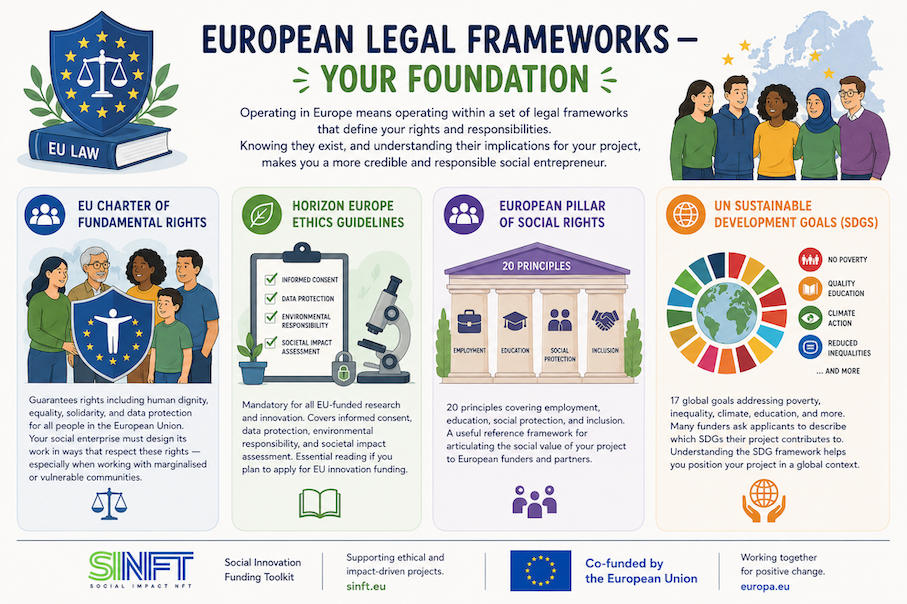
European legal frameworks — your foundation
Operating in Europe means operating within a set of legal frameworks that define your rights and responsibilities. You don't need to memorise them — but knowing they exist, and understanding their implications for your project, makes you a more credible and responsible social entrepreneur.
-
Students mustMark as done
💡 NFT connection
If your social enterprise uses an NFT campaign, the legal and ethical framework applies in specific ways.
You are selling digital assets to the public — which means transparency about fund allocation is not just ethical, it may be legally required under consumer protection law.
You are representing a community — which means the fairness and dignity principles apply to how community members are depicted and compensated.
And you are using blockchain technology — which raises specific questions about data permanence and environmental responsibility that we'll explore in Lessons 3 and 4.
-
Students mustMark as done
Ethics is a continuous commitment
Legal frameworks provide important guidance, but they cannot anticipate every situation you will encounter as a social entrepreneur. Every project is unique, every community is different, and every decision involves people with different experiences, expectations, and needs. This is why ethical practice is not something you complete once—it is a continuous commitment throughout the life of your project.
As your social enterprise grows, you will face new opportunities and new challenges. You may welcome new partners, manage larger budgets, collect more data, or work with increasingly diverse communities. Each new step brings new responsibilities. Remaining ethical means regularly reflecting on your decisions, questioning your assumptions, and being willing to adapt when you discover a better or fairer way of working.
Ethical organisations also understand that mistakes can happen. No project is perfect, and unintended consequences are sometimes unavoidable. What matters is how you respond. Listening to feedback, acknowledging mistakes openly, correcting problems quickly, and learning from experience are signs of responsible leadership. Communities and partners are far more likely to trust organisations that are honest about their challenges than those that pretend to have all the answers.
Finally, remember that ethics is not only about avoiding harm. It is about actively creating positive relationships built on fairness, transparency, accountability, and respect. These values strengthen trust with beneficiaries, volunteers, partners, funders, and the wider community. Over time, this trust becomes one of the most valuable assets your social enterprise can have.
Whenever you face a difficult decision, return to three simple questions:
- Is this fair?
- Am I being transparent?
- Am I willing to be accountable for the consequences of this decision?
If you can confidently answer "yes" to these questions, you are building not only a legally compliant organisation, but also one that people will trust, support, and want to work with.
Key takeaway: Ethics is not an additional task or a legal obligation to complete. It is a way of thinking and acting that should guide every decision, every partnership, and every innovation throughout the life of your social enterprise.
-
-
-
-
What you'll learn: What intellectual property is, how it applies to your social enterprise's creative work, and what specific questions it raises for digital content and NFTs.
Why intellectual property matters for social entrepreneurs
Every time your social enterprise creates something original — a workshop curriculum, a campaign video, a logo, a training manual, a piece of digital artwork, a website — it creates intellectual property. Understanding the basics of IP law protects you in two directions: it prevents others from using your work without permission, and it prevents you from accidentally infringing someone else's rights.
In the social sector, IP questions are often underestimated. Teams use images found online without checking the licence, publish content created by volunteers without clarifying who owns it, or collaborate with external creators without agreeing in advance on how the work will be used. These oversights create legal vulnerabilities and — more importantly — can damage the trust and relationships on which your project depends.
-
Students mustMark as done
Intellectual property is about respecting creativity
Intellectual property is often seen as a legal issue, but it is also an ethical one. Every photograph, illustration, video, story, piece of music, or educational resource represents someone's time, creativity, and expertise.
Respecting intellectual property means recognising that creators deserve credit and that their work should only be used according to the permissions they have given. In the social sector, where collaboration and knowledge sharing are common, respecting creators helps build trust between organisations, volunteers, artists, and communities.
Good social entrepreneurs do not simply ask whether they can use a piece of content—they ask whether they should, whether permission has been granted, and whether the creator is properly acknowledged.

Key takeaway: Respecting intellectual property means respecting the people behind the ideas.
-
Students mustMark as done
The main types of intellectual property
Copyright
Copyright protects original creative works: texts, images, music, videos, software code, workshop designs, visual art. In most countries, copyright is automatic — it exists from the moment of creation, without registration. The creator holds the copyright unless they explicitly transfer it to someone else.
Important implications for social enterprises: every piece of content you publish — on your website, in your communications, in your funding applications — is subject to copyright. Content created by your staff belongs to the organisation (if created as part of their employment). Content created by volunteers or community members belongs to those individuals unless you have a written agreement otherwise.
Moral rights
In many European countries, creators have moral rights that exist separately from copyright. These include the right to be identified as the author of their work (the right of attribution) and the right to object to modifications they consider harmful to their reputation or the integrity of the work.
Moral rights are especially relevant in community co-creation contexts. If a community member contributes their story, artwork, or testimony to your project, they have the right to be credited — and to object if you use their contribution in a way they find disrespectful.
Trademarks
A trademark protects a name, logo, or slogan that identifies your organisation or project in the market. Unlike copyright, trademark protection must be registered to be legally enforceable. If you are building a project with a strong brand identity that you want to protect, registering your trademark is worth considering — especially before any public launch.
Open licences — Creative Commons
Creative Commons licences allow creators to share their work with the public on specific terms — making some uses free while restricting others. They are widely used in the social innovation and non-profit sectors because they enable knowledge sharing while allowing creators to retain some control.
-
Students mustMark as done
Creative Commons licence types:
Choosing the right licence for your own work
When your organisation creates original resources, you also need to decide how others may use them. Ask yourself:
- Do you want anyone to reuse your work?
- Do you want adaptations to remain open?
- Do you want to prevent commercial use?
- Do you want to maximise dissemination?
There is no universally "best" licence. The right choice depends on your mission. For example:
- educational resources often use CC BY;
- collaborative toolkits may benefit from CC BY-SA;
- resources that generate income may require CC BY-NC.
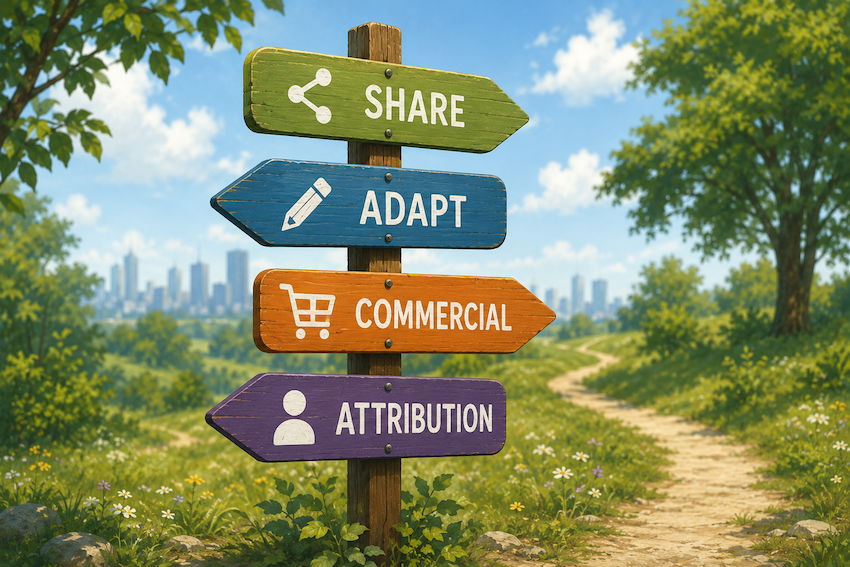
Choosing a licence is part of your communication strategy—not only a legal decision.
• CC BY: anyone can use, share, and adapt the work for any purpose, as long as they credit the creator.
• CC BY-SA: same as CC BY, but any adapted work must be shared under the same licence.
• CC BY-NC: use with credit, for non-commercial purposes only.
• CC BY-ND: use with credit, but no modifications allowed.
• CC0: the creator waives all rights — the work is in the public domain.
If your social enterprise's impact depends on knowledge being shared widely, CC BY or CC BY-SA maximises your reach. If your project generates income from its content, CC BY-NC protects you from commercial copying without your consent.
-
Students mustMark as done
The critical distinction: owning an NFT ≠ owning the copyright
When someone buys an NFT, they receive a token — a unique digital certificate of ownership recorded on the blockchain. They do not automatically receive the copyright to the artwork or content.
Copyright remains with the creator unless you explicitly transfer it or grant a licence. This means you need to decide — before minting — exactly what rights buyers receive, and state this clearly in your NFT description:
• Display rights only: buyers can display the NFT privately and share it on social media. No commercial use.
• Limited licence: buyers can use the image for non-commercial promotion of the cause.
• Full transfer: buyers own the copyright. Rare and not recommended in community co-creation contexts.

If multiple people contributed to creating an NFT — a community member who told the story, an artist who created the visual — you must clarify IP ownership in writing before minting. Ambiguity about rights is one of the most common sources of conflict in NFT projects.
-
Students mustMark as done
Intellectual property builds trust
Protecting intellectual property is not about limiting creativity—it is about creating an environment where creativity can flourish.
When organisations respect authorship, give proper credit, clarify ownership, and communicate openly about how creative work will be used, they build stronger relationships with artists, volunteers, partners, and communities.
Good intellectual property management also strengthens your organisation. It reduces misunderstandings, protects your brand, and makes collaboration easier because everyone understands their rights and responsibilities from the beginning.
As digital technologies continue to evolve, intellectual property will become increasingly important. Whether you publish educational resources, develop digital campaigns, or create NFT collections, responsible management of intellectual property helps ensure that innovation remains fair, transparent, and respectful.

Key takeaway: Intellectual property is not only about protecting ideas—it is about recognising creativity, respecting contributors, and building lasting trust.
-
-
-
-
What you'll learn: How to collect and manage personal data responsibly — both as a legal requirement under GDPR and as an ethical obligation to the communities you serve.
Why data protection matters for social enterprises
Social enterprises interact with personal data at every stage of their work: participant registration forms, interview recordings, testimonials, photos from community events, email lists, funding applications containing beneficiary information. All of this is personal data — and all of it carries legal and ethical responsibilities.
In the European Union, personal data is regulated by the General Data Protection Regulation (GDPR) — one of the strongest privacy laws in the world. GDPR applies to any organisation operating in the EU or handling the data of EU residents. For a social enterprise working with communities — especially vulnerable or marginalised communities — compliance with GDPR is not just a legal necessity. It is an expression of the respect and care that your mission demands.
-
Students mustMark as done
Privacy is about people, not paperwork
Many organisations think of GDPR as a collection of forms, consent boxes, and legal obligations. In reality, data protection begins with a simple principle: every piece of personal data belongs to a real person.
Behind every registration form, email address, photograph, or interview recording is someone who has trusted your organisation. Respecting that trust means collecting only what you need, explaining why you need it, and protecting it with the same care you would expect for your own personal information.
Good data protection is therefore not simply about avoiding fines. It is about demonstrating respect, professionalism, and responsibility towards the communities you serve.
Key takeaway: Protect people's data as carefully as you protect their dignity.
-
Students mustMark as done
GDPR — the seven principles in plain language
1. Lawfulness, fairness, and transparency: you must have a legal basis for collecting data (consent, contract, legal obligation, legitimate interest), collect it fairly, and tell people clearly what you're collecting and why.
2. Purpose limitation: collect data only for a specific, stated purpose. If you collect an email address to send someone a newsletter, you cannot use it for a different purpose without asking again.
3. Data minimisation: collect only the data you genuinely need. Do not ask for information 'just in case' it might be useful.
4. Accuracy: keep data up to date. Remove or correct inaccurate data.
5. Storage limitation: do not keep data longer than necessary. Define in advance how long you will retain different types of data, and delete it when that period ends.
6. Integrity and confidentiality: protect data against unauthorised access, loss, or damage. Use strong passwords, encrypted storage, and limited access controls
7. Accountability: be able to demonstrate that you comply with all six principles above. Keep records of what data you hold, why, and how it is protected.
-
Students mustMark as done
Consent — the foundation of ethical data collection
The most commonly used legal basis for data collection in social enterprises is consent. But not all consent is valid. Under GDPR, consent must meet four conditions:
• Freely given: the person must be able to refuse without negative consequence. If participation in your programme is conditional on agreeing to data collection, the consent is not truly free.
• Specific: consent for one purpose does not cover another. A signature on a workshop registration form is not consent to be photographed, to have your story published, or to be contacted for future campaigns.
• Informed: the person must understand, in plain language, what data is collected, why, how it will be used, who will see it, and how long it will be kept.
• Unambiguous: consent must be expressed through a clear, positive action — a signature, a checkbox that the person actively ticks. A pre-ticked box, silence, or inaction does not constitute consent.
Working with young people under 16: in most EU countries, you must obtain parental or guardian consent before collecting data from anyone under 16. Check the specific rules in your country — the age threshold varies.
-
Students mustMark as done
Artificial intelligence and personal data
Many social enterprises now use AI tools to draft reports, summarise interviews, analyse survey results, or create communication materials. Before uploading any personal information into an AI platform, check:
- Does the platform process your data securely?
- Is personal information anonymised?
- Have participants agreed to this use?
- Could sensitive information be exposed?
AI can save time, but it should never replace responsible judgement. Remember that if you upload personal data to an online AI service, you remain responsible for protecting that information.
-
Students mustMark as done
Data in digital contexts — specific challenges
Digital tools — social media, online forms, email platforms, cloud storage — introduce specific data protection challenges that social enterprises frequently underestimate:
• Third-party platforms: when you use Google Forms, Mailchimp, or a social media platform to collect or store data, that platform may also process the data. Check their privacy policies and choose GDPR-compliant providers.
• Photos and videos: any image in which a person is identifiable is personal data. You need specific consent for each use: website, social media, printed materials, NFTs.
• Blockchain permanence: data written to a blockchain cannot be deleted. This creates a direct tension with GDPR's 'right to erasure'. Never put personal data — names, faces, stories — directly into NFT metadata. Store personal content off-chain, where it can be modified or removed.
-
Students mustMark as done
Data breaches happen — be prepared
Even well-managed organisations sometimes experience mistakes. A laptop may be lost. An email may be sent to the wrong person. A cloud folder may accidentally become public.
The important question is not whether mistakes are possible—but whether your organisation knows how to respond. Good practice includes:
- reporting incidents quickly;
- informing affected people when necessary;
- correcting the problem immediately;
- reviewing procedures to prevent it happening again.
Transparency during mistakes often strengthens trust.
-
Students mustMark as done
💡 NFT connection
Every element of an NFT project that involves a real person — a portrait, a name, a personal story, a testimonial — is personal data. This means: you need specific written consent for each use, clearly explaining that the content will be minted as an NFT and sold.
You cannot rely on a general consent form. And because blockchain records are permanent, you must be especially careful about what goes on-chain.
If a participant later asks you to delete their data — and they have the legal right to do so — you must be able to honour that request for the off-chain content, and explain honestly why the on-chain record cannot be changed.
-
-
-
-
What you'll learn: How to make responsible choices about the digital tools you use in your social enterprise — including AI and blockchain — and how to build an ethical culture in your team.
Digital tools — opportunity and responsibility
Digital technologies have transformed what is possible for social enterprises. AI tools can help you write content, analyse data, and reach audiences you couldn't before. Blockchain and NFTs offer new ways to raise funds, engage supporters, and create transparent records of social impact. Social media amplifies stories that would never have reached beyond a local community.
But each of these tools also carries risks — risks of harm, of exclusion, of misinformation, of environmental damage, and of manipulation. Being a responsible digital social entrepreneur means thinking about those risks before you encounter them, not after.
Artificial intelligence — specific risks for social enterprises
AI tools are increasingly accessible and genuinely useful. But social entrepreneurs need to understand the specific ways in which AI can fail the communities they serve.
-
Students mustMark as done
Technology is never neutral
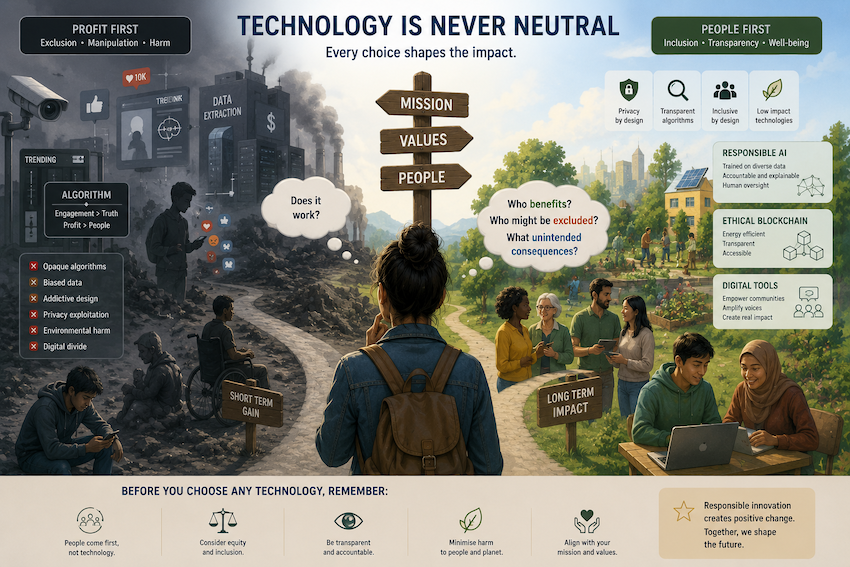
Many people describe technology as neutral, arguing that only the way people use it determines whether it creates positive or negative outcomes. In reality, every technology reflects the choices, priorities, and assumptions of the people who designed it.
Algorithms decide which information is visible. Social media platforms influence which voices receive attention. Artificial intelligence depends on the data it has been trained on. Blockchain networks are built with different technical choices that affect energy consumption, transparency, and accessibility.
As a social entrepreneur, your responsibility is therefore not only to choose digital tools because they are innovative, but because they are aligned with your mission and values.
The most responsible organisations ask not only "Does this technology work?" but also "Who benefits? Who might be excluded? What unintended consequences could appear?"
-
Students mustMark as done
Human judgement must remain at the centre
Artificial intelligence can analyse thousands of documents in seconds, generate reports, translate content, or help draft funding proposals. These capabilities can save time and improve efficiency. However, AI should support human decision-making—not replace it. Decisions affecting people's lives require empathy, context, and ethical judgement that technology cannot fully reproduce. Whether selecting participants for a programme, interpreting someone's personal story, or responding to a safeguarding concern, humans remain responsible for the final decision. AI is a powerful assistant, but it should never become the decision-maker. Good practice: Use AI to support your work, then apply human judgement before acting.
Bias is not always obvious
Imagine an AI tool helping you select applicants for a training programme. If the system has mainly learned from applications written by highly educated people, it may unintentionally score applicants with lower literacy skills less favourably—even if they would benefit the most from the programme. Similarly, translation tools may misunderstand cultural expressions, while image-generation systems may reproduce stereotypes about age, gender, disability, or ethnicity. Responsible organisations never assume AI outputs are objective. They verify results, include human oversight, and regularly question whether technology is serving everyone fairly.
Common mistakes:
• Assuming AI is objective.
• Trusting AI without verification.
• Forgetting cultural diversity.
-
Students mustMark as done
Artificial intelligence — specific risks for social enterprises
AI tools are increasingly accessible and genuinely useful. But social entrepreneurs need to understand the specific ways in which AI can fail the communities they serve.
Here are the key risks of AI in social entreprise contexts:
Bias and discrimination: AI systems learn from data — and if that data reflects historical inequalities, the AI will replicate and amplify them. A job-matching tool trained mostly on data from one demographic may systematically disadvantage others. A language model trained on English-dominant internet content may perform poorly in other languages or cultural contexts. Before using any AI tool with or for your community, investigate what data it was trained on and what groups it might underserve.
Lack of transparency: many AI systems are 'black boxes' — they produce outputs without explaining why. If an AI tool influences a decision that affects a community member (who gets referred for a service, whose story gets amplified), you need to be able to explain that decision. 'The algorithm decided' is not an acceptable answer when real people are affected.
False authority: AI tools can generate confident-sounding text, images, or analysis that is factually wrong. Always verify AI outputs — especially when they concern communities, health, legal information, or financial matters.
Overreliance: the most important inputs in social entrepreneurship are human: real conversations with community members, genuine relationships, embodied understanding of lived experience. AI can support this work. It cannot replace it.
-
-
Students mustMark as done
Blockchain and NFTs — environmental and ethical responsibilities
Blockchain technology — the system underlying NFTs — is not neutral in its environmental impact. Some blockchain networks require enormous amounts of energy to operate. Others use far less. The choice of platform matters.
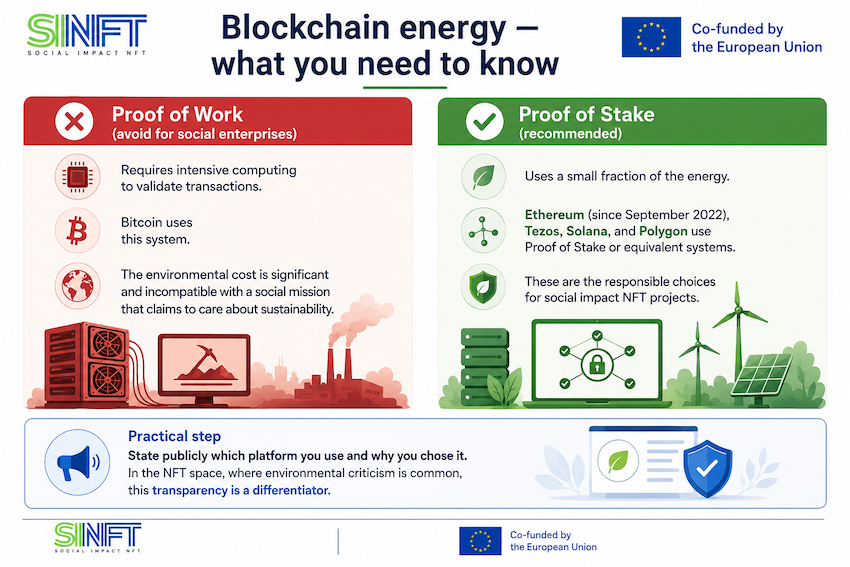
Beyond energy, responsible use of NFTs and blockchain in social entrepreneurship requires:
• Honesty about financial risk: never suggest that buying an NFT is a financial investment. Social impact NFTs are acts of solidarity, not speculation. Vulnerable communities especially should not be encouraged to spend money on digital assets they don't understand.
• Dignity in representation: campaigns that use imagery of poverty, suffering, or vulnerability to generate emotional responses and drive sales — sometimes called 'poverty porn' — cause real harm, even when the cause is genuine. Centre community members as agents and creators, not subjects.
• Transparency in fund allocation: publish exactly what percentage of sales reaches the cause, and report back to buyers on how the funds were used. This is both an ethical requirement and a trust-building practice that distinguishes credible campaigns from exploitative ones.
-
Students mustMark as done
Building an ethical culture in your team
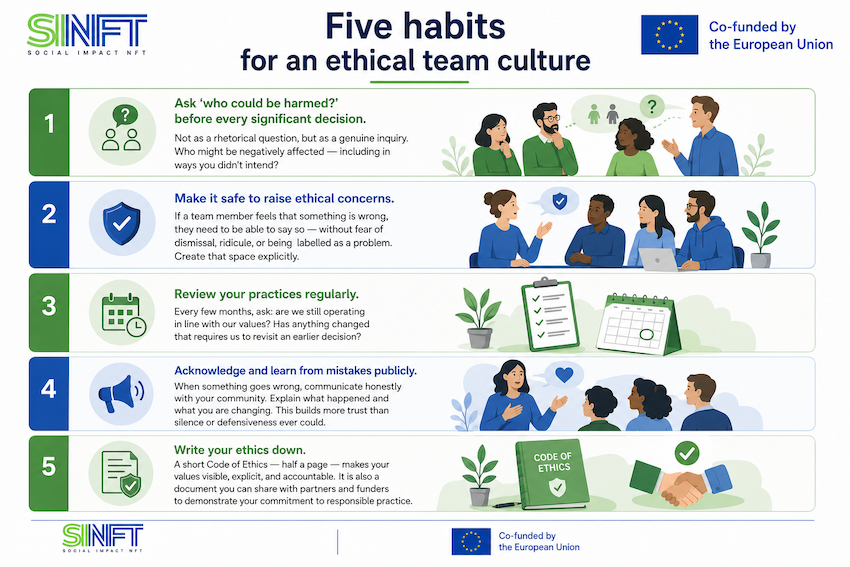
Individual awareness is not enough. Ethics in a social enterprise needs to be a shared practice — built into how the team makes decisions, how it responds to problems, and how it learns over time.
-
Students mustMark as done
Conclusion – Responsible technology serves people—not the other way around
Technology continues to evolve at extraordinary speed. Artificial intelligence becomes more powerful, blockchain applications continue to expand, and new digital platforms appear every year. For social entrepreneurs, these developments create exciting opportunities to increase impact, reach new audiences, and develop innovative solutions to complex social challenges.
However, technology should never become the centre of a social enterprise. People remain the reason social enterprises exist. Digital tools are valuable only when they strengthen human relationships, increase inclusion, improve transparency, and help communities achieve their own goals.
Responsible innovation therefore requires balance. Be curious enough to explore new technologies, but thoughtful enough to question them. Embrace innovation while remaining critical. Experiment with new tools without abandoning the values that define your organisation.
The organisations that will create the greatest long-term impact will not necessarily be those using the newest technology. They will be those using technology most responsibly—with honesty, transparency, accountability, and respect for every individual they serve.
Whenever your team adopts a new digital tool, ask one final question: “Will this technology genuinely improve people's lives—or is it simply impressive?”

-
-

Shape the Future.
Mint the Change.