
Lesson 2 - Intellectual Property and Digital Rights
Legal & Ethical Foundations
Section outline
-
What you'll learn: What intellectual property is, how it applies to your social enterprise's creative work, and what specific questions it raises for digital content and NFTs.
Why intellectual property matters for social entrepreneurs
Every time your social enterprise creates something original — a workshop curriculum, a campaign video, a logo, a training manual, a piece of digital artwork, a website — it creates intellectual property. Understanding the basics of IP law protects you in two directions: it prevents others from using your work without permission, and it prevents you from accidentally infringing someone else's rights.
In the social sector, IP questions are often underestimated. Teams use images found online without checking the licence, publish content created by volunteers without clarifying who owns it, or collaborate with external creators without agreeing in advance on how the work will be used. These oversights create legal vulnerabilities and — more importantly — can damage the trust and relationships on which your project depends.
-
Students mustMark as done
Intellectual property is about respecting creativity
Intellectual property is often seen as a legal issue, but it is also an ethical one. Every photograph, illustration, video, story, piece of music, or educational resource represents someone's time, creativity, and expertise.
Respecting intellectual property means recognising that creators deserve credit and that their work should only be used according to the permissions they have given. In the social sector, where collaboration and knowledge sharing are common, respecting creators helps build trust between organisations, volunteers, artists, and communities.
Good social entrepreneurs do not simply ask whether they can use a piece of content—they ask whether they should, whether permission has been granted, and whether the creator is properly acknowledged.

Key takeaway: Respecting intellectual property means respecting the people behind the ideas.
-
Students mustMark as done
The main types of intellectual property
Copyright
Copyright protects original creative works: texts, images, music, videos, software code, workshop designs, visual art. In most countries, copyright is automatic — it exists from the moment of creation, without registration. The creator holds the copyright unless they explicitly transfer it to someone else.
Important implications for social enterprises: every piece of content you publish — on your website, in your communications, in your funding applications — is subject to copyright. Content created by your staff belongs to the organisation (if created as part of their employment). Content created by volunteers or community members belongs to those individuals unless you have a written agreement otherwise.
Moral rights
In many European countries, creators have moral rights that exist separately from copyright. These include the right to be identified as the author of their work (the right of attribution) and the right to object to modifications they consider harmful to their reputation or the integrity of the work.
Moral rights are especially relevant in community co-creation contexts. If a community member contributes their story, artwork, or testimony to your project, they have the right to be credited — and to object if you use their contribution in a way they find disrespectful.
Trademarks
A trademark protects a name, logo, or slogan that identifies your organisation or project in the market. Unlike copyright, trademark protection must be registered to be legally enforceable. If you are building a project with a strong brand identity that you want to protect, registering your trademark is worth considering — especially before any public launch.
Open licences — Creative Commons
Creative Commons licences allow creators to share their work with the public on specific terms — making some uses free while restricting others. They are widely used in the social innovation and non-profit sectors because they enable knowledge sharing while allowing creators to retain some control.
-
Students mustMark as done
Creative Commons licence types:
Choosing the right licence for your own work
When your organisation creates original resources, you also need to decide how others may use them. Ask yourself:
- Do you want anyone to reuse your work?
- Do you want adaptations to remain open?
- Do you want to prevent commercial use?
- Do you want to maximise dissemination?
There is no universally "best" licence. The right choice depends on your mission. For example:
- educational resources often use CC BY;
- collaborative toolkits may benefit from CC BY-SA;
- resources that generate income may require CC BY-NC.
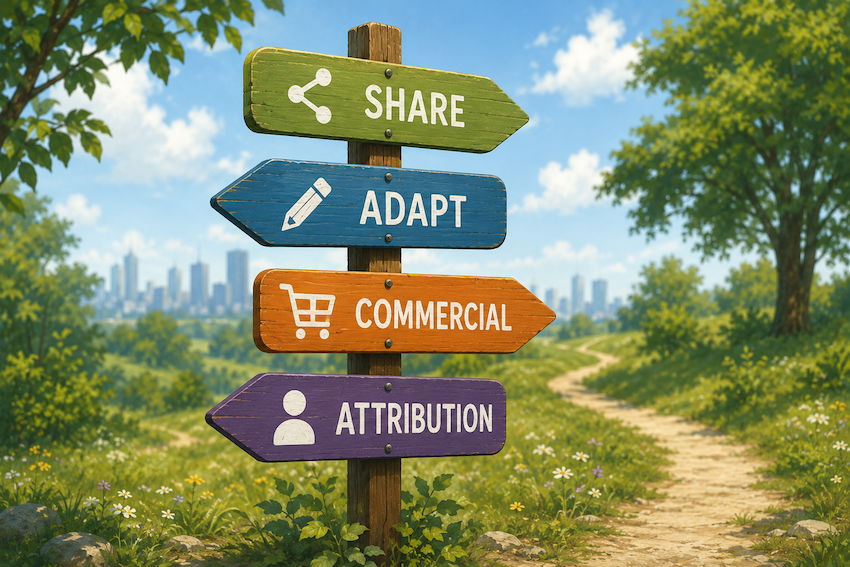
Choosing a licence is part of your communication strategy—not only a legal decision.
• CC BY: anyone can use, share, and adapt the work for any purpose, as long as they credit the creator.
• CC BY-SA: same as CC BY, but any adapted work must be shared under the same licence.
• CC BY-NC: use with credit, for non-commercial purposes only.
• CC BY-ND: use with credit, but no modifications allowed.
• CC0: the creator waives all rights — the work is in the public domain.
If your social enterprise's impact depends on knowledge being shared widely, CC BY or CC BY-SA maximises your reach. If your project generates income from its content, CC BY-NC protects you from commercial copying without your consent.
-
Students mustMark as done
The critical distinction: owning an NFT ≠ owning the copyright
When someone buys an NFT, they receive a token — a unique digital certificate of ownership recorded on the blockchain. They do not automatically receive the copyright to the artwork or content.
Copyright remains with the creator unless you explicitly transfer it or grant a licence. This means you need to decide — before minting — exactly what rights buyers receive, and state this clearly in your NFT description:
• Display rights only: buyers can display the NFT privately and share it on social media. No commercial use.
• Limited licence: buyers can use the image for non-commercial promotion of the cause.
• Full transfer: buyers own the copyright. Rare and not recommended in community co-creation contexts.
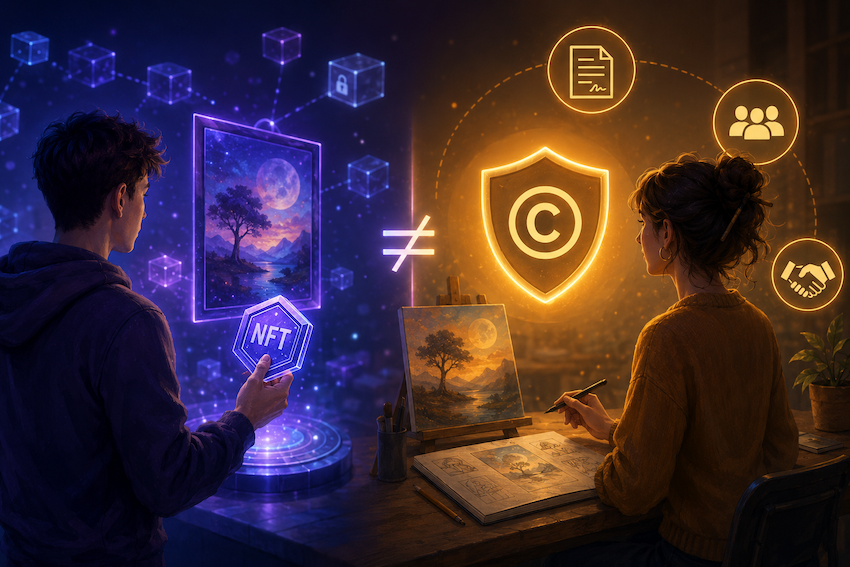
If multiple people contributed to creating an NFT — a community member who told the story, an artist who created the visual — you must clarify IP ownership in writing before minting. Ambiguity about rights is one of the most common sources of conflict in NFT projects.
-
Students mustMark as done
Intellectual property builds trust
Protecting intellectual property is not about limiting creativity—it is about creating an environment where creativity can flourish.
When organisations respect authorship, give proper credit, clarify ownership, and communicate openly about how creative work will be used, they build stronger relationships with artists, volunteers, partners, and communities.
Good intellectual property management also strengthens your organisation. It reduces misunderstandings, protects your brand, and makes collaboration easier because everyone understands their rights and responsibilities from the beginning.
As digital technologies continue to evolve, intellectual property will become increasingly important. Whether you publish educational resources, develop digital campaigns, or create NFT collections, responsible management of intellectual property helps ensure that innovation remains fair, transparent, and respectful.

Key takeaway: Intellectual property is not only about protecting ideas—it is about recognising creativity, respecting contributors, and building lasting trust.
-

Shape the Future.
Mint the Change.