
Lesson 4 - Ethics and Responsibility in the Digital Era (AI, Web3, and Social Impact)
Legal & Ethical Foundations
Section outline
-
What you'll learn: How to make responsible choices about the digital tools you use in your social enterprise — including AI and blockchain — and how to build an ethical culture in your team.
Digital tools — opportunity and responsibility
Digital technologies have transformed what is possible for social enterprises. AI tools can help you write content, analyse data, and reach audiences you couldn't before. Blockchain and NFTs offer new ways to raise funds, engage supporters, and create transparent records of social impact. Social media amplifies stories that would never have reached beyond a local community.
But each of these tools also carries risks — risks of harm, of exclusion, of misinformation, of environmental damage, and of manipulation. Being a responsible digital social entrepreneur means thinking about those risks before you encounter them, not after.
Artificial intelligence — specific risks for social enterprises
AI tools are increasingly accessible and genuinely useful. But social entrepreneurs need to understand the specific ways in which AI can fail the communities they serve.
-
Students mustMark as done
Technology is never neutral
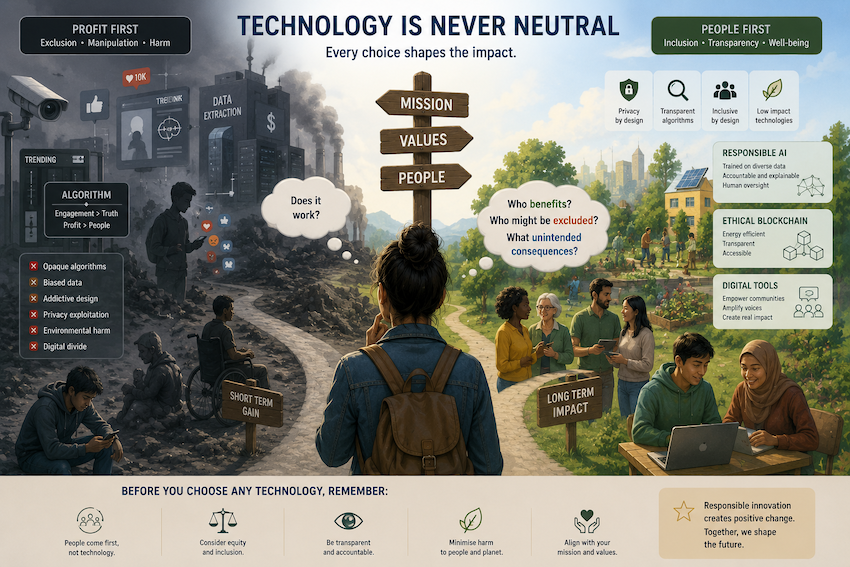
Many people describe technology as neutral, arguing that only the way people use it determines whether it creates positive or negative outcomes. In reality, every technology reflects the choices, priorities, and assumptions of the people who designed it.
Algorithms decide which information is visible. Social media platforms influence which voices receive attention. Artificial intelligence depends on the data it has been trained on. Blockchain networks are built with different technical choices that affect energy consumption, transparency, and accessibility.
As a social entrepreneur, your responsibility is therefore not only to choose digital tools because they are innovative, but because they are aligned with your mission and values.
The most responsible organisations ask not only "Does this technology work?" but also "Who benefits? Who might be excluded? What unintended consequences could appear?"
-
Students mustMark as done
Human judgement must remain at the centre
Artificial intelligence can analyse thousands of documents in seconds, generate reports, translate content, or help draft funding proposals. These capabilities can save time and improve efficiency. However, AI should support human decision-making—not replace it. Decisions affecting people's lives require empathy, context, and ethical judgement that technology cannot fully reproduce. Whether selecting participants for a programme, interpreting someone's personal story, or responding to a safeguarding concern, humans remain responsible for the final decision. AI is a powerful assistant, but it should never become the decision-maker. Good practice: Use AI to support your work, then apply human judgement before acting.
Bias is not always obvious
Imagine an AI tool helping you select applicants for a training programme. If the system has mainly learned from applications written by highly educated people, it may unintentionally score applicants with lower literacy skills less favourably—even if they would benefit the most from the programme. Similarly, translation tools may misunderstand cultural expressions, while image-generation systems may reproduce stereotypes about age, gender, disability, or ethnicity. Responsible organisations never assume AI outputs are objective. They verify results, include human oversight, and regularly question whether technology is serving everyone fairly.
Common mistakes:
• Assuming AI is objective.
• Trusting AI without verification.
• Forgetting cultural diversity.
-
Students mustMark as done
Artificial intelligence — specific risks for social enterprises
AI tools are increasingly accessible and genuinely useful. But social entrepreneurs need to understand the specific ways in which AI can fail the communities they serve.
Here are the key risks of AI in social entreprise contexts:
Bias and discrimination: AI systems learn from data — and if that data reflects historical inequalities, the AI will replicate and amplify them. A job-matching tool trained mostly on data from one demographic may systematically disadvantage others. A language model trained on English-dominant internet content may perform poorly in other languages or cultural contexts. Before using any AI tool with or for your community, investigate what data it was trained on and what groups it might underserve.
Lack of transparency: many AI systems are 'black boxes' — they produce outputs without explaining why. If an AI tool influences a decision that affects a community member (who gets referred for a service, whose story gets amplified), you need to be able to explain that decision. 'The algorithm decided' is not an acceptable answer when real people are affected.
False authority: AI tools can generate confident-sounding text, images, or analysis that is factually wrong. Always verify AI outputs — especially when they concern communities, health, legal information, or financial matters.
Overreliance: the most important inputs in social entrepreneurship are human: real conversations with community members, genuine relationships, embodied understanding of lived experience. AI can support this work. It cannot replace it.
-
-
Students mustMark as done
Blockchain and NFTs — environmental and ethical responsibilities
Blockchain technology — the system underlying NFTs — is not neutral in its environmental impact. Some blockchain networks require enormous amounts of energy to operate. Others use far less. The choice of platform matters.
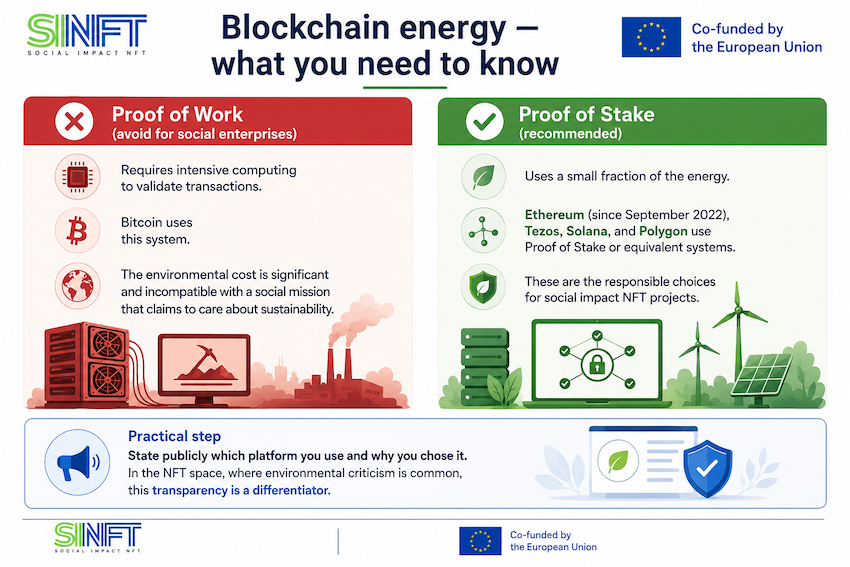
Beyond energy, responsible use of NFTs and blockchain in social entrepreneurship requires:
• Honesty about financial risk: never suggest that buying an NFT is a financial investment. Social impact NFTs are acts of solidarity, not speculation. Vulnerable communities especially should not be encouraged to spend money on digital assets they don't understand.
• Dignity in representation: campaigns that use imagery of poverty, suffering, or vulnerability to generate emotional responses and drive sales — sometimes called 'poverty porn' — cause real harm, even when the cause is genuine. Centre community members as agents and creators, not subjects.
• Transparency in fund allocation: publish exactly what percentage of sales reaches the cause, and report back to buyers on how the funds were used. This is both an ethical requirement and a trust-building practice that distinguishes credible campaigns from exploitative ones.
-
Students mustMark as done
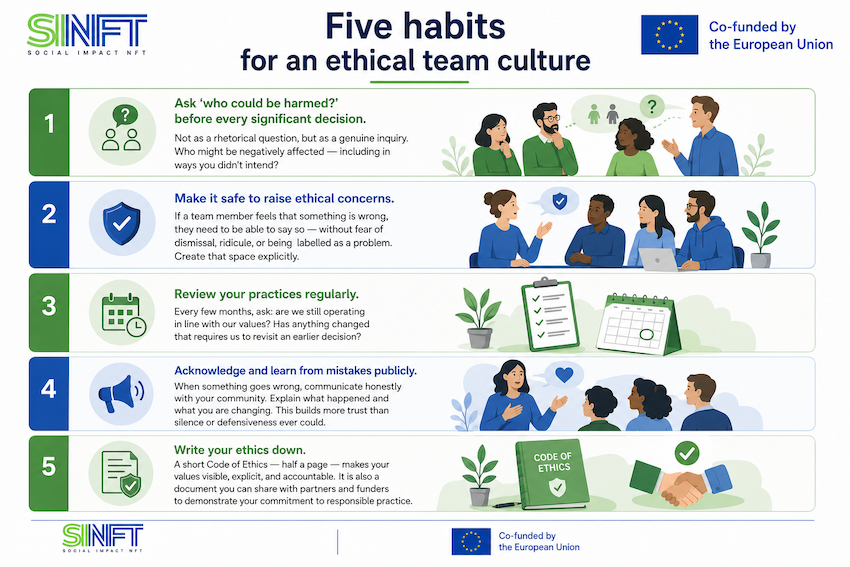
Building an ethical culture in your team
Individual awareness is not enough. Ethics in a social enterprise needs to be a shared practice — built into how the team makes decisions, how it responds to problems, and how it learns over time.
-
Students mustMark as done
Conclusion – Responsible technology serves people—not the other way around
Technology continues to evolve at extraordinary speed. Artificial intelligence becomes more powerful, blockchain applications continue to expand, and new digital platforms appear every year. For social entrepreneurs, these developments create exciting opportunities to increase impact, reach new audiences, and develop innovative solutions to complex social challenges.
However, technology should never become the centre of a social enterprise. People remain the reason social enterprises exist. Digital tools are valuable only when they strengthen human relationships, increase inclusion, improve transparency, and help communities achieve their own goals.
Responsible innovation therefore requires balance. Be curious enough to explore new technologies, but thoughtful enough to question them. Embrace innovation while remaining critical. Experiment with new tools without abandoning the values that define your organisation.
The organisations that will create the greatest long-term impact will not necessarily be those using the newest technology. They will be those using technology most responsibly—with honesty, transparency, accountability, and respect for every individual they serve.
Whenever your team adopts a new digital tool, ask one final question: “Will this technology genuinely improve people's lives—or is it simply impressive?”

-

Shape the Future.
Mint the Change.