
Lesson 1 - Introduction to Legal and Ethical Principles in Social Innovation
Legal & Ethical Foundations
Section outline
-
-
Students mustMark as done
Ethics is not about avoiding mistakes
Many people believe that ethics means following rules or avoiding legal problems. In reality, ethical decision-making is much broader.
Social entrepreneurs constantly face situations where there is no perfect answer. Resources are limited, different groups may have conflicting needs, and every decision creates both opportunities and consequences.
Being ethical means asking good questions before acting:
- Who benefits from this decision?
- Could anyone be unintentionally excluded?
- Have the people concerned had the opportunity to express their views?
- Would I be comfortable explaining this decision publicly?
Ethics is therefore not a checklist. It is a way of thinking that guides every stage of a social innovation project—from identifying a problem to evaluating its impact.

Key message: Good social entrepreneurs don't just ask "Can we do this?" They also ask "Should we do this?"
-
Students mustMark as done
Ethics begins with the people you serve
Every social innovation starts with people. This means respecting not only their needs, but also their dignity, privacy, culture, and ability to make their own decisions. Communities should never be treated as "beneficiaries" who simply receive help. Instead, they should be recognised as partners who contribute knowledge, experience, and ideas. When people participate in shaping solutions, projects become more relevant, more inclusive, and more sustainable.
Ask yourself:
- Have we listened before designing?
- Have we included different voices?
- Are people represented fairly?
-
Students mustMark as done
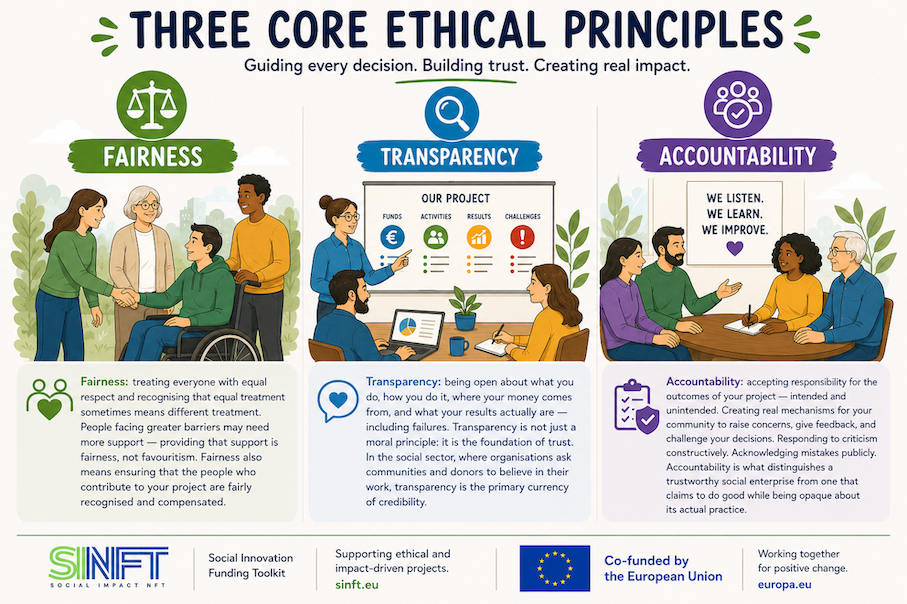
Three core ethical principles
Across all the frameworks you'll encounter — European legal instruments, social innovation codes of practice, funding ethics requirements — three principles appear consistently. Understanding them deeply will help you navigate almost any ethical question you face.
-
Students mustMark as done
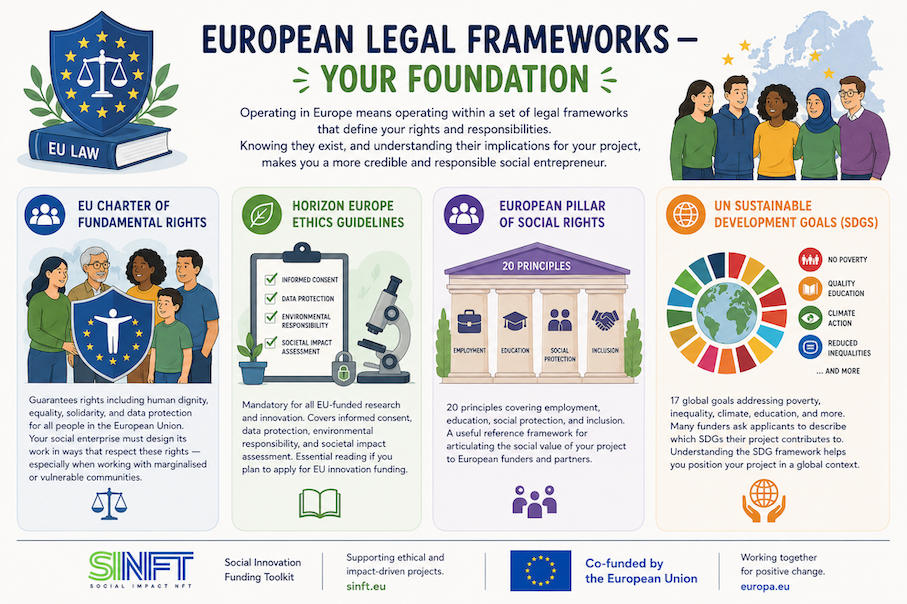
European legal frameworks — your foundation
Operating in Europe means operating within a set of legal frameworks that define your rights and responsibilities. You don't need to memorise them — but knowing they exist, and understanding their implications for your project, makes you a more credible and responsible social entrepreneur.
-
Students mustMark as done
💡 NFT connection
If your social enterprise uses an NFT campaign, the legal and ethical framework applies in specific ways.
You are selling digital assets to the public — which means transparency about fund allocation is not just ethical, it may be legally required under consumer protection law.
You are representing a community — which means the fairness and dignity principles apply to how community members are depicted and compensated.
And you are using blockchain technology — which raises specific questions about data permanence and environmental responsibility that we'll explore in Lessons 3 and 4.
-
Students mustMark as done
Ethics is a continuous commitment
Legal frameworks provide important guidance, but they cannot anticipate every situation you will encounter as a social entrepreneur. Every project is unique, every community is different, and every decision involves people with different experiences, expectations, and needs. This is why ethical practice is not something you complete once—it is a continuous commitment throughout the life of your project.
As your social enterprise grows, you will face new opportunities and new challenges. You may welcome new partners, manage larger budgets, collect more data, or work with increasingly diverse communities. Each new step brings new responsibilities. Remaining ethical means regularly reflecting on your decisions, questioning your assumptions, and being willing to adapt when you discover a better or fairer way of working.
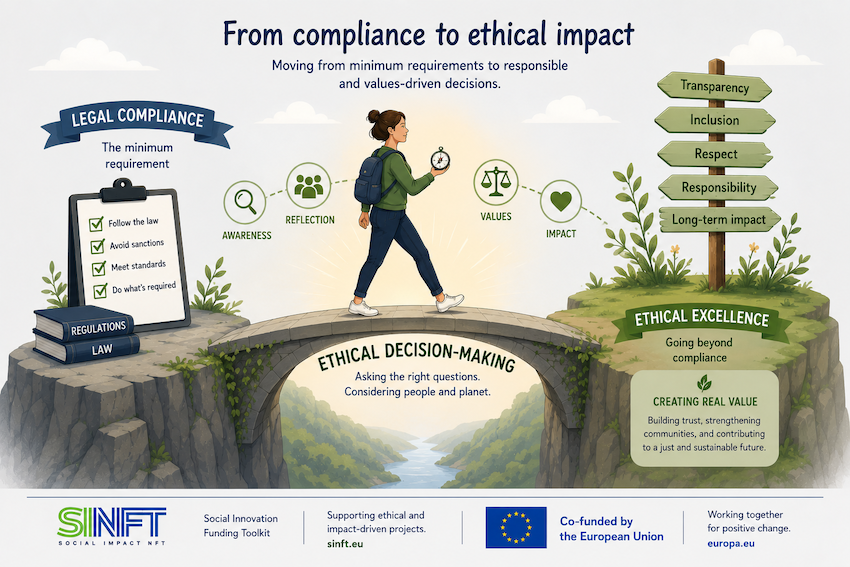
Ethical organisations also understand that mistakes can happen. No project is perfect, and unintended consequences are sometimes unavoidable. What matters is how you respond. Listening to feedback, acknowledging mistakes openly, correcting problems quickly, and learning from experience are signs of responsible leadership. Communities and partners are far more likely to trust organisations that are honest about their challenges than those that pretend to have all the answers.
Finally, remember that ethics is not only about avoiding harm. It is about actively creating positive relationships built on fairness, transparency, accountability, and respect. These values strengthen trust with beneficiaries, volunteers, partners, funders, and the wider community. Over time, this trust becomes one of the most valuable assets your social enterprise can have.
Whenever you face a difficult decision, return to three simple questions:
- Is this fair?
- Am I being transparent?
- Am I willing to be accountable for the consequences of this decision?
If you can confidently answer "yes" to these questions, you are building not only a legally compliant organisation, but also one that people will trust, support, and want to work with.
Key takeaway: Ethics is not an additional task or a legal obligation to complete. It is a way of thinking and acting that should guide every decision, every partnership, and every innovation throughout the life of your social enterprise.
-

Shape the Future.
Mint the Change.