
📦MODULE 2: AI for Common Good
Digital Literacy & Online Safety
Section outline
-
-
What is Artificial Intelligence? Do you know the concept of Large Language Models (LLMs)?
-
-
Welcome to “Meet the AI” – Introduction to Large Language Models (LLMs)
Hello and welcome! This beginner-friendly lesson will gently introduce you to one of the most exciting technologies of our time: Large Language Models (LLMs) like ChatGPT, Gemini, Grok, and Claude.
Imagine an AI that has read millions of books, articles, and conversations — learning the patterns of human language so it can chat with you, answer questions, write stories, brainstorm ideas, translate languages, and help you create meaningful content. In this lesson, you will discover how LLMs actually work (at a simple, high-level view), explore their real-world applications in education, creativity, and social impact, and understand both their impressive strengths and important limitations.
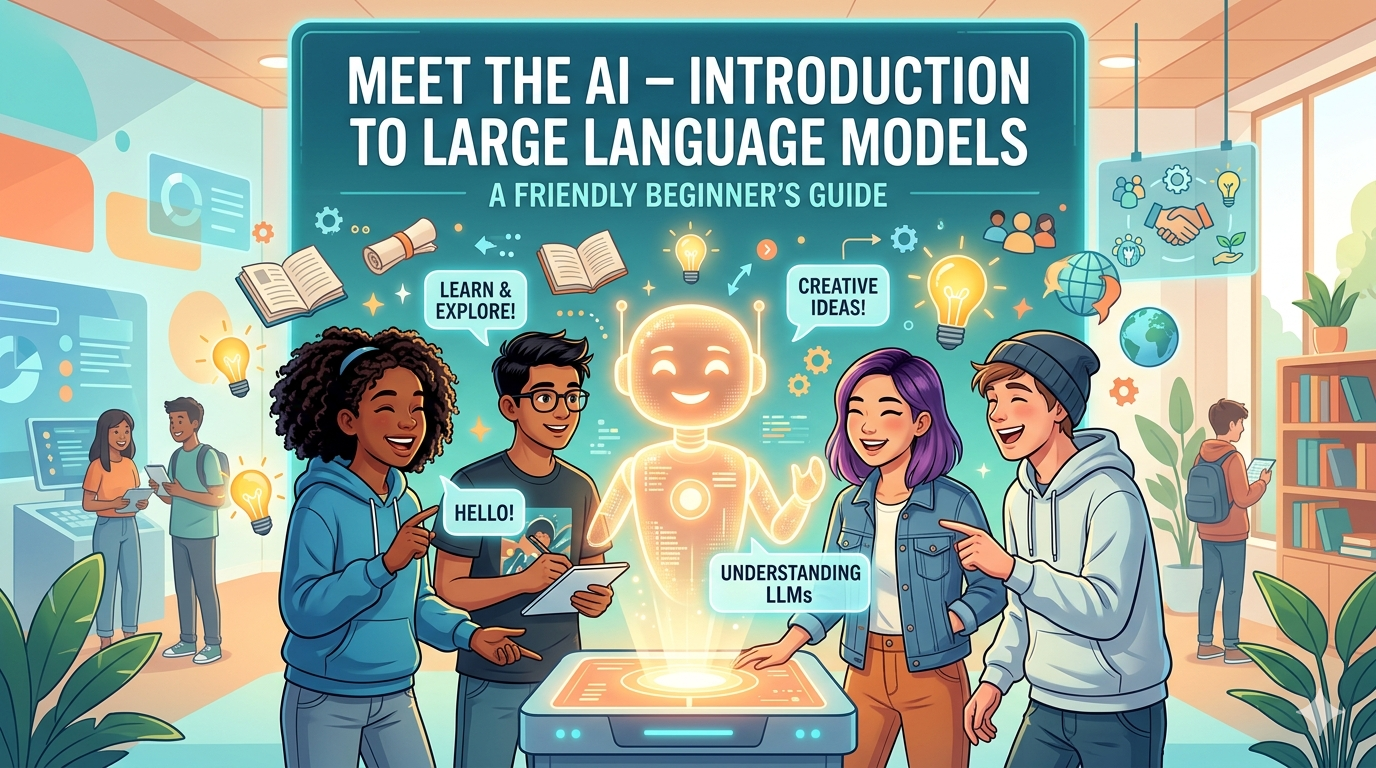
Most importantly, you will learn how to use these powerful tools responsibly and ethically — turning AI into a helpful creative partner for your projects, campaigns, and ideas that create positive change in your community.
By the end of this lesson, you will feel confident using LLMs for communication, planning, storytelling, and social good, while keeping critical thinking and human values at the center.
Activities: 9
-
-
-
Large Language Models (LLMs) like ChatGPT, Gemini, and Copilot are powerful reasoning and creative engines. For youth workers, NGOs, and social entrepreneurs, these tools can supercharge the ability to create impactful campaigns, stories, and educational materials.
Artificial Intelligence is transforming the way ideas are generated, content is created, and messages are communicated. Tasks that once required hours of brainstorming, drafting, and design can now be supported by AI tools capable of generating text, suggesting creative concepts, and assisting with visual production. However, the true value of these tools lies not in replacing human creativity, but in enhancing it.
For organizations working toward social impact, AI can serve as a creative partner throughout the content creation process. It can help generate campaign ideas, identify compelling narratives, develop educational materials, draft communication strategies, and support the creation of visual content that engages diverse audiences.
At the same time, effective use of AI requires more than simply entering prompts and accepting the first result. Meaningful content emerges when human expertise, values, and critical thinking guide the creative process. AI may generate possibilities, but people remain responsible for selecting, refining, and adapting those ideas to real-world contexts and community needs.
In this lesson, you will explore how AI can support brainstorming and creative development, learn how to transform prompts into narratives and campaign content, and discover ways to integrate AI-assisted visuals into communication materials. Through practical examples and activities, you will develop skills for using AI as a collaborative tool in projects that aim to create positive social impact.
Activities: 6
-
-
-
While it is impressive that Artificial Intelligence can generate text, images, and other creative outputs, its value extends far beyond content creation. AI can also serve as a powerful tool for strategic thinking, helping individuals and organizations analyze challenges, explore alternatives, and make more informed decisions.
For youth workers, nonprofit organizations, social entrepreneurs, and community leaders, many everyday tasks involve planning initiatives, evaluating opportunities, managing uncertainty, and solving complex problems. These activities require critical thinking, creativity, and the ability to consider multiple perspectives. AI tools can support these processes by organizing information, generating analytical frameworks, identifying potential risks, and helping users explore different scenarios.
However, AI does not replace human judgment. Strategic decisions often involve values, local knowledge, stakeholder interests, and contextual factors that AI cannot fully understand. Instead, AI should be viewed as a thinking ally — one that can challenge assumptions, suggest alternative viewpoints, and help structure decision-making processes.
In this lesson, you will learn how AI can support critical thinking through tools such as SWOT analysis, counterargument generation, and scenario planning. You will also explore how AI can be used to simulate strategic situations and support planning activities through mind mapping, idea clustering, and automated summarization.
Activities: 7
-

Shape the Future.
Mint the Change.