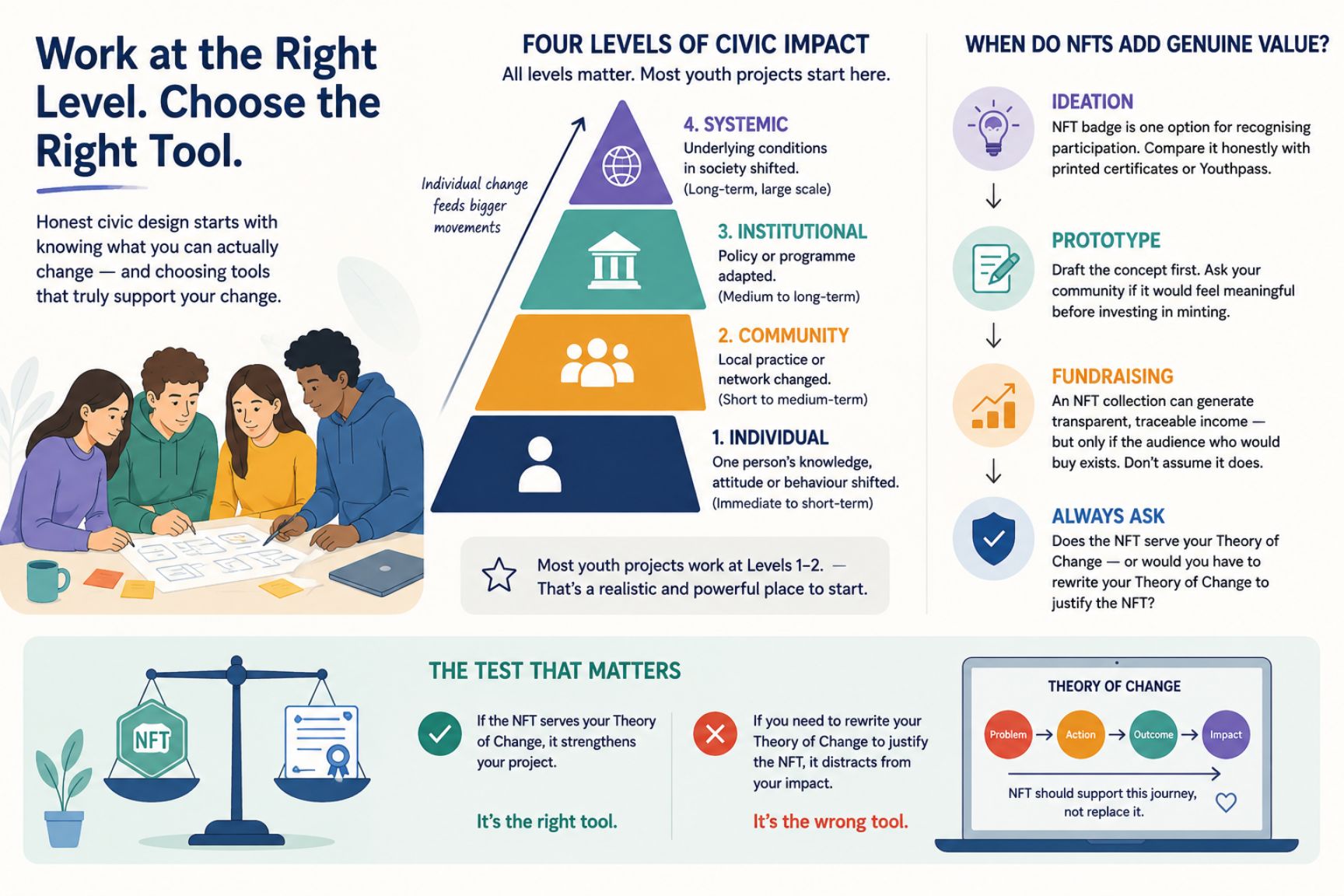
One of the most important skills in civic design is being honest about what you can actually change. Young people often enter projects with enormous ambitions and leave feeling they failed — not because they did nothing, but because they measured themselves against a scale they could never have reached alone.
Civic impact operates at four levels, and all of them matter: individual (one person's knowledge or behaviour shifted), community (a local practice or network changed), institutional (a policy or programme adapted), and systemic (the underlying conditions shifted). Most youth projects work at the first two levels. That is not a failure — it is a realistic starting point, and individual-level change is often what eventually feeds larger movements.
Knowing which level you are working at makes your project more credible, more honest to evaluate, and easier to connect to the broader change it belongs to.
At this point in the course you already understand what NFTs are and what they can do — so the question here is more precise: when in the civic design process do they add genuine value? At the ideation stage, an NFT badge is one option among several for recognising participation — compare it honestly against a printed certificate or a Youthpass credential before committing. At the prototype stage, draft the concept first and ask your community whether it would feel meaningful before investing in minting. For fundraising, an NFT collection can generate transparent, traceable income — but only if the audience who would buy exists. Do not assume it does.
The test that matters: does the NFT serve your Theory of Change, or would you have to rewrite your Theory of Change to justify the NFT? If it is the second, it is the wrong tool for this project.