Citizenship Education Framework
1.2 – International perspectives on Citizenship Education
Citizenship is often associated with belonging to a particular country: having rights, respecting laws, voting, or participating in public life. But many of the challenges young people face today do not stop at national borders.
Climate change, migration, inequality, discrimination, conflicts and digital misinformation affect communities across countries. At the same time, a young person can study in one country, collaborate online with peers from several others, follow global movements and participate in digital communities that have no geographical borders.
This changes the way we think about citizenship education.
It is no longer enough to ask:
“How can I participate in my community?”
We also need to ask:
“How are my choices connected to people and communities beyond my own?”
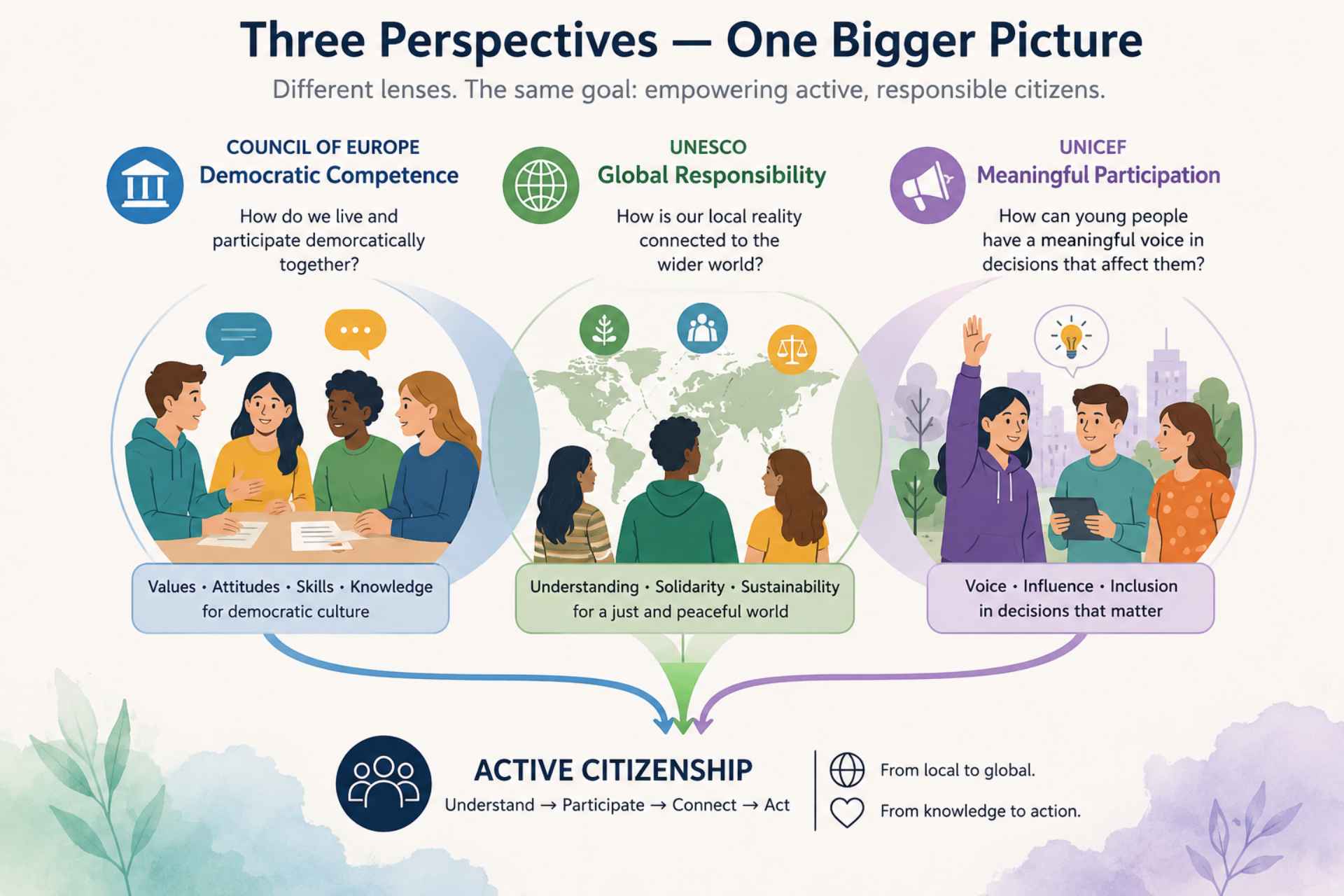
Several international organisations have developed frameworks that help answer these questions. They approach citizenship education from different perspectives, but they share one important idea:
Citizenship is something we learn through understanding, participation and practice.
Council of Europe – Reference Framework of Competences for Democratic Culture (RFCDC)
Imagine a youth group discussing a controversial issue. Participants have very different political, cultural and social perspectives.
Knowing that everyone has freedom of expression is important. But what happens when people strongly disagree?
Can they listen to each other?
Can they question information critically?
Can they express disagreement without attacking another person?
Can they cooperate despite their differences?
This is where democratic competences become important.
The Council of Europe developed the Reference Framework of Competences for Democratic Culture (RFCDC) to describe the competences people need to participate effectively in democratic and culturally diverse societies.
The framework brings together 20 competences across four areas:
❤️ Values
Human dignity, human rights, democracy, justice, fairness and the rule of law.
🌍 Attitudes
Openness to cultural otherness, respect, civic-mindedness, responsibility and self-efficacy.
🛠 Skills
Autonomous learning, analytical and critical thinking, communication, cooperation and conflict resolution.
🧠 Knowledge & Critical Understanding
Understanding ourselves, language and communication, politics, law, human rights, cultures, history and the wider world.
The important point is that democracy requires more than knowing democratic principles.
You learn democracy by practising democracy.
A youth council where young people negotiate priorities, a classroom debate where disagreement is handled respectfully, or an international youth project where participants make decisions together can all become spaces for developing democratic competences.
Key idea:
Council of Europe → How do we participate democratically with others?
Explore the Council of Europe RFCDC
UNESCO – Global Citizenship Education (GCED)
Now imagine another situation.
A young person decides to organise a campaign about excessive clothing consumption. At first, this might seem like an individual or local issue.
But follow the story of one T-shirt.
The cotton may be grown in one country, the fabric produced in another, the garment manufactured somewhere else, sold across Europe and eventually discarded or exported again.
One everyday decision suddenly connects consumption, working conditions, inequality, climate and communities across several countries.
This is the perspective behind UNESCO's approach to Global Citizenship Education (GCED).
GCED encourages learners to understand that local and global realities are interconnected. It develops the capacity to recognise global challenges, understand different perspectives and act with responsibility and solidarity.
A global citizen therefore does not need to solve every global problem. The starting point is understanding:
My community is connected to other communities. My choices can have consequences beyond the place where I live.
This can mean:
- understanding connections between climate, inequality and peace;
- recognising perspectives different from our own;
- showing solidarity with people we may never personally meet;
- taking informed action on issues that have both local and global dimensions.
Key idea:
UNESCO → How is my local reality connected to the wider world?
Explore UNESCO Global Citizenship and Peace Education
UNICEF – Child and Youth Participation
But understanding democracy and global connections is not enough if young people are only learning about participation without actually having opportunities to participate.
Imagine that a municipality is redesigning a public park used every day by children and young people.
Architects are consulted.
Local authorities are consulted.
Parents are consulted.
But nobody asks young people who actually use the park.
Can we really call the process participatory?
UNICEF emphasises that children and young people should have opportunities to express their views and participate in decisions that affect their lives.
This principle can take practical forms.
Through initiatives such as Child Friendly Cities, young people can contribute to discussions about their neighbourhoods and public spaces. Children's rights approaches emphasise their right to be heard and taken seriously. Youth participation programmes can create opportunities for young people to contribute to community planning, policymaking and social action.
The important shift is from:
Decisions FOR young people to Decisions WITH young people.
Key idea:
UNICEF → How can young people have a meaningful voice in decisions that affect them?
Explore UNICEF Child Friendly Cities Initiative
Shape the Future.
Mint the Change.