
How to develop Advocacy campaigns which can support the social causes
Deep Dive: Launching and Promoting Ethical NFT Advocacy Campaigns
The final phase of any digital advocacy campaign is its execution in the public arena. A project coordinator can design a flawless strategy, balance a technical roadmap, and clear all resource budgets, but if the public launch lacks ethical alignment and radical transparency, the campaign will immediately fail the public trust threshold.
In the Web3 ecosystem, which is historically crowded with financial speculation and overhyped promises, ethical advocacy stands apart by shifting the narrative from speculation to systemic impact. Launching an ethical campaign means ensuring that your communication is non-manipulative, your data is completely verifiable, and your community is engaged as stakeholders rather than passive donors.
Part 1: The Ethical Promotion Framework
To separate your movement from standard commercial marketing, your launch must adhere to three foundational ethical pillars:
1. Radical Clarity of Purpose
-
The Standard: All promotional materials—including landing pages, social media threads, and video assets—must communicate the direct, real-world goal of the campaign without wrapping it in complex technical jargon.
-
The Application: If your digital assets are funding a supreme court legal defense team for a local forest, the text must explicitly state: "100% of primary proceeds are routed to the multi-sig treasury to fund court filing fees and environmental attorneys." Avoid vague promises like "saving the planet" or hinting at future financial returns (utility/token roadmaps) which dilute the campaign's civic integrity.
2. Open Custody of Funds
-
The Standard: Financial transparency cannot be a retrospective report published months after the campaign. It must be live, open, and audit-ready from the exact second the launch button is pressed.
-
The Application: Your public launch page must clearly display the public smart contract addresses, the wallet addresses of your multi-sig signers, and explicit instructions on how any everyday user can track fund movements on public block explorers (like Etherscan or Polygonscan).
3. Responsible Community Engagement
-
The Standard: Ethical promotion rejects manipulative growth tactics, such as high-pressure scarcity marketing, countdown timers that induce panic (FOMO), or paid bot networks to artificially inflate community numbers.
-
The Application: Focus entirely on value-driven, organic community building. Educate your community on the root cause of the structural issue, and treat your digital solidarity badges as tools for collective action and governance, rather than speculative assets.
Part 2: Interactive Launch & Evaluation Protocols
To ensure every project is stress-tested before meeting the public, Lesson 6 mandates three core interactive activities designed to refine your launch readiness:
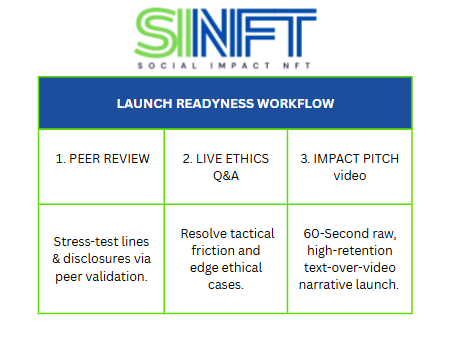
1. The Peer Review Process
Coordinators do not launch in isolation. You will submit your complete campaign plan draft to your peer cohort. Your peers will review your blueprints based on a strict ethical rubric:
-
Is the data backing the campaign easily accessible?
-
Are the multi-sig financial guardrails clearly disclosed?
-
Does the messaging avoid manipulative, high-pressure marketing traps? This process exposes blind spots and operational vulnerabilities before the campaign hits public networks.
2. The Live Q&A Framework
During this interactive session, we dive into the complex gray areas of running decentralized public campaigns. We will address real-world operational questions such as:
-
How do we protect user data and identity when coordinating local activists in high-risk political environments?
-
What is our protocol if a malicious actor tries to "wash trade" or manipulate our solidarity badges to distort community metrics?
3. The Short Campaign Pitch Video
The ultimate hook of your launch is a 60-second, high-retention short-form video pitch. This format requires you to strip away all background noise and deliver a raw, compelling case for your movement. Your video must execute three tight phases:
-
The Hook (0-15s): Visually expose the structural problem with undeniable raw footage or data.
-
The Core Solution (15-45s): Introduce your multi-channel strategy and explain exactly how the digital assets fund the physical legal or operational solution.
-
The Call to Action (45-60s): Direct the viewer to your transparent landing page to secure their digital pass and join the movement.
Part 3: Maintaining Trust in Long-Term Campaigns
A launch is only day one. To maintain trust across multi-month or multi-year legal timelines, an advocacy coordinator must implement a Continuous Update Protocol (CUP):
-
The Milestone Report: Every time a phase on your timeline concludes (e.g., filing the supreme court challenge), a public update must be pushed to your community Discord, email newsletter, and national press lists simultaneously.
-
On-Chain Governance Routing: If your campaign encounters an unexpected obstacle requiring a shift in strategy, do not make the decision behind closed doors. Route the proposal through Snapshot.org, letting your badge holders use their cryptographic voices to collectively steer the campaign's next step. This maintains radical accountability and ensures your civic base remains actively locked in until systemic change is achieved.

Shape the Future.
Mint the Change.