
How to develop Advocacy campaigns which can support the social causes
Deep Dive Reading: Measuring Impact & Navigating Systemic Risk in Web3 Activism
The ultimate test of a digital advocacy project coordinator is not the speed of a campaign’s launch, but the verifiability of its impact and the resilience of its infrastructure. In the high-velocity world of Web3 activism, projects frequently dissolve after the initial token minting or fundraising spike. This occurs because teams often focus on short-term cultural hype rather than establishing a long-term, self-sustaining operational framework.
To transition from a temporary protest to a permanent institutional force, an advocacy campaign must implement a sophisticated Monitoring and Evaluation (M&E) architecture, construct a rigorous risk-mitigation defense system, and plan for organizational evolution via Decentralized Autonomous Organizations (DAOs).
Part 1: The Dual-Layered M&E Framework
To evaluate a campaign's true efficacy, coordinators must measure two completely distinct layers of data: On-Chain Ecosystem Metrics and Off-Chain Policy Impact. Relying on just one layer creates an incomplete picture of your movement's health.
1. On-Chain & Community Growth Metrics (Ecosystem Health)
These data points are tracked using open-source blockchain ledgers and community analytics. They measure the structural strength, retention, and financial velocity of your civic base.
-
Unique Wallet Holders: Measures the true distribution of your community. A high fund balance held by only 5 wallets indicates centralization; a balance distributed across 2,000 unique wallets proves widespread grassroots power.
-
Donor Retention Rate: Tracks how many unique backers participate in secondary resource pools or follow-up milestones over a 60-day period.
-
Voter Participation Rate: Measures community engagement by tracking the percentage of eligible token/badge holders who actively cast votes on governance platforms like Snapshot.org.
2. Off-Chain Policy & Systemic Impact Metrics (Real-World Efficacy)
These metrics measure whether your digital power is successfully converting into structural, physical changes in the institutional arena.
-
Regulatory Responses: Formal acknowledgments, written statements, or investigative freezes issued by target ministries or municipal bodies.
-
Budgetary Reallocations: Verifiable shifts in public funds, environmental grants, or infrastructural spending lines resulting directly from your alternative blueprints.
-
Legislative Milestones: The introduction, amendment, or passing of local decrees and state laws backed by your community’s on-chain data verification.
Part 2: The Campaign Execution Matrix
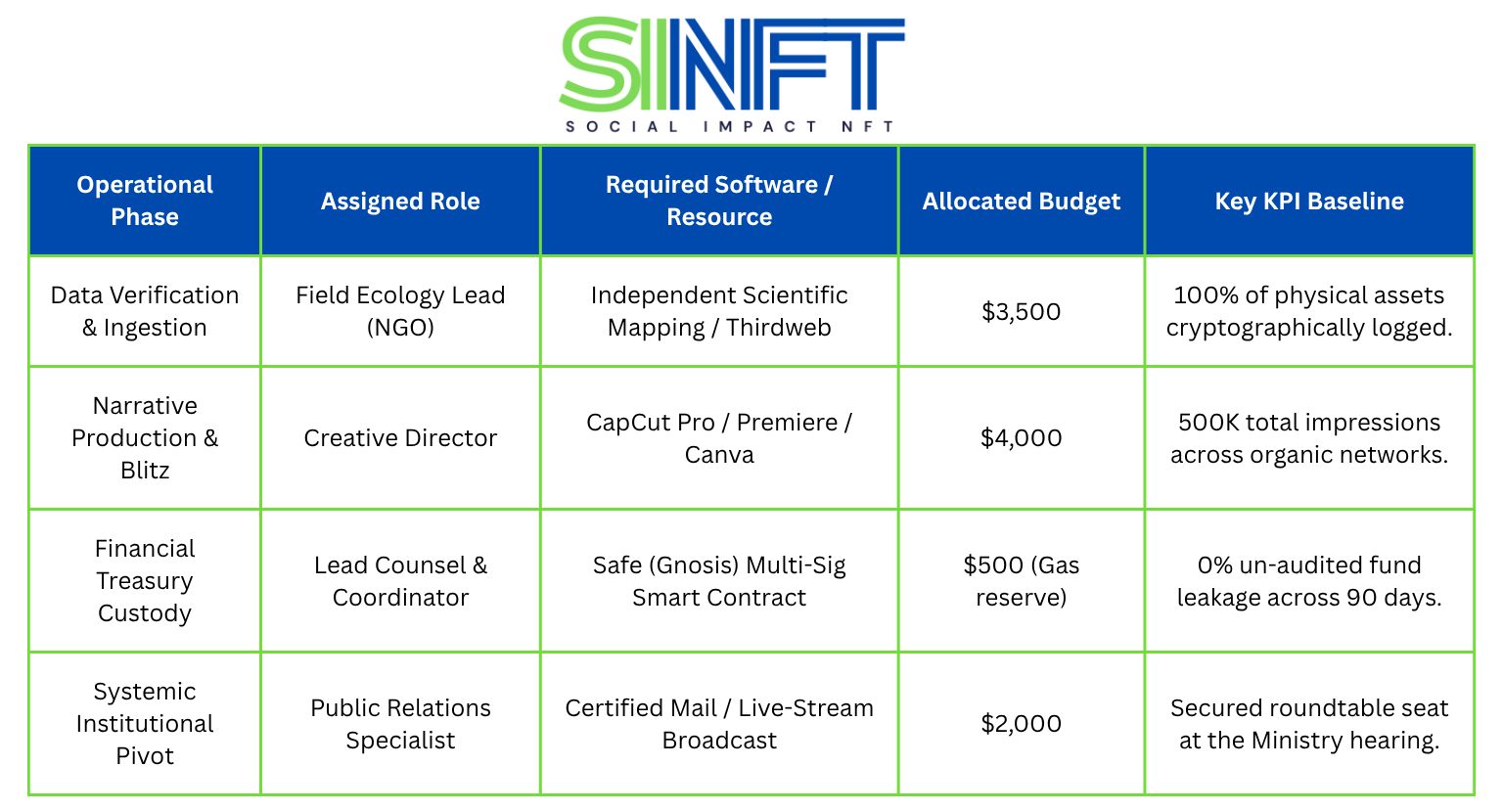
A resilient campaign requires an explicit, formalized operational blueprint before entering high-risk deployment phases. Below is the structural template a coordinator uses to allocate resources and assign accountability:
Part 3: Mitigating the 4 Systemic Campaign Risks
The moment an advocacy movement achieves global scale, it attracts aggressive pushback from opposing developers, institutional gatekeepers, and malicious online actors. A coordinator must pre-emptively build defense walls against these four distinct threat vectors:
1. Greenwashing & Media Misinformation
-
The Threat: Target corporations or opposing agencies launch counter-marketing campaigns using superficial "green" narratives to confuse the public and invalidate your raw field data.
-
The Defense: Maintain absolute data dominance. Use open-source IPFS storage networks to make your raw scientific audits completely public. When opposition forces make unverified environmental claims, counter them by pointing the press directly to your unalterable cryptographic audit trail.
2. Security Exploits & Phishing Scams
-
The Threat: Malicious hackers compromise your community Discord servers, hijack team social accounts, or deploy fake mirror contracts to drain your supporters' wallets.
-
The Defense: Implement a strict Zero-Trust Technical Protocol. Enforce mandatory hardware-based Two-Factor Authentication (2FA) for all core team accounts. Never post contract deployment links directly on social feeds without secondary cryptographic verification via your official website domain.
3. Technical Accessibility Barriers
-
The Threat: Non-technical local residents, grassroots volunteers, and senior citizens become alienated by complex wallet setups, seed phrases, and blockchain terminology.
-
The Defense: Abstract the complexity. Build web landing pages that allow users to acquire solidarity badges using standard email onboarding and credit cards via account abstraction tools, shielding them from raw Web3 code.
4. Financial & Long-Term Sustainability Concerns
-
The Threat: The initial energy of the campaign drops after the primary fundraising window closes, leaving the movement without operational capital to sustain multi-year legal battles.
-
The Defense: Program sustainable funding mechanics directly into your smart contracts. Implement automated secondary market royalties (e.g., 5% on all secondary asset transfers) that stream capital directly into the multi-sig operational vault to fund long-term legal teams and field testing.
Part 4: Future Horizons: From Campaigns to DAOs
The ultimate evolution of modern digital advocacy is the transition from a temporary centralized campaign into a permanent Decentralized Autonomous Organization (DAO).
By replacing rigid corporate hierarchies with code-enforced rules, an activist community can transform its initial momentum into a self-governing institution. Tokens or digital badges are no longer just receipts of donation; they act as voting shares. Through platforms like Snapshot, the global community directly controls the treasury, votes on which legal teams to hire, and determines which physical ecological plots to protect next. This ensures the movement outlives its initial creators, establishing a decentralized ecosystem of permanent accountability.

Shape the Future.
Mint the Change.