
How to develop Advocacy campaigns which can support the social causes
Deep Dive Reading: Web3 SMART Goals & The Stakeholder Matrix
Deep Dive Reading: The Architecture of Web3 SMART Goals & Stakeholder Alliances
Introduction: The Steering Wheel of Advocacy
A common pitfall for digital-forward movements is launching an initiative powered entirely by vague sentiment. Many campaigns mint an NFT collection with an open-ended mission statement: "We want to leverage Web3 to empower youth and protect our shared spaces." While inspiring, an unquantified goal gives a campaign no strategic direction. Without precise parameters, your team cannot budget efficiently, collectors cannot verify your progress, and local decision-makers can easily brush you aside.
Strategic advocacy requires transforming raw civic passion into machine-grade SMART Goals tailored specifically for the Web3 landscape. Once your goals are locked in, your next critical task is building a multi-sector Stakeholder Ecosystem. You cannot win a systemic battle alone. A modern project coordinator acts as a cross-industry diplomat, building an alliance that bridges traditional grassroots institutions, digital artists, borderless crypto networks, and institutional policymakers.
Part 1: Deconstructing the Web3 SMART Goal
To keep a digital campaign grounded, every core objective must pass the SMART framework test. In social impact asset campaigns, your objectives will balance three primary dimensions: Awareness (Digital Footprint), Fundraising (Capital Allocation), and Community Action (Civic Pressure).
SMART= Specific + Measurable+ Attainable+ Relevant+ Time-bound
Let’s dissect how a weak, traditional goal evolves into an ironclad Web3 SMART objective:
-
❌ The Weak Goal: "We want to drop an NFT collection to raise crypto to fix the community library and get people to sign a petition on social media before winter."
-
Why it fails: It doesn't define the token supply, the blockchain network, the exact dollar amount needed, where the funds sit, or how the petition directly forces structural change.
-
-
▲ The Web3 SMART Goal: "We will mint a limited collection of 500 utility-backed NFTs on the Polygon network by October 1st to raise $15,000 USD worth of crypto assets. 100% of the primary sale revenue will be locked in a public multi-signature wallet to finance a 6-month salary for two professional instructors and utility overhead for the youth hub. Concurrently, we will use the digital token gating mechanism to mobilize 300 unique wallet holders to verify and sign an on-chain ledger petition by November 15th, demanding the local municipal council formally vote to integrate the hub's operational costs into the 2027 Annual City Budget."
Breaking Down the Mechanics:
-
Specific: It states the exact token mechanics (500 NFTs on Polygon), the specific operational target ($15,000 for salaries/utilities), and the exact policy outcome (forcing a city council budget vote for 2027).
-
Measurable: Progress can be verified in real-time on a public blockchain ledger—anyone can look at the contract address to see if 500 tokens were minted and if $15,000 is sitting in the multi-sig wallet.
-
Attainable: It targets a realistic micro-funding threshold ($15,000) and a practical local policy outcome, rather than trying to fix global infrastructure all at once.
-
Relevant: The digital fundraising directly serves as a bridge fund to keep the library open, while the on-chain petition applies the direct political pressure needed to solve the root cause.
-
Time-bound: It locks in firm operational deadlines (Mint completion by October 1st, petition delivery by November 15th, targeting the 2027 budget cycle).
Part 2: Mapping the 5-Quadrant Stakeholder Matrix
An advocacy campaign is only as strong as the legitimacy of its network. In a digital-forward campaign, your ecosystem spans across five distinct groups. Each group possesses a unique asset your campaign needs, and each requires a customized Value Proposition to join your alliance.
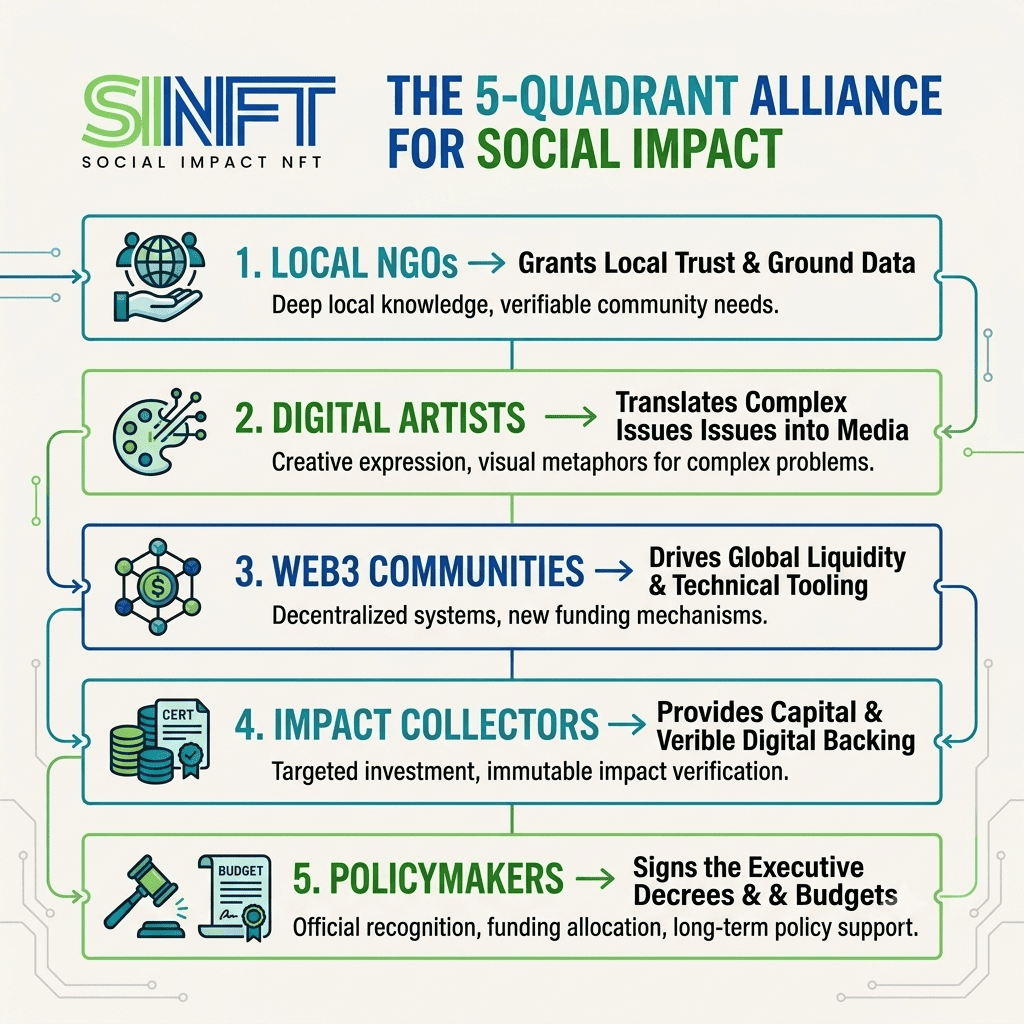
Quadrant 1: Non-Profits & Grassroots NGOs (The Trust Anchors)
-
What they bring: Historical context, verified local data, organizational infrastructure, and long-standing public credibility. They ensure your campaign isn't just an online trend, but a real-world necessity.
-
Their Core Problem: They are often paralyzed by slow international banking systems, heavy bureaucratic reporting overhead, and growing donor skepticism regarding administrative waste.
-
The Partnership Pitch: “We will build the technical Web3 infrastructure to expand your local cause to a borderless, tech-native audience. By routing funds through a transparent ledger, we will prove your operational integrity to the world, while securing an immediate, low-fee digital bridge fund to support your ground teams.”
Quadrant 2: Digital Artists & Creative Collectives (The Translators)
-
What they bring: High-quality visual assets, emotional resonance, identity design, and cultural relevance. They take dry spreadsheets of community data and translate them into beautiful visual assets.
-
Their Core Problem: Talented creators frequently want to support social causes but lack the technical skills to deploy smart contracts, and they are tired of corporate platforms taking massive cuts of their digital reach.
-
The Partnership Pitch: “Your art will become the visual badge of this movement. We will handle 100% of the smart contract deployment and minting logistics. This campaign will give your portfolio global exposure to impact collectors, and your work will be permanently etched onto the blockchain as a historical catalyst for civic change.”
Quadrant 3: Web3 Developer Communities & DAOs (The Infrastructure Engines)
-
What they bring: Technical optimization, code audits, localized marketing channels, liquidity pools, and native experience in digital mobilization.
-
Their Core Problem: Decentralized networks are constantly looking for high-integrity, real-world utility projects to prove to mainstream critics that blockchain technology can be used for genuine social good, not just speculation.
-
The Partnership Pitch: “Partner with us to demonstrate a real-world use case for decentralized technology. We provide a fully verified, community-backed civic campaign on the ground. Your developers can audit our smart contracts, and your community can showcase how Web3 tools can systematically solve local public infrastructure failures.”
Quadrant 4: Social Impact Collectors & Patrons (The Capital Fuel)
-
What they bring: Initial financial runway, borderless amplification, and long-term holding commitment. They don't buy digital assets to "flip" them for quick cash; they buy them to signal their alignment with a cause.
-
Their Core Problem: They are highly suspicious of online scams, rug-pulls, and corporate "impact washing" where organizations mask empty gestures behind trendy tech jargon.
-
The Partnership Pitch: “We practice radical financial transparency. Every cent raised from this token drop is locked in a multi-signature wallet requiring verified community sign-offs. By collecting this asset, you are buying a permanent, on-chain receipt of real-world social impact that you can display across your digital identity.”
Quadrant 5: Policymakers, Municipal Officers & Councillors (The Systemic Target)
-
What they bring: The institutional power to pass amendments, sign zoning permits, update directives, and permanently reallocate tax revenues.
-
Their Core Problem: They are risk-averse and generally ignore unorganized social media noise, but they react intensely to structured data, organized voting blocks, and independent alternative funding structures that lower the city's financial burden.
-
The Partnership Pitch: “We are not here to disrupt your municipal operations blindly. We have mobilized a borderless coalition and raised an independent $15,000 digital fund to cover the immediate operational gap of this youth library. We have the data, the community backing, and the funding. We are inviting you to the table to co-sign an updated, modernized youth development directive to make this asset permanent.”
Part 3: The Synergy of Incentive Alignment
The magic of a modern advocacy campaign manager lies in Incentive Alignment. In traditional charity models, donors give money and get nothing back but a thank-you email, artists work for free out of pure guilt, and NGOs operate in silos.
By utilizing a Web3 ecosystem framework, you turn a zero-sum sacrifice into a positive-sum network: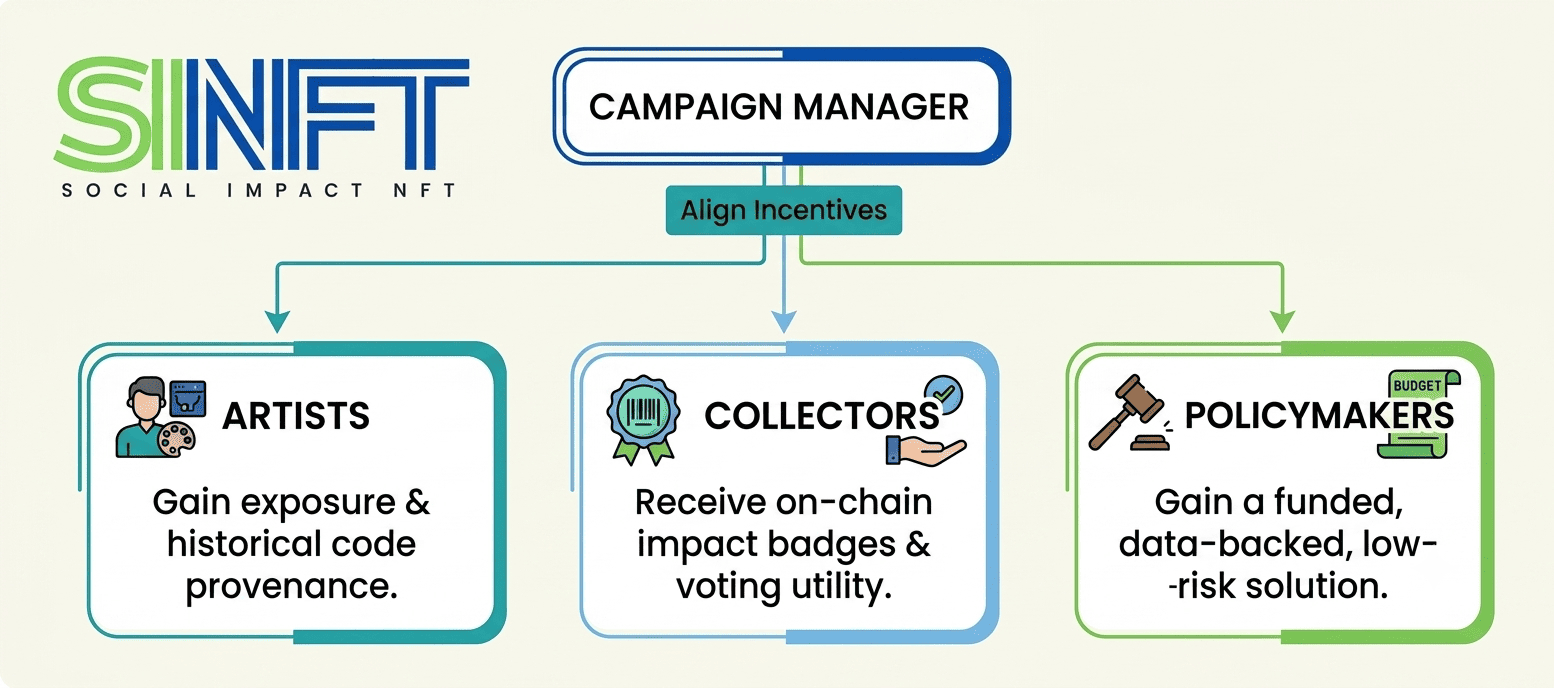
When these incentives lock together perfectly, your campaign stops being a temporary cry for help and becomes an unshakeable ecosystem capable of altering institutional power dynamics.

Shape the Future.
Mint the Change.