
How to develop Advocacy campaigns which can support the social causes
Evidence-Mining & On-Chain Integrity
1. Data-Mining: Finding the "Iceberg Roots"
Professional advocacy requires moving beyond Google searches. To find structural evidence, a coordinator must engage in Desk Research and Primary Data Collection:
-
Municipal Budget Audits: Every municipality has a public record of its annual budget. Search for keywords like "Youth Programs," "Capital Repairs," or "Contingency Funds." If your "Ghost Library" has no staff, the budget audit will prove if the money was never allocated or if it was diverted.
-
The Power of Local Surveys: Data isn't just in books; it's in people. Use simple tools to conduct community surveys. Quantitative data (e.g., "85% of local youth say they have no indoor study space") is your most powerful tool in a city council meeting.
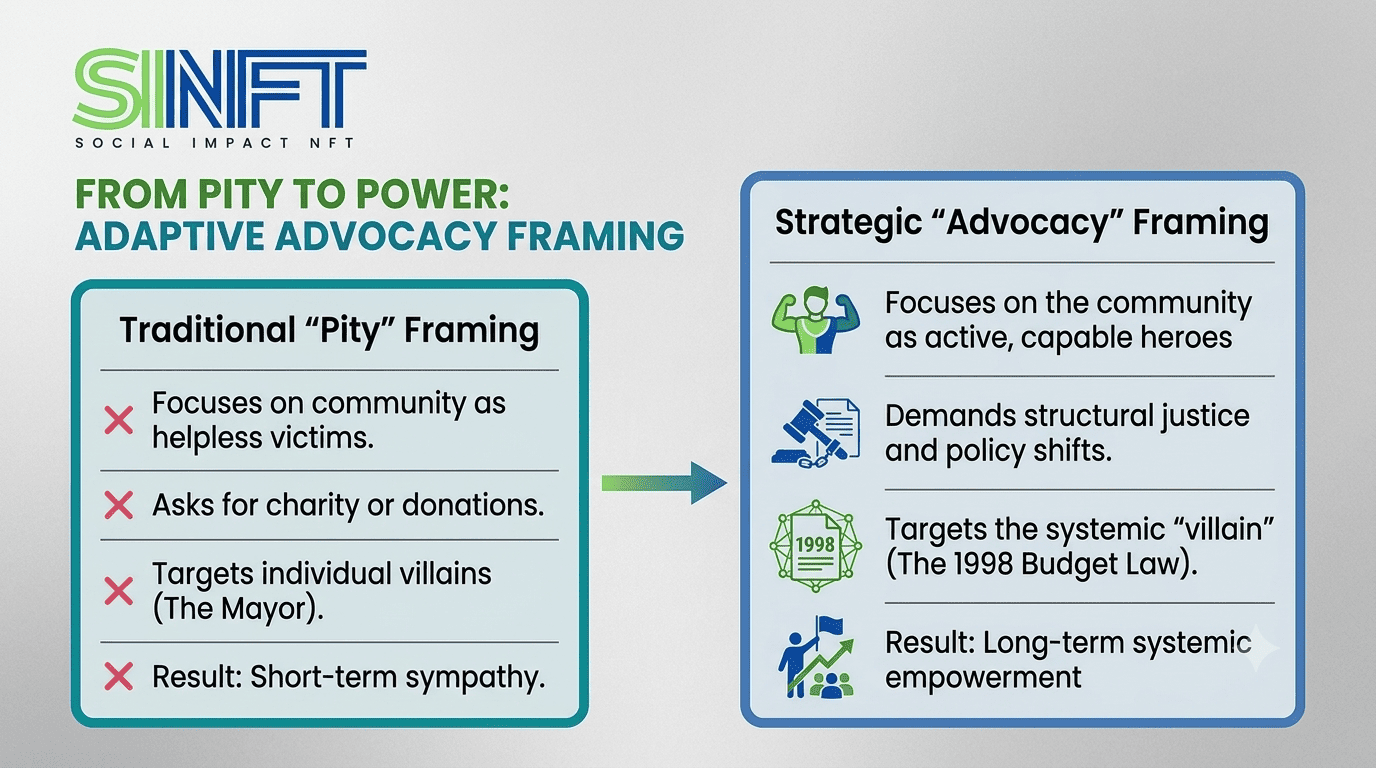
2. Narrative Framing: From Pity to Power
How you "frame" your cause determines who joins your movement.
3. Web3 & On-Chain Evidence: The "Proof of Integrity"
One of the biggest challenges in advocacy is protecting your evidence from being deleted or suppressed by powerful opponents.
-
Immutable Evidence (Minting Facts): Using tools like IPFS (InterPlanetary File System) and blockchain, advocates can "mint" photographic or document evidence as digital assets. Once a photo of a community issue (like a locked library or an illegal dump) is recorded on the blockchain with its timestamp and GPS metadata, it becomes technically impossible to delete.
-
Radical Transparency: By linking your data-mining results directly to your NFT campaign's metadata, you show donors and decision-makers that your cause isn't just an opinion—it’s a verifiable fact recorded on the public ledger

Shape the Future.
Mint the Change.