
How to develop Advocacy campaigns which can support the social causes
Deep Dive Reading: Problem Trees, Evidence Gathering, and Digital Storytelling
Introduction: The Anatomy of a Defined Cause
The difference between a failed initiative and a successful campaign lies in the architecture of how the problem is framed. Well-meaning campaigns often stall out because they attack massive, abstract concepts rather than isolated, manageable issues. If a campaign targets a vague goal like "fixing local education," it becomes impossible to allocate resources, assign team roles, or measure milestones.
To build a winning case for change, a campaign coordinator must dissect a broad social issue, gather unshakeable proof, and translate that evidence into a compelling digital narrative.
Part 1: The Campaign Strategy Iceberg
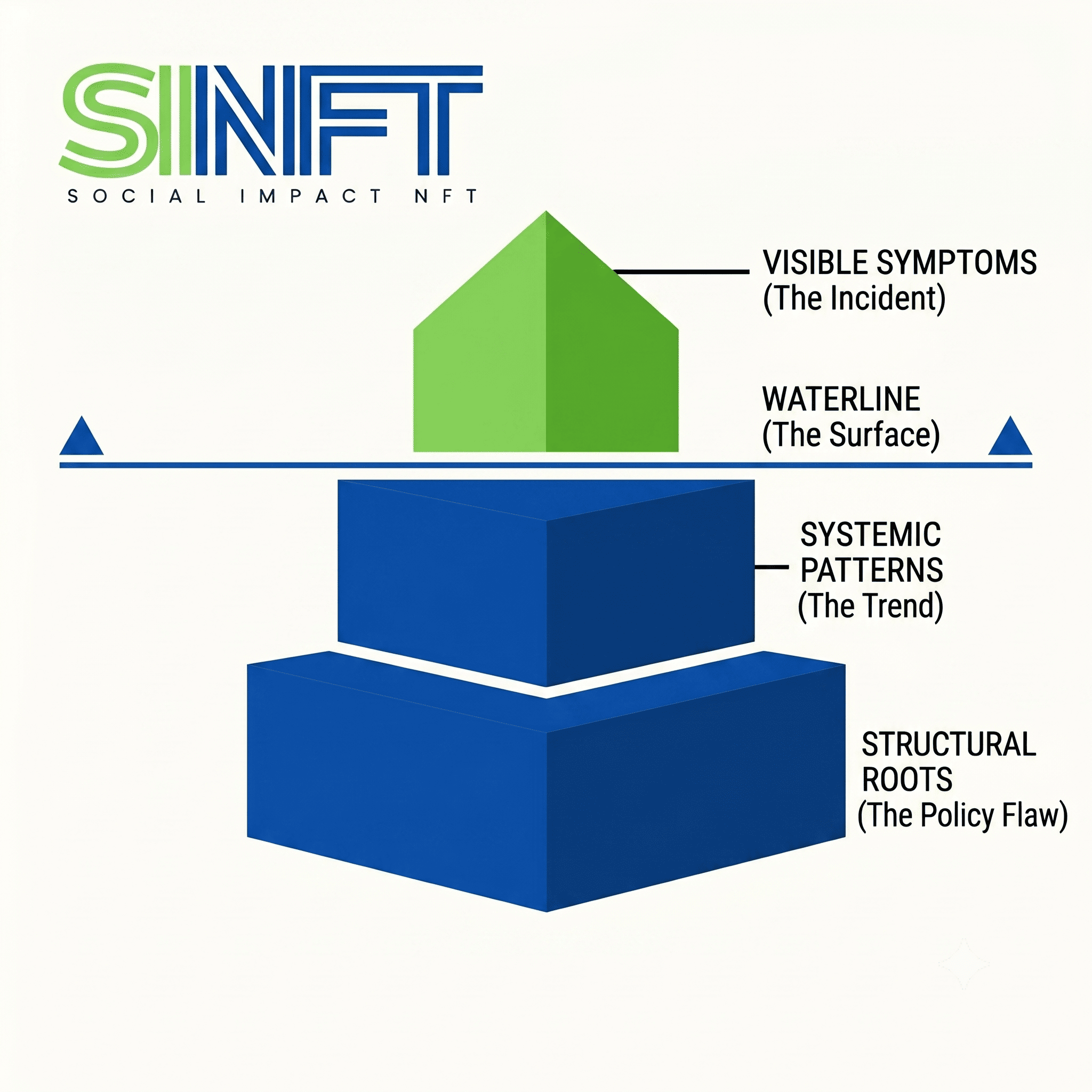
To build a campaign that creates permanent change, a coordinator must look beneath the surface. Well-meaning advocates often exhaust their resources by attacking the visible symptoms of a problem, while leaving the underlying systems completely untouched. To prevent this, we utilize the Civic Iceberg Model, driven by the "5 Whys" Analysis Technique.
-
Above the Waterline (The Symptom): This is the immediate, visible event that causes public outcry. For example: A massive pile of electronic waste is dumped illegally in a community field.
-
Below the Waterline (The Systemic Pattern): This is the trend line over time. It proves the problem isn’t a one-time accident, but a recurring issue. For example: Illegal dumping incidents in this district have increased by 60% over the last three years.
-
The Base of the Iceberg (The Structural Root): This is the ultimate target of an advocacy campaign—the policy flaw, missing budget, or outdated law that allows the problem to exist.
How to Dig Deeper: The "5 Whys" Technique
To guide your campaign team from the top of the iceberg down to its structural base, you ask the question "Why?" five consecutive times. Watch how this process exposes the exact policy target needed for an advocacy campaign:
-
Why is there a massive pile of electronic waste in the community field?
-
Because local tech repair shops and residents are dumping their old computers and batteries there. (The Surface Symptom)
-
-
Why are they dumping it in a public field instead of recycling it?
-
Because there are no specialized e-waste recycling bins anywhere in the municipal district. (The Systemic Pattern)
-
-
Why are there no specialized e-waste recycling bins in the district?
-
Because the city's current waste management contract only covers standard plastic, paper, and household trash. (The Operational Gap)
-
-
Why does the city's waste management contract completely exclude electronic waste?
-
Because the local Municipal Waste Directive was last written and approved in 1998, long before modern electronic waste became a crisis. (The Policy Root Cause)
-
-
Why has the Municipal Waste Directive not been updated since 1998?
-
Because no youth organization, community group, or legal coalition has formally drafted an amendment or pressured the city council to reallocate funds to modernize the directive. (The Campaign Opportunity)
-
The Advocacy Shift: If you stop asking questions at Why #1, your reaction is pure activism (gathering volunteers to clean up the field). If you dig all the way down to Why #4 and #5, you launch a true advocacy campaign aimed directly at forcing the city council to rewrite the outdated 1998 Municipal Waste Directive. You fix the system, so the symptom disappears forever.
Part 2: Building the Case—The Data & Story Equation
Once your campaign has isolated its root causes, you must gather verifiable evidence to build legitimacy. An unshakeable advocacy case relies on a precise equation: Data + Story = Impact.
Data (Logic & Authority)} +Story (Emotion & Connection)} =Impact (Actionable Advocacy)
1. Data: The Intellectual Anchor
Data provides your campaign with objective authority. When negotiating with local municipalities, institutional partners, or corporate sponsors, raw opinions carry no weight. You must back your case with:
-
Quantitative Metrics: Local percentages, demographic studies, and environmental data. (e.g., "Water quality tests reveal a 45% increase in microplastics in our district over the last 12 months.")
-
Policy Gaps: Direct citations of outdated local laws, or unfulfilled government budgets.
-
Verified Sources: Independent research reports, academic papers, or structural surveys conducted within the target community.
2. Story: The Lived Experience
While data changes minds, stories move hearts and inspire people to take action. Data can feel cold and detached; human storytelling bridges that gap by providing a lived experience:
-
The Micro-Narrative: Focusing on the lived experience of one specific individual, family, or living entity impacted by the root cause.
-
Visual Testimonials: Highlighting unedited photographs, brief interview audio clips, or diary-style accounts from the community.
-
The Human Connection: Presenting the problem in a way that makes your target audience think, "That could be my family, my neighborhood, or my future."
Part 3: Digital Storytelling & The Symbolic Power of NFTs
In the digital era, campaigns have a brand-new medium for storytelling: Non-Fungible Tokens (NFTs). In a modern social impact campaign, an NFT is far more than a digital collectible—it functions as a permanent, immutable symbol of the cause itself, turning a real-world community issue into an active digital asset.
Cause Branding & Visual Metaphors
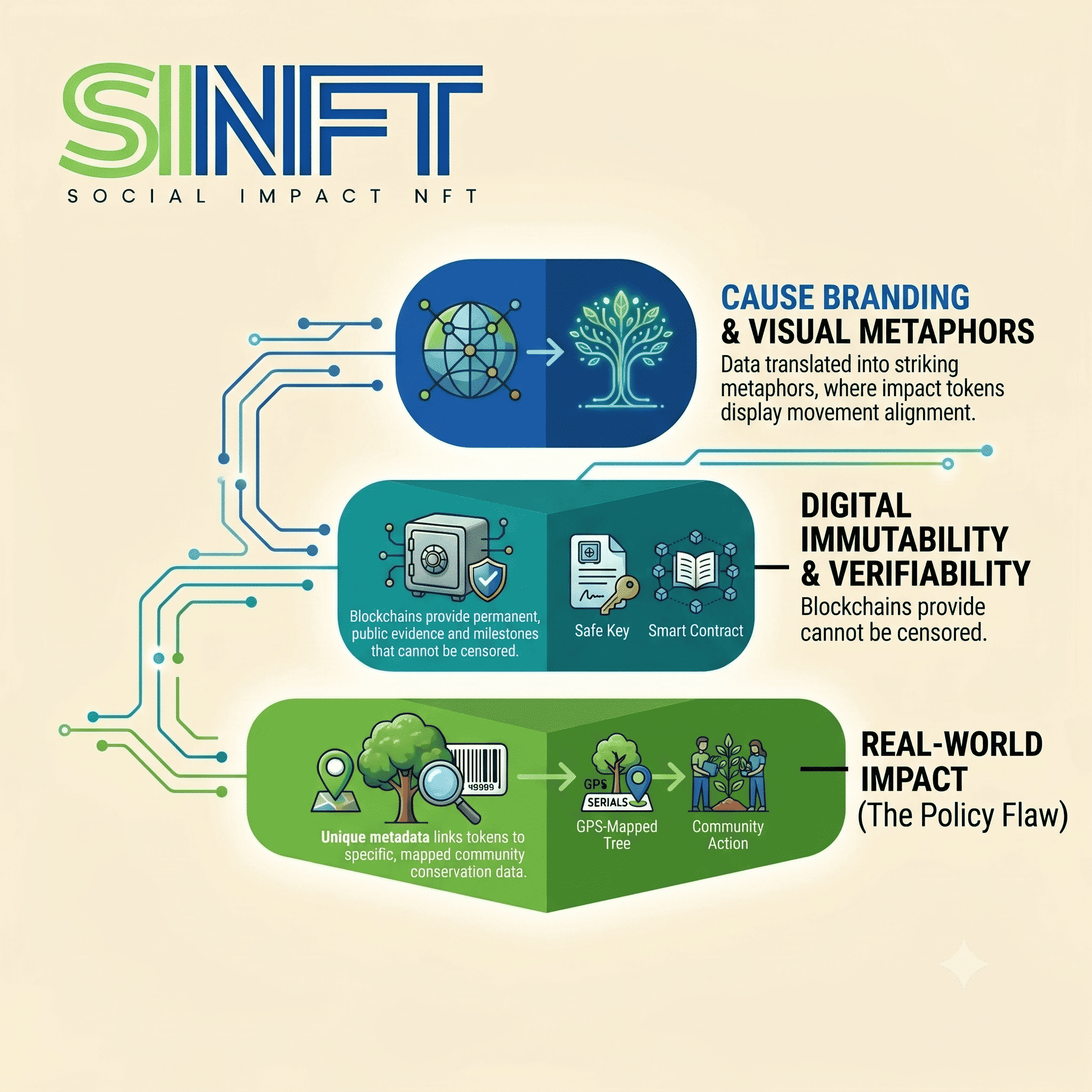
Web3 advocacy projects use digital art to translate complex data points into immediate visual metaphors. Instead of presenting a dry 50-page spreadsheet on local ecological degradation, a project can collaborate with creators to turn that data into striking visual media.
The digital asset becomes a badge of identity. When a supporter collects a project's impact token, they are displaying their alignment with the movement across their digital platforms.
Digital Immutability & Verifiable Claims
Because NFTs live on decentralized, public blockchains, they possess a unique strategic property: immutability. This means that once a piece of digital evidence, a creative testimonial, or a campaign milestone is written into a smart contract, it cannot be edited, deleted, or censored by a corporation or a hostile local authority.
Furthermore, by attaching clear metadata to an NFT collection, a campaign can link each unique token directly to a specific, real-world data point. For example, a youth-led environmental campaign can mint an NFT collection where each token's unique serial number corresponds to a specific, GPS-mapped tree in an urban forest, turning the blockchain into a permanent, public registry for community conservation.

Shape the Future.
Mint the Change.