
How to develop Advocacy campaigns which can support the social causes
Lesson 1 Summary: The Foundation of Civic Action & Digital Shift
Congratulations on completing the first lesson of this module! Before you take the end-of-lesson quiz, let’s review the foundational concepts, definitions, and strategies we covered regarding traditional and digital change-making.
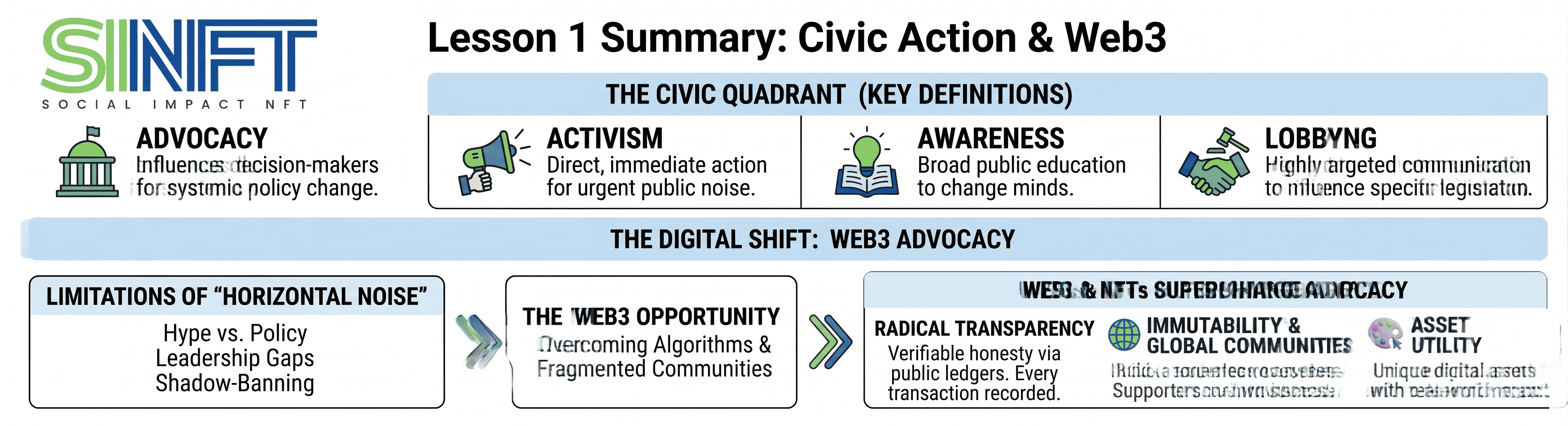
1. The Civic Quadrant: Key Definitions
To design an impactful initiative, a campaign coordinator must select the right tool for the right job. True social change requires understanding how these four approaches differ in their goals and methods:
- Advocacy: The strategic process of influencing decision-makers (such as local municipalities, city councils, or organizations) to change policies, institutional rules, or resource allocations. It addresses the root causes of community issues to create lasting, systemic change.
- Activism: Direct, immediate action (such as protests, strikes, or sit-ins) designed to create urgent public noise and force an ignored issue into the political spotlight. Activism acts as a catalyst but rarely rewrites laws on its own.
- Awareness: Broad public education efforts (such as infographic campaigns, flyers, or documentation) aimed at changing minds and informing citizens. It is a necessary prerequisite to advocacy, but it does not change structural rules.
- Lobbying: Highly targeted, direct communication with legislators or policymakers to influence specific pieces of pending legislation.
2. The Evolution of Digital Mobilization
Looking back at early 2010s digital movements like Occupy Wall Street, modern advocates have learned critical lessons about the limitations of relying purely on social media hype:
-
The Trap of "Horizontal Noise": Early movements were incredible at gathering thousands of people quickly, but because they lacked a defined leadership structure or targeted advocacy goals, they struggled to turn public attention into policy wins.
-
The Shift to Web3: Today's digital advocates face corporate algorithms, shadow-banning, and noisy feeds. To overcome this, innovative campaigns are shifting toward decentralized, user-owned Web3 networks and transparent public ledgers.
3. How Web3 and NFTs Supercharge Modern Advocacy
Digital advocacy doesn't replace traditional civic frameworks—it amplifies them by dismantling the classic barriers of funding opacity and geographic fragmentation.
- Radical Transparency: By using open blockchain infrastructure, a campaign moves from a model of "blind trust" to verifiable honesty. Every single transaction is recorded on a public ledger, proving to your community exactly where funds are being allocated.
- Immutability & Global Communities: Utilizing Web3 platforms allows a localized youth group to build a borderless ecosystem of supporters, collectors, and allies who co-own a stake in the campaign's success.
Remember Our Core Case Studies:
- Ukraine DAO: Demonstrated rapid global mobilization by using a tool called PartyBid, allowing thousands of individual donors to pool their crypto assets together and raise over $7 million via a single NFT auction.
- WWF Germany: Launched the "Non-Fungible Animal" (NFA) campaign, matching the digital art token supply exactly to the number of endangered species left alive in the wild, raising €270,000 for conservation on the eco-friendly Polygon blockchain.
The Ultimate Takeaway
Noise is not a strategy. A professional campaign coordinator uses activism and awareness to generate public attention, and then immediately channels that momentum into a structured advocacy campaign to negotiate permanent, systemic solutions with decision-makers.

Shape the Future.
Mint the Change.