
How to develop Advocacy campaigns which can support the social causes
Deep Dive Reading: The Architecture of Civic Change
Introduction: Moving Beyond Noise
In the modern landscape of social change, the terms advocacy, activism, awareness, and lobbying are frequently used interchangeably. However, to a strategic organizer, they represent completely distinct tools within the civic ecosystem. Running a loud campaign that gets thousands of likes on social media feels successful, but if it does not change the structural rules governing the issue, the problem will return once the online trend fades.
Advocacy is the deliberate process of shifting power dynamics and institutional frameworks to create permanent, structural solutions. It moves your initiative from addressing symptoms to fixing the root causes of systemic failure.
The Civic Quadrant: Dissecting the Mechanisms of Influence
To deploy a campaign effectively, you must understand where your tactical actions sit within the broader civic architecture. Let's break down the four core approaches to social change:
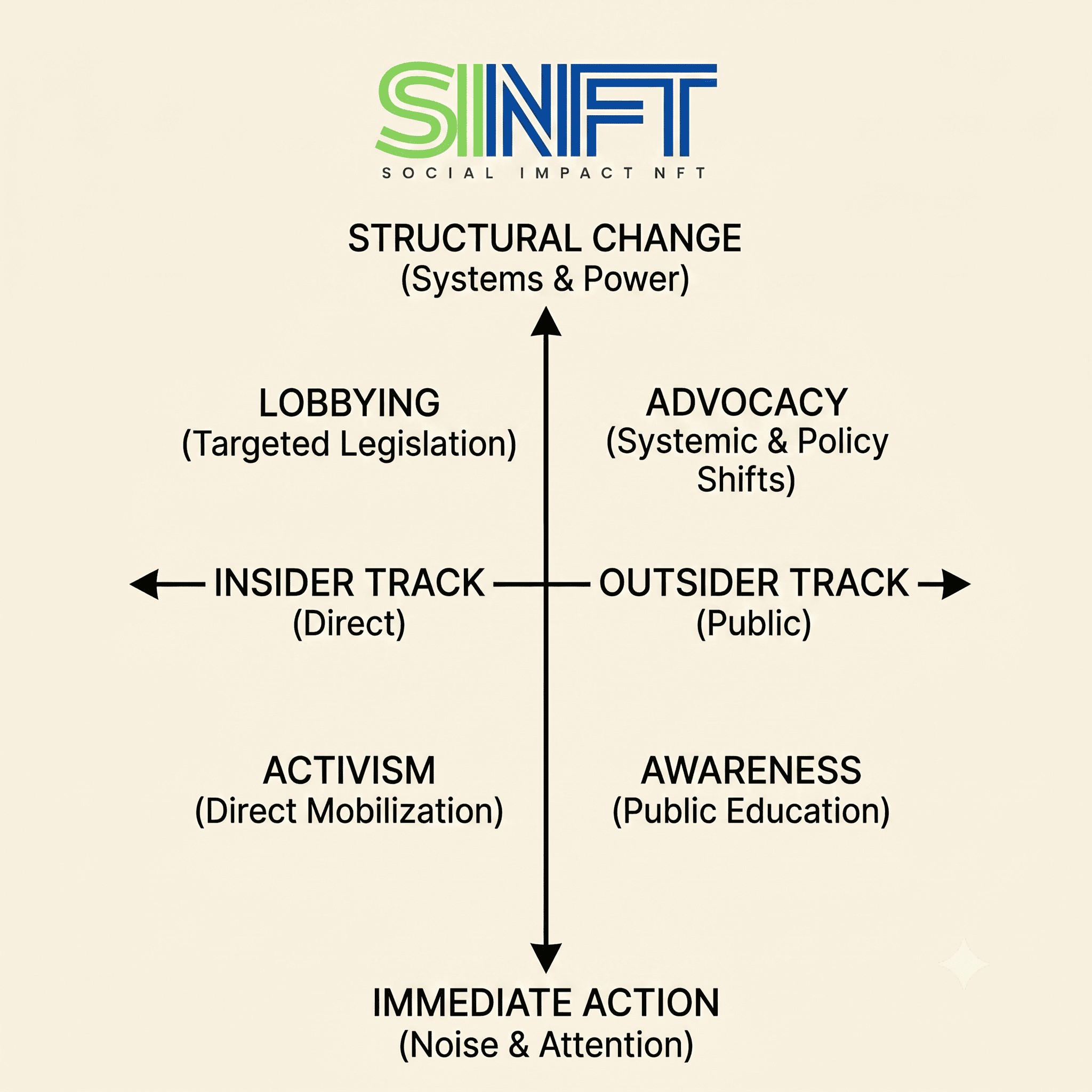
1. Advocacy: Systemic Transformation
- Core Focus: Structural change via policy, institutional rules, or resource reallocation.
- Methodology: Rooted in extensive research, stakeholder alliance-building, and public messaging.
- Example: Working with municipal authorities, local NGOs, and youth councils to draft and fund a permanent electronic waste management policy for a city.
- The Web3 Dimension: Utilizing decentralized autonomous organizations (DAOs) and transparent blockchain mechanics to manage community-led oversight of policy implementation.
2. Activism: Immediate Direct Action
- Core Focus: Drawing immediate attention to a moral or political crisis through visible disruption.
-
Methodology: Protests, sit-ins, strikes, and highly visible public demonstrations.
- Example: Organizing a youth strike outside a town hall to protest the sudden closure of a community center.
-
Strategic Role: Activism acts as the catalyst. It forces an invisible issue into the public spotlight, creating the political urgency that advocates need to negotiate structural changes.
3. Awareness: Public Education
- Core Focus: Building a foundational knowledge base among the general public.
- Methodology: Educational campaigns, documentary screenings, flyers, and information graphics.
- Example: Launching a social media infographic campaign explaining how plastic pollution directly degrades local biodiversity.
- Strategic Limitation: Awareness changes minds, but it does not automatically change laws. It is a necessary prerequisite to advocacy, preparing the public to support structural policy shifts.
4. Lobbying: Targeted Legislative Pressure
- Core Focus: Influencing specific pieces of pending legislation or voting outcomes.
-
Methodology: Direct, private communication with legislators, policymakers, or government officials.
-
Example: Meeting directly with parliament members to convince them to vote "Yes" on a specific environmental protection amendment.
The Digital Shift: Enter Web3 and Tokenized Advocacy
Traditional advocacy has historically suffered from three systemic barriers: geographic fragmentation, financial opacity, and donor fatigue. The emergence of Web3 infrastructure—specifically Non-Fungible Tokens (NFTs) and public ledgers—offers a structural toolkit to systematically dismantle these barriers
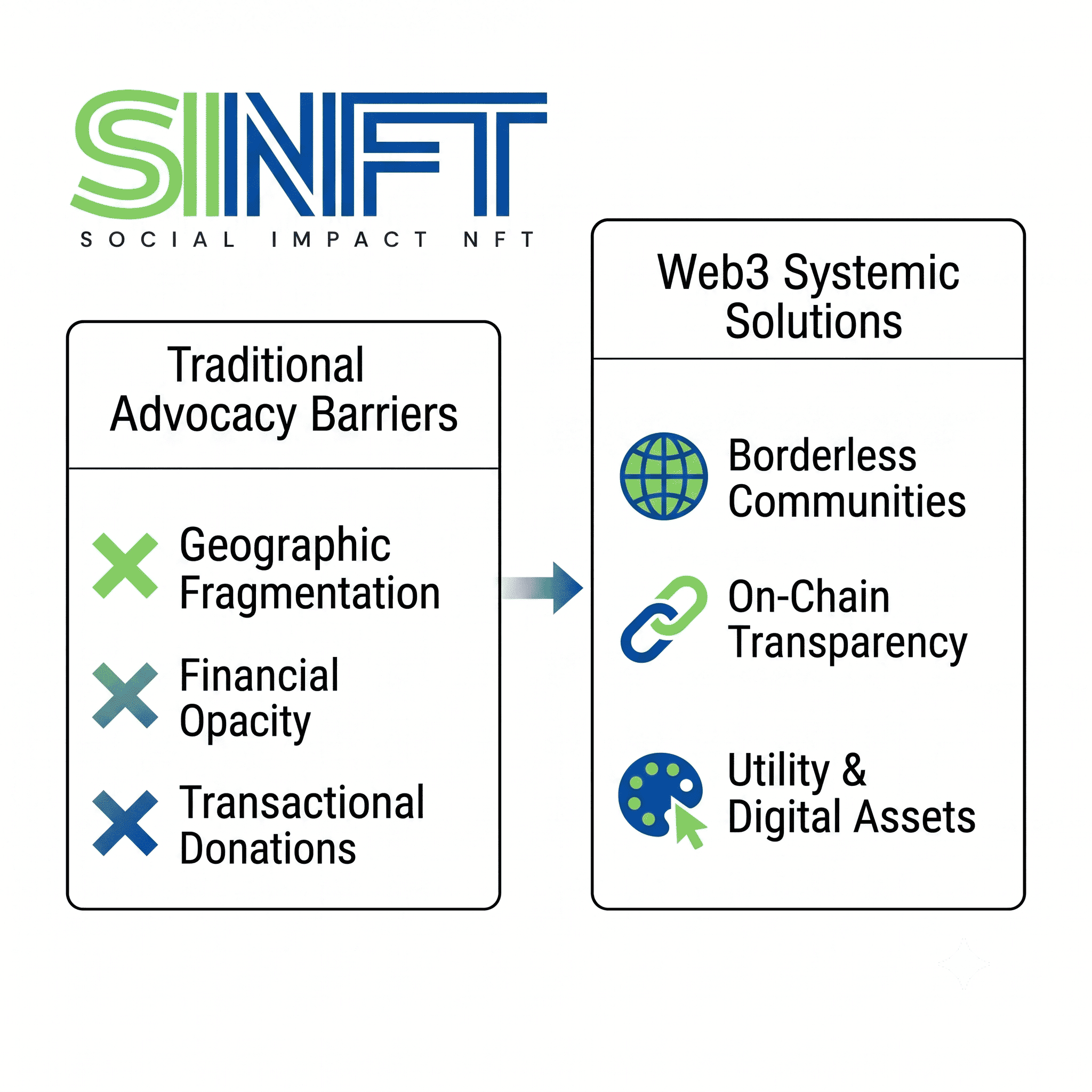
Decentralized Communities
Traditional campaigns are often limited by local laws, local currencies, and national borders. Web3 tools allow a local youth-led cause in Georgia to instantly build a borderless stakeholder ecosystem. Supporters from Tokyo, Paris, and Tbilisi can collectively pool resources, vote on campaign strategies, and co-own the campaign's digital assets without relying on slow international banking systems.
On-Chain Transparency vs. The "Black Box" of Charity
One of the primary causes of advocate fatigue is the lack of visible impact—donors hand over funds and never see exactly how they are spent. Web3 shifts campaigns from a model of "blind trust" to radical transparency. By routing campaign funds through public smart contracts and multi-signature wallets, every single currency movement is permanently logged on a public blockchain ledger. Anyone can independently verify that 100% of a digital asset sale went directly to the targeted social cause.
Deep Dive Case Studies: Web3 in Action
Case Study A: Ukraine DAO — Rapid-Response Global Mobilization
When an urgent crisis emerged in early 2022, traditional humanitarian fundraising channels faced bureaucratic bottlenecks. Within 72 hours, a decentralized coalition formed Ukraine DAO to raise emergency funds.
- The Strategy: Instead of selling thousands of individual pieces of art, they minted a single, 1-of-1 NFT of the Ukrainian flag.
-
The Innovation: They used a Web3 tool called PartyBid, which allowed thousands of individual donors to pool their crypto assets together to place one massive, collective bid on the flag.
-
The Impact: The campaign raised over $7 million in a single auction. Because the funds were transacted entirely on-chain, the allocation of resources to verified medical and humanitarian teams was transparently visible to every participant in real-time.
Case Study B: WWF Germany — The Non-Fungible Animal (NFA) Campaign
In an effort to engage a younger, digitally native demographic with wildlife conservation, the World Wide Fund for Nature (WWF) launched the NFA project.
- The Strategy: WWF collaborated with prominent digital artists to create unique digital art assets representing 10 highly endangered species (such as the Mountain Gorilla and the Baltic Porpoise).
- The Innovation: The supply of the NFTs was strictly limited to the exact number of those animals left alive in the wild. For instance, only 290 NFAs were minted for the Vaquita whale.
-
The Technical Choice: To ensure environmental alignment, WWF deployed the project on the Polygon blockchain, a proof-of-stake network that uses 99.9% less energy than traditional proof-of-work networks, eliminating criticisms of carbon footprint impact.
-
The Impact: The initiative raised over €270,000 for biodiversity conservation while turning digital collectors into permanent, active advocates for wildlife protection.
Core Takeaway for the Modern Advocate
Digital advocacy is not about replacing traditional civic structures; it is about supercharging them. A modern campaign manager uses traditional advocacy to map out the policy change they want to see, and leverages Web3 tools to fund, scale, and build an unshakeable ecosystem of global trust around that cause.

Shape the Future.
Mint the Change.