Lesson 1: Digital Ads & Organic Reach
SEO and Analytics
Section outline
-
Lesson 1: Digital Ads & Organic Reach
-
Students mustMark as done
Search Engine Optimization (SEO) – The Organic Foundation
Before spending money on ads, you must build a system that attracts people naturally. While the SINFT project champions Web3 and decentralization, billions of people still use Web2 search engines (Google) or privacy-focused alternatives (Brave, DuckDuckGo) to find information.
SEO (Search Engine Optimization) is the practice of structuring your content so that it ranks at the top of these search results for free.
The 3 Pillars of Social Impact SEO:
1.Keyword Intent: Don't just target broad words like "charity" or "NFT." Target specific phrases your ideal supporters are actually searching for.
- Example: Instead of trying to rank for "clean water," optimize your pages for "how to donate crypto for clean water projects."
2. On-Page Optimization: Ensure search engines can easily read your site.
- Include your primary keyword in your Page Title (H1), subheadings (H2), and the URL slug.
- Write highly readable, structured content. Search engines prioritize sites that offer clear, immediate value to the user.
3. E-E-A-T (Experience, Expertise, Authoritativeness, Trustworthiness): Search engines heavily favor trustworthy sources, especially for financial or charitable topics. Build authority by earning backlinks (links pointing to your site) from established NGOs, Web3 grant platforms, and news outlets.
-
Students mustMark as done
Digital Ads – Renting Web2 Attention
While SEO builds long-term value, it takes time. Digital Ads buy you immediate, guaranteed visibility.
Organic reach has plummeted across major platforms like Facebook and Instagram. Algorithms prioritize keeping users on the app, often showing them massive creators rather than local NGOs. If you have 1,000 followers, a regular post might reach only 50 of them.
Web3 Philosophy Note: As a decentralized project, our ultimate goal is to build communities on open-source, Web3 platforms. However, to scale our impact, we must temporarily use Web2 monopolies (e.g., Meta and Google) as megaphones. We rent their attention to bring mainstream users into our decentralized ecosystem.
The Main Types of Digital Advertising (With Real-World Cases):
Not all ads work the same way. Depending on your goal, you will choose different tools from the broader digital advertising ecosystem:
Targeted Social Media Ads (e.g., Meta/Facebook, Instagram, LinkedIn):
This is "Push" marketing. You define an audience based on their interests, age, or location, and the platform pushes your message into their social feeds while they are scrolling.Real-World Case: UNICEF Emergency Appeals. During global crises, UNICEF uses hyper-targeted Meta ads directed at people who have previously engaged with humanitarian pages. They push urgent, emotional posts directly into Instagram feeds to generate immediate donations.
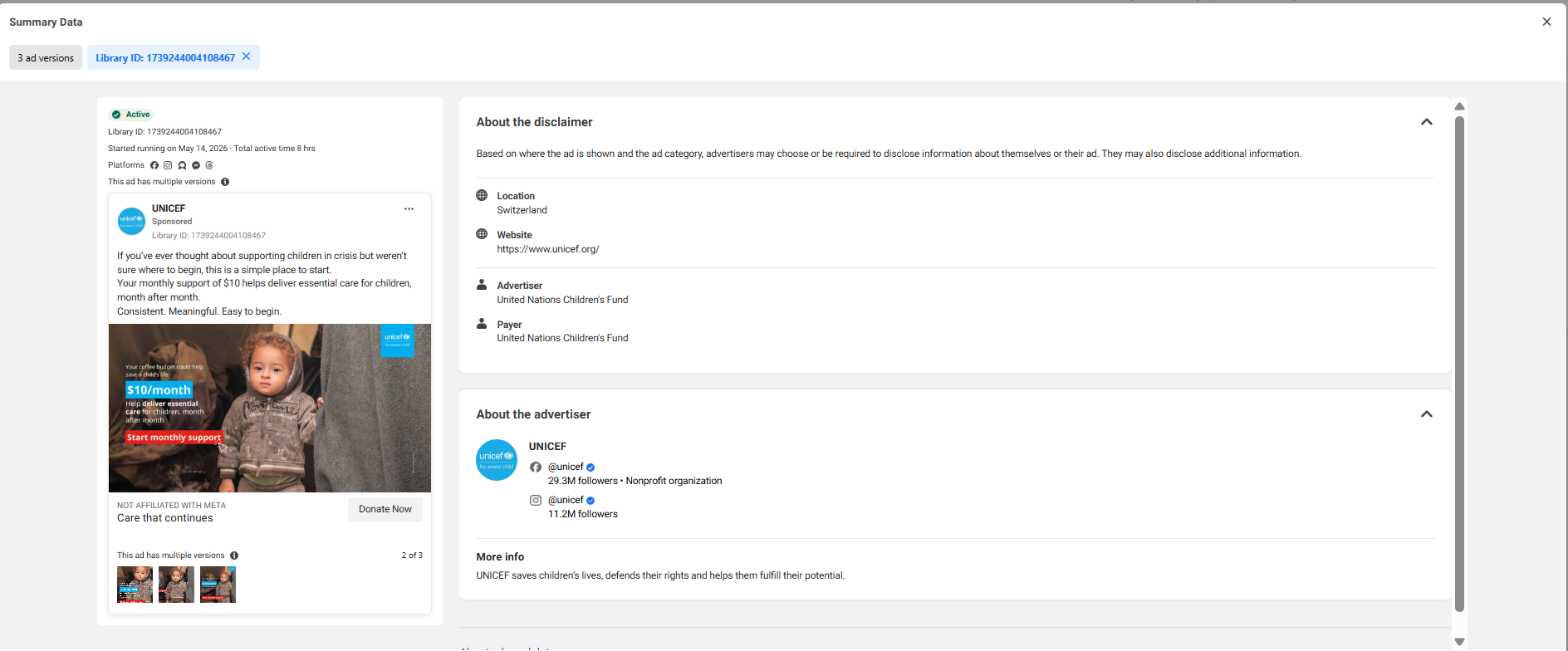
Pro Tip: You can study active charity ads transparently via the Meta Ad Library to find inspiration!
Contextual & Search Ads (e.g., Google Search Ads):
This is "Pull" marketing. Your ad only appears when someone actively searches for a specific keyword (e.g., "how to support local youth NGOs"). You are answering a question they are already asking.Real-World Case: Save Ukraine. When a user types "how to help Ukraine from the UK" into Google, this initiative appears at the very top of the search results as a Sponsored ad. They capture people with high intent who are already looking for a way to contribute.
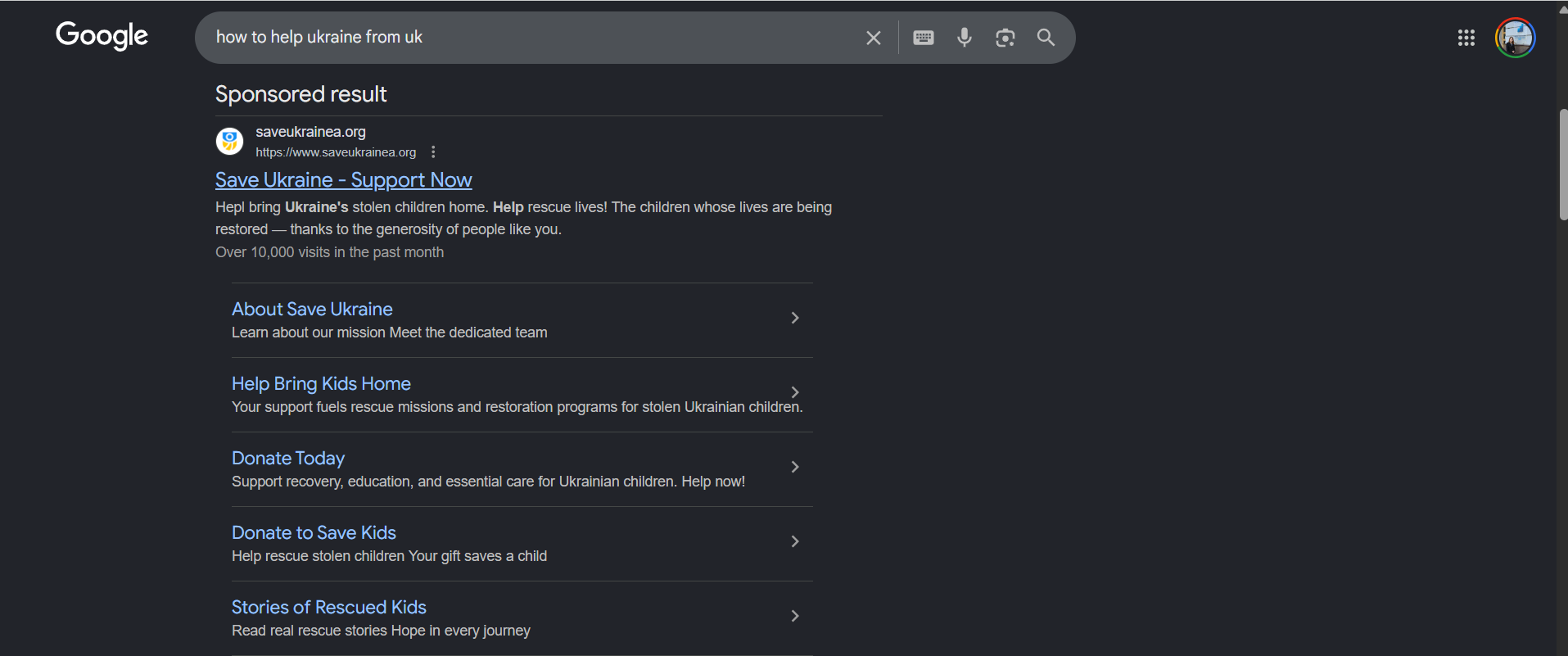
Pro Tip for NGOs: You can apply for Google Ad Grants, which provides up to $10,000 per month in free search ads for eligible non-profits!
Display & Banner Ads:
These are the visual banners you see on the side of news websites or blogs. They are excellent for "Retargeting" — reminding people who have already visited your website to come back and complete an action.Real-World Case: Save the Children. Imagine someone visits the Save the Children website, reads about child hunger, but leaves without donating. Using tools like the Google Display Network, the charity places a visual banner on a news website that user visits the next day. The banner acts as a gentle visual reminder (a "nudge") to return and complete their donation.

Native & Influencer Ads:
Paying a trusted community figure or a niche blogger to talk about your project naturally within their own content. In the Web3 and social impact space, an authentic endorsement from a trusted creator is often more powerful than a traditional banner ad.Real-World Case: #TeamTrees by MrBeast & Arbor Day Foundation. Instead of buying traditional corporate ads, this initiative partnered with hundreds of YouTube influencers. These creators made their own authentic, native videos about planting trees and asked their audiences to donate. Because the message came directly from creators the audience already trusted, the campaign went incredibly viral and raised over $24 million.
-
Students mustMark as done
How to Work with Digital Ads
You do not need a massive budget to run effective digital campaigns (you can start with €5 a day). You just need to understand the architecture. Platforms like Meta (Facebook/Instagram) structure ads in three levels: Campaign (The Goal) ➔ Ad Set (The Audience) ➔ Ad (The Visual/Text).
The Campaign Level: Setting Simple Goals
Before spending a single penny, the platform will ask you for your objective. What do we actually want people to do?
-
Awareness (The Megaphone): You want maximum eyeballs on a new initiative. The platform will show your ad to people most likely to look at it and remember it. Goal: Let people know you exist.
-
Traffic / Clicks (The Bridge): You want people to leave the social platform and visit your website, read a detailed impact report, or sign a petition. The platform shows the ad to people who have a history of clicking links.
-
Engagement (The Conversation): You want people to interact with the post—liking, sharing, commenting, or messaging your page to spark a public conversation.
The Ad Set Level: Budgeting and Targeting
The true superpower of digital ads is precision. You are not buying a billboard on a motorway hoping the right person drives past; you are delivering a message directly to people who already share your values.
Cold vs. Warm Audiences
- Cold Audiences (Interest-Based): These are people who don't know you yet. You target them by defining location, interests, and demographics.
- Warm Audiences (Custom Retargeting): This is where the magic happens. You can tell Meta to show your ad only to people who have already engaged with your Instagram page in the last 90 days, or people who watched 50% of your last video. They already trust you, making them 10x more likely to donate or sign up!
Setting Up Targeted Ads in Meta Business Suite
To run professional ads, never use the simple "Boost Post" button on your phone. It limits your targeting and wastes your budget. Instead, use the Meta Business Suite (Ads Manager), which gives you full control.
Stepping into the Meta Business Suite for the first time can feel overwhelming – there are dozens of buttons, graphs, and settings. But do not worry! You only need to understand a few core features to launch a successful campaign. In the video tutorial below, we will demystify this dashboard.
Quick Setup Checklist:
- Goal: Choose your objective (e.g., "Get more website visitors").
- Schedule & Budget: Set duration and a small daily budget (e.g., €5.00).
- Audience: Define location, age, and interests in the Detailed Targeting box.
- Creative: Upload authentic photos/videos, paste your impact-focused story, and choose a Call to Action button.
- Publish: Review the mobile preview and click "Promote Now."
-
-
Students mustMark as done
Balancing Organic Growth and Paid Strategies
Before we look at the comparison, let's clearly define our terms:
🌱 Organic Promotion is the digital equivalent of word-of-mouth. It involves posting content on your feed, engaging in comments, and naturally growing your audience without spending money on distribution. It relies on the platform's algorithm and community sharing. It builds deep, authentic trust but takes significant time.
📢 Paid Promotion, on the other hand, is the digital equivalent of buying a targeted megaphone. You pay the platform to guarantee your message is placed directly in front of a specific, defined audience, bypassing the natural algorithm for immediate visibility.
A healthy digital strategy requires a balance of both paid and organic efforts. They are not competitors; they are partners. Relying solely on organic growth might mean your project starves for attention in the beginning, while relying only on paid ads can make your project feel like a soulless corporation. Let's see how their strengths and weaknesses compare.
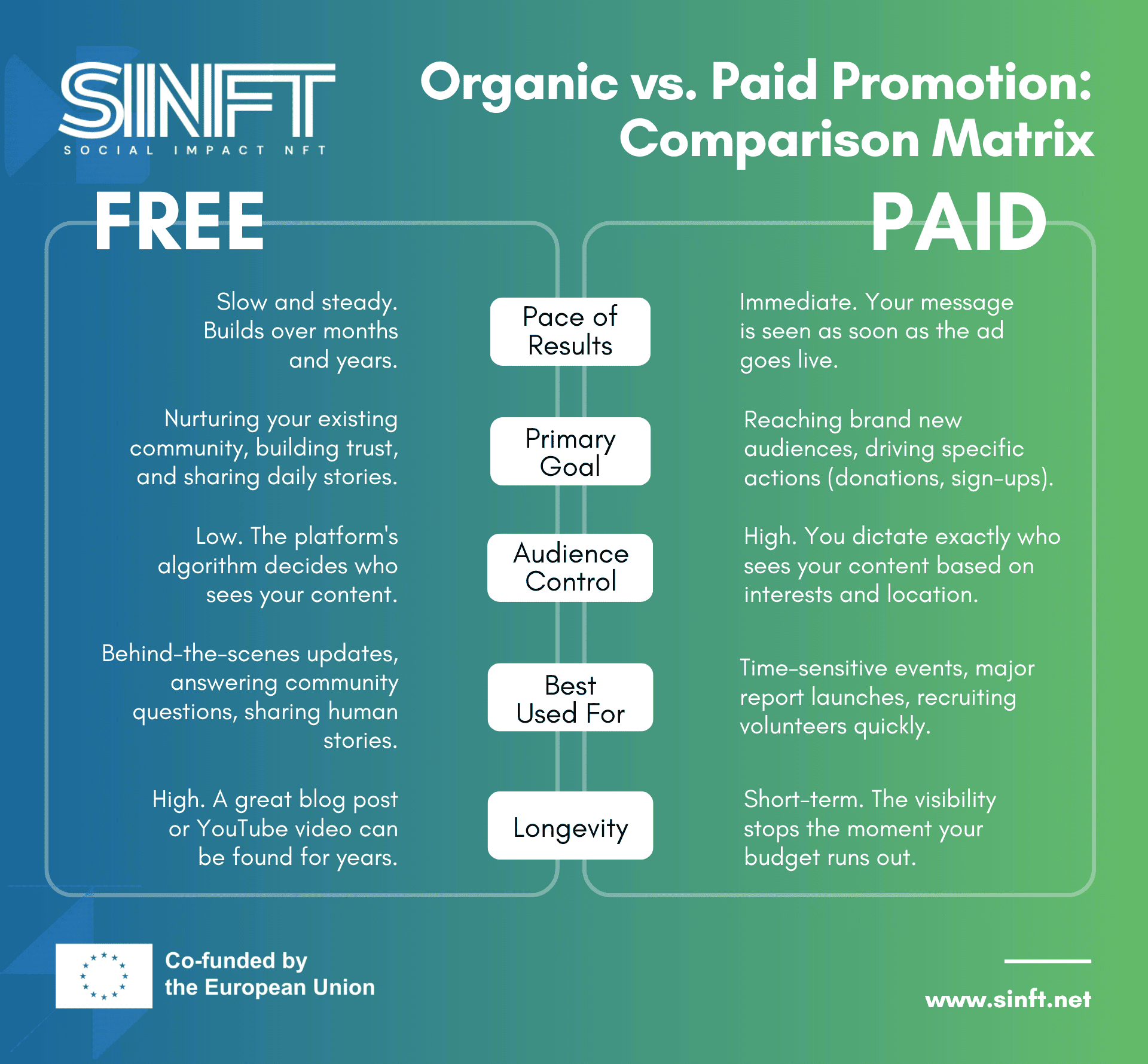
How to combine them? Do not guess what will make a good ad. Use your organic content as a testing ground. Post 4 or 5 different stories organically for free. See which one naturally gets the most likes, comments, and shares from your core community. Take that specific winning post and turn it into a Paid Ad. If your current community loved it, the algorithm will easily find new people who will love it too.
-
Students mustMark as done
Impact-Focused Messaging
How do you promote a social cause without sounding like a
pushy salesperson?Shift your focus from selling to storytelling. In Web3, avoid aggressive "shilling" ("Mint now!", "To the moon!"). Frame the call to action around the tangible result. Blend digital art with real-world visuals, and ditch the heavy crypto jargon.Use these frameworks for ad copywriting:
The AIDMA Model (For short ads):
- Attention: Hook them immediately.
- Interest: Explain why it matters now.
- Desire: Show the benefit.
- Memory: Make it stick.
- Action: Tell them what to do.
Example (Ocean Cleanup Initiative):
(A) Did you know 70% of city plastic ends up in our local river? (I) Our volunteer teams have been tracking this pollution for a year, and the levels are rising fast. (D) Imagine a river where our kids can safely swim again, free of toxic waste. (M) Last month, we removed 2 tons of plastic — but we need more hands. (A) Click the link below to join our next Sunday cleanup!The DIBABA Model
-
Define the specific community need or problem.
-
Identify with the audience's shared values and emotions regarding this issue.
-
Build trust by showing how your project effectively addresses the need.
-
Acceptance: Share a brief testimonial or data point to prove your work is real.
-
Buy-in: Create a desire to be part of the solution.
-
Action: Provide a clear, low-friction next step.
Example (Youth Digital Hub):
(Define) Right now, over 40% of youth in our region lack access to laptops and digital skills. (Identify) Like you, we believe that talent is everywhere, but opportunity is not. No young person should be left behind in the digital age. (Build) That’s why we launched the 'TechBridge Hub', providing free coding classes and computer access after school. (Acceptance) Since January, 150 students have already built their first websites, and 10 have secured paid internships. (Buy-in) You have the power to help us keep these doors open and launch the next generation of digital leaders. (Action) A €10 donation sponsors one student's internet access for a month. Tap 'Donate' to make a real impact today.Launch a Movement, Not Just an Ad
The digital landscape is incredibly noisy, but authentic social impact always cuts through. Your goal is no longer to just "post and hope" — it is to take proactive control of your visibility.
Remember that behind every data point, algorithm, and targeting metric is a real human being looking to be part of something meaningful. Whether you are relying on the steady, trust-building growth of organic content or the immediate megaphone of paid advertising, your core mission remains the same: transforming passive scrollers into passionate advocates.
Do not be afraid to invest in your visibility. Use these communication frameworks to speak from the heart, step out of the traditional corporate monologue, and start putting your project directly in front of the people who are already waiting to support your cause.
-
Ready to test your knowledge?
Take this quick 5-question quiz to review the key concepts covered in this lesson. This brief knowledge check will help you reinforce what you've learned and ensure you're ready to apply these new strategies to your own project.
Shape the Future.
Mint the Change.