
Lesson 2 - Working in diverse/multicultural teams
COMMUNICATION
Section outline
-
Intercultural teams refer to groups of individuals from diverse cultural backgrounds, working together toward a common goal or objective. These teams consist of members with different languages, beliefs, customs, values, and communication styles. The importance of intercultural teams lies in their ability to leverage this diversity as a strength, fostering a rich pool of perspectives, experiences, and knowledge. Such teams play a crucial role in today's globalized world, where organizations operate on an international scale, and cultural differences are inevitable.
The significance of intercultural teams includes:
Enhanced Problem-Solving: Intercultural teams bring together individuals with unique problem-solving approaches, increasing the likelihood of innovative and comprehensive solutions.
Increased Creativity and Innovation: The exchange of diverse ideas and perspectives promotes creativity, leading to a more innovative work environment.
Improved Communication and Adaptability: Interacting with people from various cultures enhances team members' communication skills and adaptability, making them more effective collaborators.
Cultural Exchange and Learning: Intercultural teams offer opportunities for members to learn about each other's cultures, fostering mutual respect and appreciation.
On the other hand, to express the above-mentioned addedd value, multicultural teams ofter face challenges, especially in the building process. They might encounter:
- Communication Barriers: Language differences and communication styles can lead to misunderstandings and misinterpretations.
- Conflicting Norms and Values: Conflicting cultural norms and values may cause clashes within the team.
- Stereotyping and Bias: Preconceived notions about certain cultures may lead to bias and hinder effective collaboration.
- Power Imbalance: Cultural differences can sometimes result in power imbalances within the team, affecting decision-making and cooperation.
- Resistance to Change: Some team members may be resistant to embracing diversity, viewing it as a threat to the status quo.
Cultural dimensions refer to the aspects of culture that influence individuals' behaviors, beliefs, and communication styles. These dimensions help us understand how cultures differ from one another and why certain practices are more prevalent in some societies than others. Some widely recognized cultural dimensions include individualism vs. collectivism, power distance, uncertainty avoidance, masculinity vs. femininity, and long-term vs. short-term orientation.
Understanding cultural dimensions and variations is essential for effective intercultural communication and collaboration. By recognizing and appreciating cultural differences, individuals can adapt their communication styles, manage expectations, and build positive relationships across cultures.
So-called "Cultural Intelligence" (CQ) refers to the ability to interact and work effectively with people from different cultural backgrounds. Developing cultural intelligence enables individuals to adapt, understand, and function in multicultural environments. Culturally intelligent individuals can recognize cultural differences, navigate cultural challenges, and build meaningful connections across cultures.
Given that Cultural intelligence is fundamental working and/or managing multicultural teams, a sort of requirement to be able to actively participate in, reserach also confirm that multicultural teams are more cretaive compated to homogeneus teams, especially those with deep-level diversity. For sure, on the other hand, multicultural teams can encounter difficulties in cooperation, due to linguistic barriers, but, with proper support and enough tema, the interaction might be smooth and productive. If you would like to explore more on how to manage and interact with multicultural teams, look at the video here ("Managing Multicultural teams"):
Making a step forward, according to Deloitte, every professional, worker and especially leader, must have specific capacities and skills to work in multicultural environments and to motivate multicultural teams. This skills are visulaised in the table below (source: Six signature traits of inclusive leadership | Deloitte Insights)
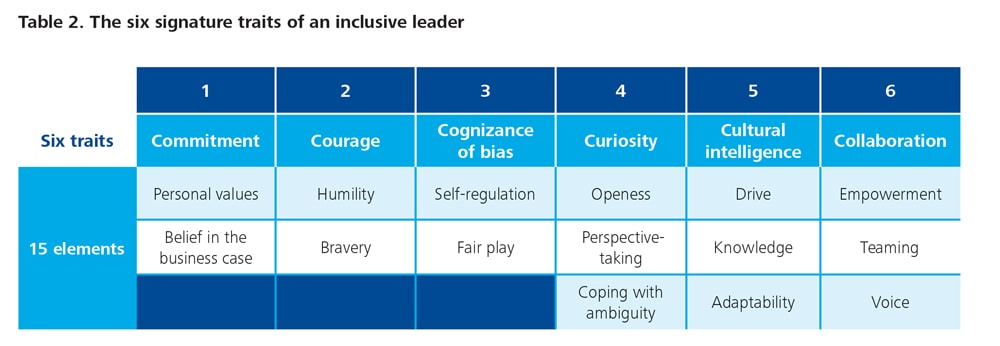
In short, if you would like to actively take part in effective multicultura teans, you should consider the above mentione skills as "critical" or fundational. Those skills are also crucial for effective team management and to reach set common goals. More in detail:
- Be goal-oriented: this means to have clear in mind what you have to reach in terms of results by cooperating with others, to b committed, convinced and even, to be able to orient others' activities and behaviours (leadership).
- Be curious: curiosity is essential to stay open and to see new opportunities. Curiosity means exploration, and finding out-of-the-box solutions.
- Cultivate self-determination and empowerment: we have been living in challenging times, working in teams can be a valuable way of facing complexity, (complex problems, complex projects, etc.), but the capacity of stay motivated in the long run, even in front of difficulties which might happen, stay focused on the result to be obtained, managing our own resourses/capacities, pays a crucial role in the process.
- Active listing: working with other is great because everyone can bring different perspectives, different way of thinking and feeling. Diversity is a value and it is important to listen to the others, to get this potenatial reachness in analysing questions, facts and problems.
-
-
Students mustMark as done
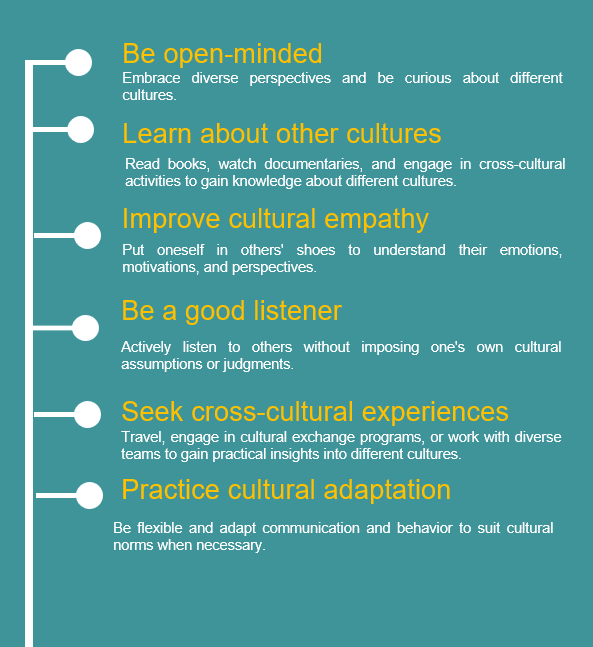
Follow these steps to reinforce your cultural intelligence!

Shape the Future.
Mint the Change.