
Critical & Media Literacy
From Civic Story to Civic NFT
1. The Core Idea: Format vs. Meaning
Before anything else, one distinction matters above all others in this lesson:
|
The NFT is the FORMAT — a digital container. It gives a digital object verified uniqueness on a blockchain. It does not, by itself, create any meaning. |
The Story gives the NFT its MEANING — the civic values, human experiences, and community connections that the digital object represents. |
Think of it this way: a printed poster can carry a powerful human rights message — or it can carry an advertisement for shampoo. The format (printed paper) is the same. The meaning comes entirely from what is on it and why it was created.
The same is true for NFTs. The blockchain provides the container. The civic story provides the content. Both are necessary for a civic NFT to have real purpose.
This lesson explores how civic educators, youth workers, and young activists can move intentionally from a civic story to a digital object that carries genuine meaning — and when doing so adds value, and when it does not.
2. The Framework: Five Steps from Story to Digital Object
Creating a meaningful civic NFT is not primarily a technical process. It is a design process — and it begins long before anyone thinks about blockchain. The five steps below show how a civic story becomes a digital object with genuine purpose.
|
1. STORY What happened? Who? |
2. EMOTION Why should people care? |
3. VALUE What civic idea does it represent? |
4. VISUAL SYMBOL How does it look? |
5. DIGITAL OBJECT How do people engage with it? |
Each step builds on the previous one. If you skip straight to step 5 without working through 1 to 4, the result will be a digital object without a civic purpose — a format without meaning.
Step 1 — Story: The Human Entry Point
Every civic issue is easier to understand when it is connected to a person or a community experience. Abstract statements — 'refugees face barriers to integration' or 'young people are excluded from decision-making' — are accurate but difficult to feel.
A story makes the same issue concrete. It gives the audience someone to follow, a moment to experience, and an outcome to care about. This is why civic storytelling — whether in journalism, documentary film, or digital art — always starts with a specific person, event, or place rather than a general claim.
The five elements of a strong civic story work here just as they do in narrative writing:
• CHARACTER — a specific person or community, not a category
• CONFLICT — the tension, barrier, or injustice they face
• ACTION — what they do in response, however small
• RESOLUTION — what changes, or begins to change
• MESSAGE — the civic value or idea the story represents
Step 2 — Emotion: What Should the Audience Feel?
Not all emotions serve civic storytelling equally well. Pity, for example, tends to reduce people to their vulnerability. It positions the audience as observers of suffering rather than participants in change. Civic storytelling works better when it generates emotions like:
• solidarity — the sense that this affects all of us, not only some of us
• agency — the feeling that change is possible, and that the audience can be part of it
• recognition — the experience of seeing your own values or struggles reflected in someone else's story
• admiration — respect for the courage or persistence of the people in the story
The emotional arc matters too. The most effective civic stories move from tension toward possibility — not from suffering toward despair. They show that something can shift, even if the broader issue has not been solved.
Step 3 — Value: Naming the Civic Idea
Once the story is clear and the emotion is identified, the creator needs to name the underlying civic value. This is the conceptual bridge between the story and the digital object. It answers the question: what does this experience represent as an idea?
Common civic values that appear in digital civic art include:
|
Belonging |
Solidarity |
Freedom |
|
Inclusion |
Justice |
Environmental responsibility |
|
Dignity |
Participation |
Collective memory |
Naming the value precisely matters. 'Inclusion' is more specific than 'good things'. 'Environmental responsibility' points in a different direction than 'nature'. The more specific the value, the more intentional the visual design can be.
Step 4 — Visual Symbol: From Abstract to Visible
This is where the design work begins. The question is: how do you translate an abstract civic value into a visual form that communicates it without words?
Effective visual symbols in civic digital art share a few common qualities. They are simple enough to read immediately — not cluttered with detail. They are specific enough to carry meaning — not so generic that they could represent anything. And they connect to the human experience behind the value — they feel rooted in a real story, not floating in abstraction.
Consider how different visual approaches might represent the value of belonging:
• a circle formed by many different lines joining from different directions — representing convergence from diversity
• a table with many hands of different sizes and colours reaching toward the centre
• a seed growing between two hands — representing cultivation of community
• a door standing open in a crowd — representing access and welcome
None of these is 'correct'. What matters is that the creator can explain the connection between the image and the value — and that the visual has been chosen deliberately, not randomly.
Step 5 — Digital Object: Choosing the Right Format and Purpose
Only at this final step does the question of NFT technology become relevant. The question to ask is not 'should we make an NFT?' but rather: what would this format add to the civic goal we already have?
Possible answers with genuine civic logic:
• We want to create a verifiable record of participation in a civic programme — the NFT functions as a digital credential.
• We want to connect a community of people around a shared value — the NFT functions as a membership symbol.
• We want to raise funds transparently for a cause — the NFT functions as a fundraising mechanism where every transaction is publicly traceable on the blockchain.
• We want to preserve a campaign digitally in a way that cannot be altered or deleted — the blockchain's permanence serves the archival purpose.
If none of these answers applies, a different format — a printed poster, a short film, a social media campaign, a traditional badge — may serve the civic goal better. Technology should always serve the purpose, not the other way around.
Model 1 — NFT as Story: Making Civic Experience Visible
In this model, the NFT is primarily a vehicle for a story or message. The artwork carries the civic content directly — in its imagery, its title, its description, or the community context in which it was created. The digital object communicates independently of whether it is bought or sold.
The civic logic here is similar to a poster, a photograph, or a mural — except that the NFT format provides global reach, digital permanence, and the possibility of spreading through online communities in ways that physical formats cannot.
What makes this model effective:
• The artwork represents something specific — a value, a community, a historical moment — rather than being decorative.
• The creator can explain the story behind the piece, creating a direct connection between audience and civic content.
• The NFT can be shared, displayed, and referenced without being sold — its civic purpose does not require a financial transaction.
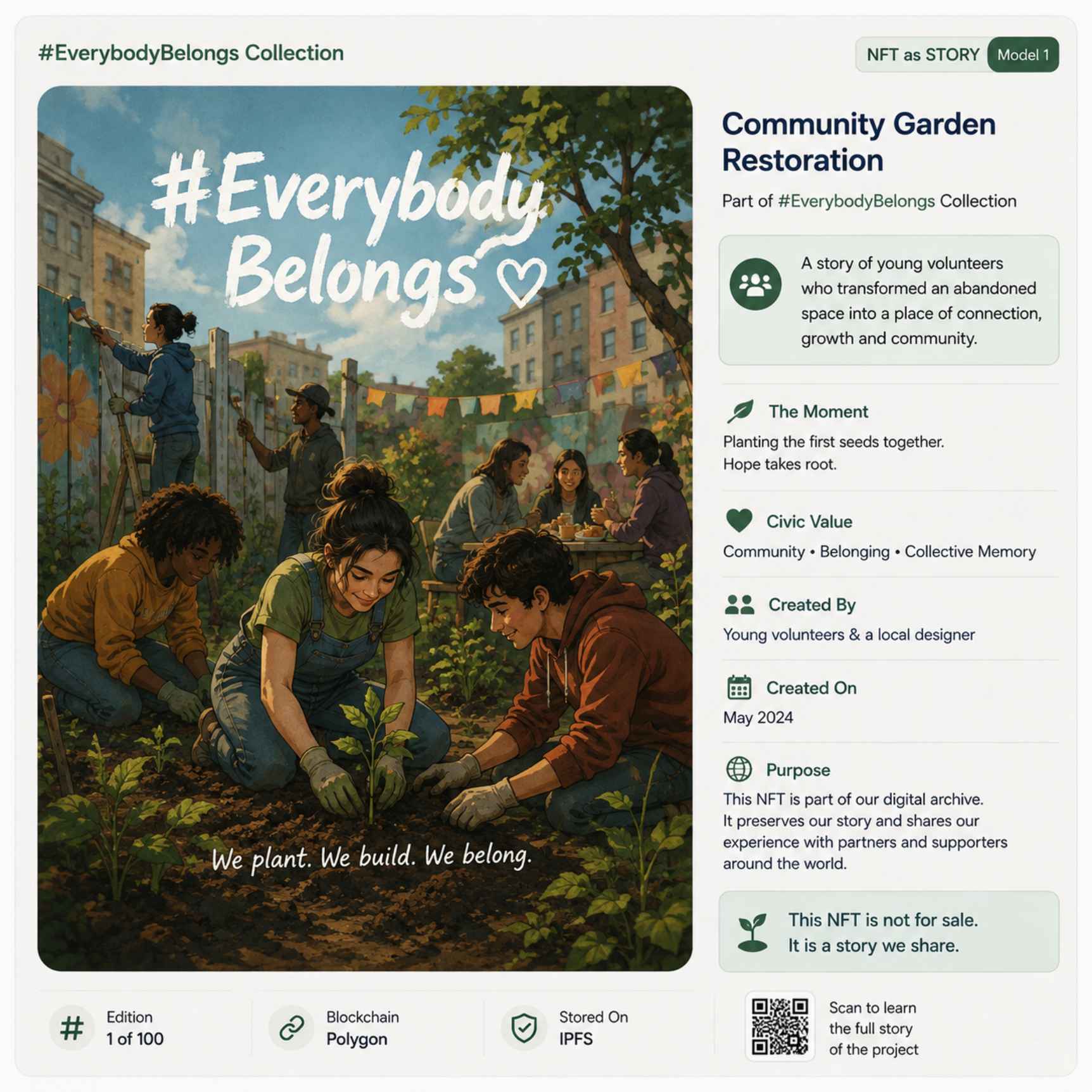
Example — #EverybodyBelongs
Imagine a group of young volunteers who restore an abandoned community garden. A young designer turns their experience into a series of digital illustrations showing moments of cooperation, connection, and change.
The illustrations become a small NFT collection that preserves and shares the story of the project.
Civic value: Community · Belonging · Collective memory
NFT's role: Digital archive · Storytelling · Sharing
No sale is necessary. The NFT achieves its civic purpose simply by carrying and preserving the story.
Example 2 — World Scouting's JOTA-JOTI 2024 NFT Badge
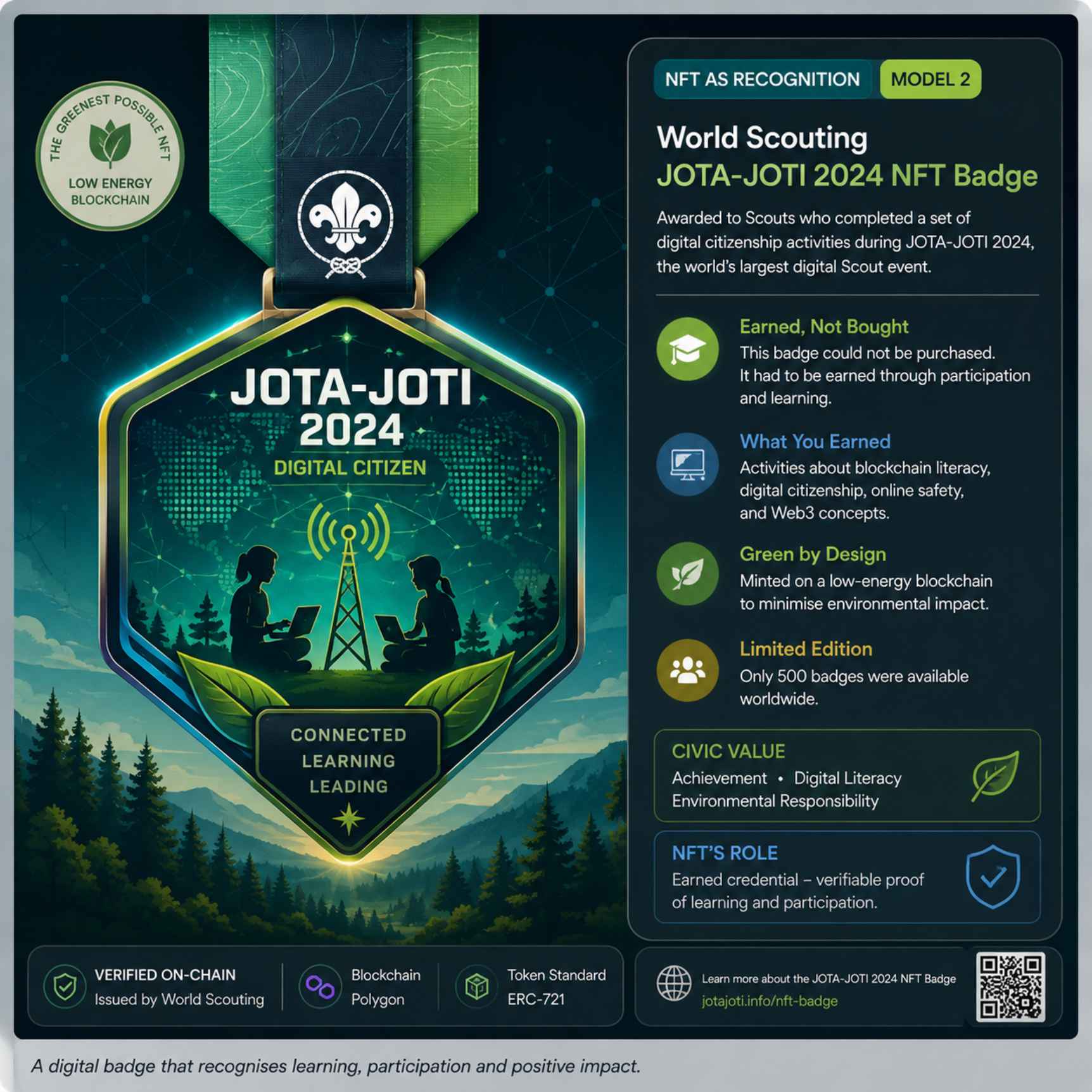
During JOTA-JOTI 2024, World Scouting introduced an NFT badge that participants could earn by completing digital learning activities. Unlike a traditional NFT that is bought or traded, this badge was designed to recognise learning and participation.
The example shows how an NFT can function as a digital credential: it connects a specific achievement to a verifiable digital badge.
Civic value: Achievement · Digital literacy · Participation
NFT's role: Earned credential · Proof of learning and participation
The key idea: you don't buy the badge — you earn it through action and learning.
💭 Think about it:
How is an NFT that you earn through civic participation different from an NFT that you simply buy?
#Example 3 — NFT as Fundraising: Art Connecting Audience to Cause
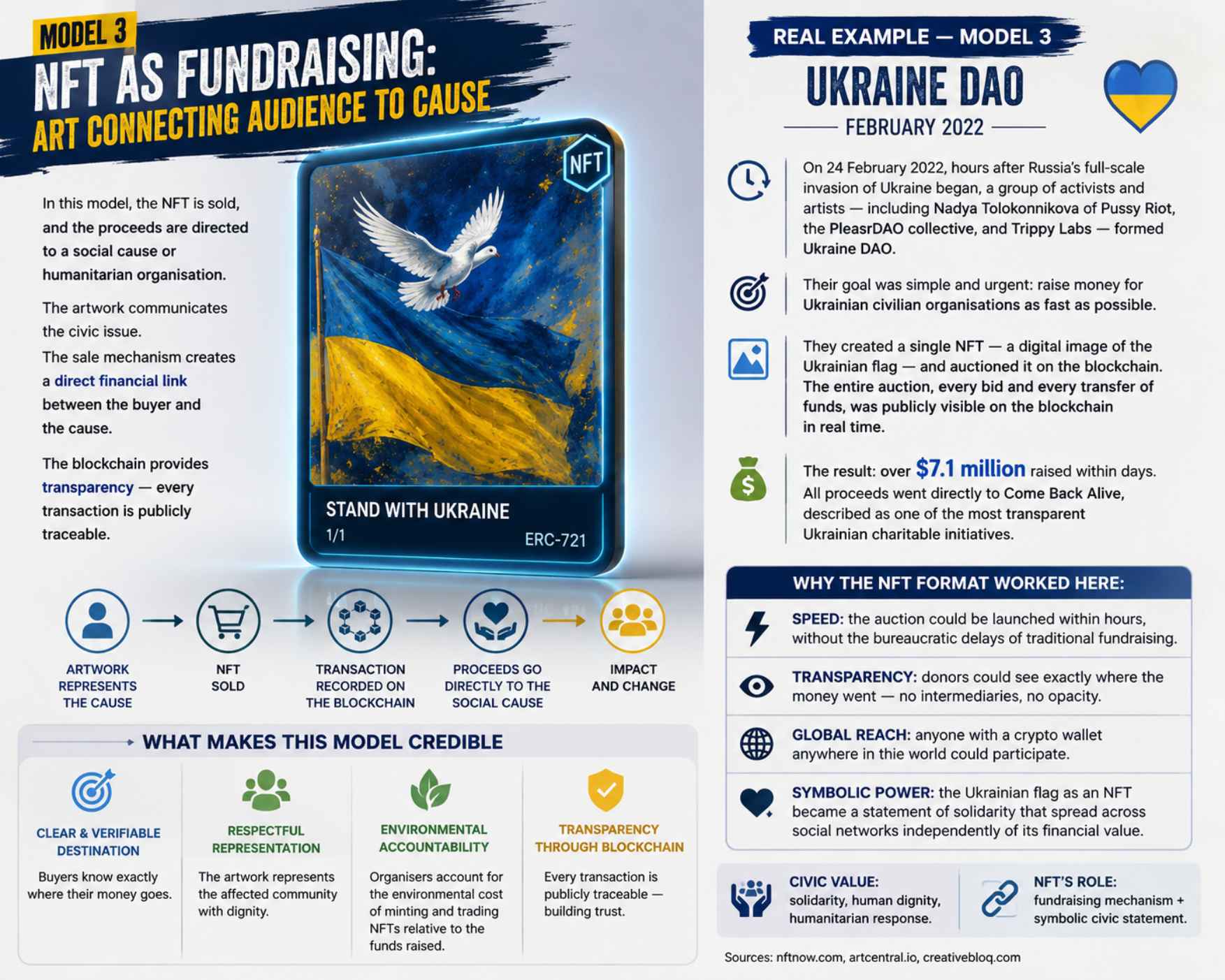
🖼️ About this Visual
This visual shows how an NFT can function as both a fundraising mechanism and a symbolic expression of solidarity. The artwork attracts attention to a cause, the NFT transaction connects supporters financially to that cause, and blockchain technology can make the movement of funds publicly traceable.
The Ukraine DAO example demonstrates the potential of this model at scale. However, successful fundraising alone does not automatically make an NFT campaign responsible.
The key question is not only “Can an NFT raise money?” but “Should an NFT be used for this cause — and can it be done responsibly?”
🔍 Look Closer
As you explore the visual, notice the three relationships:
ARTWORK → communicates the cause
TRANSACTION → connects the supporter to the cause
FUNDS → create potential real-world impact
Blockchain adds another layer: traceability. But transparency of transactions does not automatically guarantee ethical storytelling, responsible use of funds, or meaningful impact.
⚖️ Ethical Check: Before You Mint
Before choosing NFT fundraising, an organisation should be able to answer five questions:
1. Follow the money.
Where exactly will the funds go, and how will supporters be able to verify this?
2. Protect dignity.
Does the artwork represent affected people respectfully, or does it turn their suffering into something designed to generate sales?
3. Consider the environmental footprint.
What environmental costs are associated with the chosen blockchain, and are they proportionate to the campaign's expected benefit?
4. Enable informed participation.
Do buyers clearly understand what they are purchasing, what their contribution supports, and what it does—and does not—guarantee?
5. Ask whether an NFT is actually necessary.
Could a simpler, cheaper, or more accessible fundraising method achieve the same—or greater—impact?
💭 Learning Pause
Imagine your organisation wants to raise €10,000 for a local environmental project.
You have two options:
A. Create and sell an NFT collection.
B. Launch a traditional online donation campaign.
Before choosing, ask yourself:
What additional civic value would the NFT create that a normal donation page could not?
If the answer is only “because NFTs are innovative”, that may not be a strong enough reason to use the technology.
💡 Key Takeaway
Technology should serve the civic purpose — the civic purpose should not be redesigned simply to justify using the technology.
These ethical questions are not arguments against NFT fundraising. They are what distinguish responsible civic innovation from opportunistic use of a technological trend.

Shape the Future.
Mint the Change.