
Critical & Media Literacy
NFTs as Civic Expression
What is an NFT?
Most people first encounter the word "NFT" in the context of expensive digital art sold for millions of dollars — and that association is not entirely wrong, but it is incomplete. To understand why NFTs matter for civic life, it helps to start with what they actually are, stripped of the hype.
An NFT — Non-Fungible Token — is a unique digital item stored on a blockchain. Unlike an ordinary digital file, which anyone can copy infinitely with no way to tell the original from the copy, an NFT has a verified owner, and that ownership can be checked publicly through blockchain technology. Think of it as a digital certificate of authenticity: anyone can see the image, the badge, or the file, but only one person — or one verified holder — actually owns the original.
NFTs can represent almost anything digital: artwork, photographs, music, videos, game items, digital certificates, and — most relevant for this lesson — civic achievements.
Watch a beginner-friendly video explaining what an NFT is:
💡 Key takeaway
Most people know NFTs because of expensive digital art.
However...
NFT technology can also support democracy and civic participation.
Instead of selling expensive artwork, communities can create NFTs that recognise:
volunteering environmental action youth participation human rights education community leadership
The value is not money. The value is recognition, identity, and belonging.
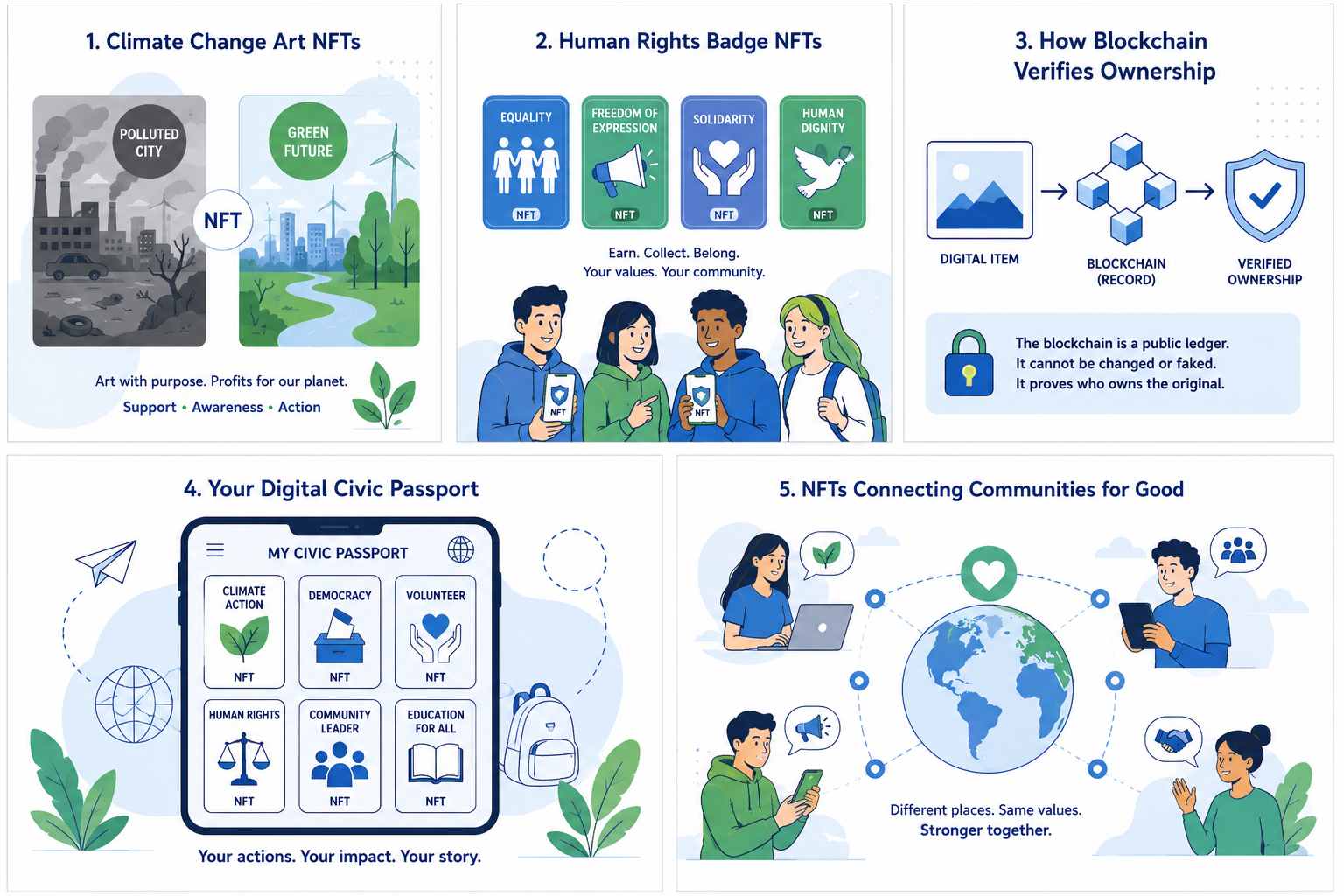
Figure 1. Examples of how NFTs can be used to promote civic participation and social impact.
What does this infographic show?
This infographic illustrates five concrete ways in which NFT technology can serve civic purposes — moving beyond financial speculation toward meaningful community impact. Each example demonstrates a different dimension of how digital ownership can recognise, reward, and connect people around shared values
🌱 1. Climate change art NFTs
Artists and activists can collaborate to create collections of digital artworks that visualise environmental issues — from polluted cities to sustainable futures. Each NFT in the collection carries a civic message and, when acquired, directly supports the financing of climate projects or environmental NGOs. This model transforms art consumption into a form of civic contribution: the act of owning an NFT becomes a public statement of environmental commitment.
🏅 2. Human Rights badge NFTs
Youth organisations and non-formal education providers can issue digital badges to participants who complete workshops, training programs, or civic activities related to human rights, equality, freedom of expression, or solidarity. Unlike paper certificates, these badges are stored on blockchain — meaning they are verifiable, permanent, and impossible to forge. A young person who completes a human rights course receives not just a certificate, but a piece of verifiable digital evidence of their learning and engagement that they can carry and display across platforms.
🔗 3. Verified digital ownership
At the core of all civic NFT applications is the principle of verified digital ownership. Blockchain technology ensures that every NFT is unique, traceable, and publicly verifiable — which means that a digital achievement, badge, or contribution record can be trusted in the same way a physical stamp or signature would be. This has significant implications for civic life: for the first time, it is possible to create digital credentials that are genuinely tamper-proof and independently verifiable without relying on a central institution.
📱 4. Digital civic passport
Rather than collecting disconnected certificates and paper documents, young people can build a digital civic passport — a structured portfolio of NFT badges representing their volunteering history, climate action, democratic participation, and community leadership. This passport grows over time and tells a coherent story of a young person's civic identity. It can be shared with employers, educational institutions, or civil society organisations as credible evidence of non-formal learning and active citizenship.
🌍 5. Global civic communities
Perhaps the most transformative application of NFTs for civic purposes is their ability to build communities across borders. When people hold the same NFT — whether it represents a shared value, a completed action, or membership in a cause — they are connected by a verifiable common identity. This creates the foundation for global civic communities: networks of people who share not just an interest, but a demonstrated commitment to a cause, recognised and recorded in a way that is transparent and open to all.
Together, these five examples illustrate a broader principle: NFT technology is not inherently about money or speculation. In the right hands, with the right intent, it can become a powerful infrastructure for recognising civic contribution, building community identity, and connecting people around shared values across the world.

Shape the Future.
Mint the Change.