
Critical & Media Literacy
Case example - Youth Civic Blog
In the previous section, we saw that effective digital civic action starts with a purpose, not with a tool.
Now consider a simple example.
🗳️ The challenge
A group of university students in Moldova noticed a problem among young people preparing to vote for the first time.
Information about local elections was available online, but much of it was written in formal or institutional language. Young people could find information — but they did not always understand how local elections affected their everyday lives.
Questions kept appearing:
What does a local council actually do?
Why should I care about local elections?
How can I participate beyond voting?
Are the things I hear about elections actually true?
The students identified a clear civic need:
Young first-time voters needed accessible and practical information about local democracy.
💡 Choosing the Right Digital Tool
The students considered several ways to respond.
A social media campaign could reach people quickly, but individual posts would provide limited space for explanation.
Short videos could attract attention, but more complex questions would still require additional information.
They therefore decided to create a youth civic blog.
Why a blog?
Because their primary goal was not simply to generate visibility. They wanted to create a resource where young people could read, understand and return to reliable information when they needed it.
This illustrates an important principle:
The tool was chosen because it matched the civic purpose — not because it was the most popular platform.
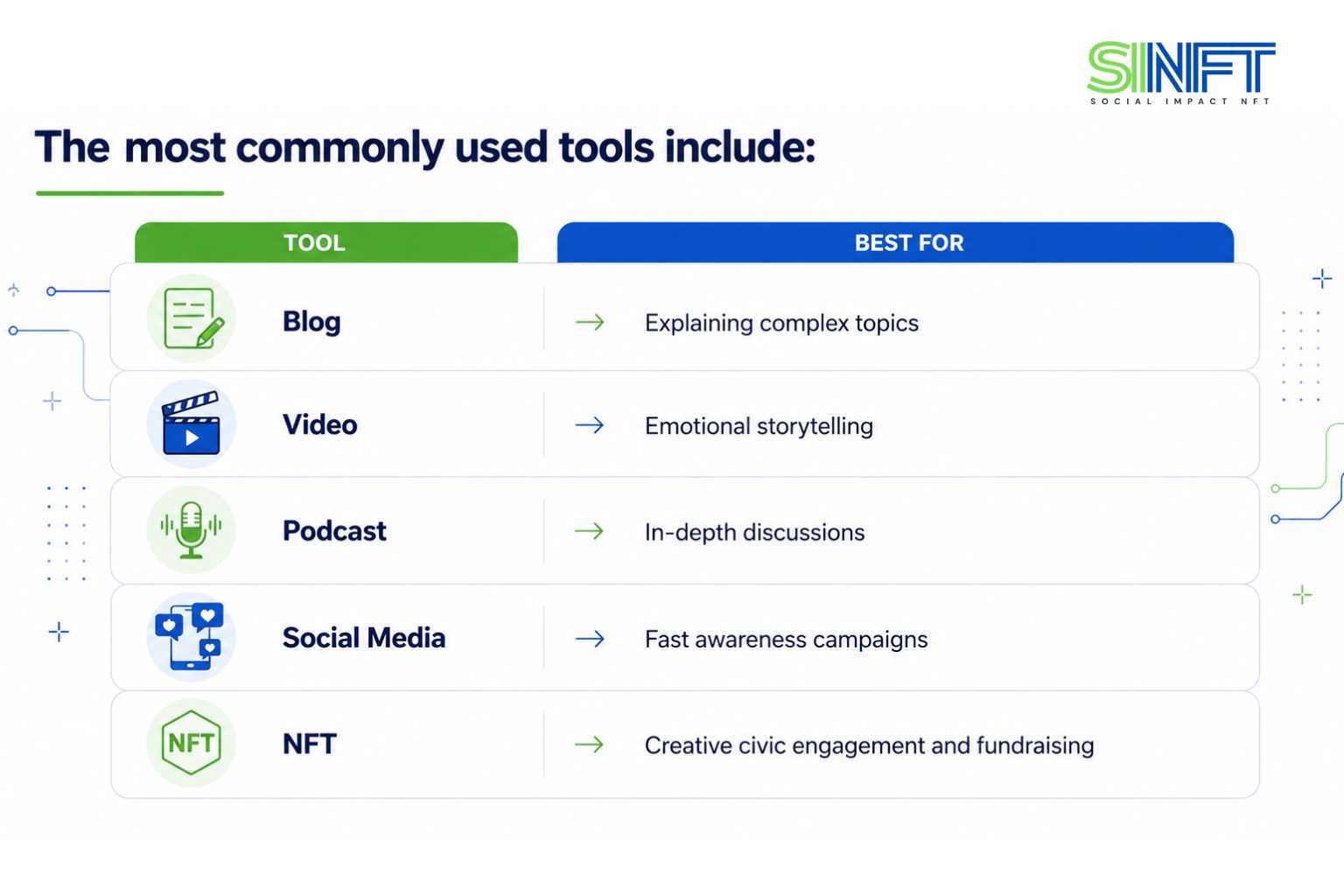
The most commonly used tools include:
📝 What did they create?
The blog published youth-friendly articles explaining:
- how local elections work;
- what local councils actually decide;
- how citizens can participate in local democracy;
- common myths and misconceptions about voting.
But the students did not simply reproduce official information.
They translated complex ideas into clear language, added local examples, used infographics, and included practical questions relevant to first-time voters.
For example, instead of only explaining the formal responsibilities of a local council, an article might ask:
Who decides whether your neighbourhood gets a new park, better street lighting or safer public spaces?
The institutional concept suddenly becomes connected to everyday life.
📣 From publishing to reach
Creating the blog was only the first step.
At first, its audience grew slowly. Unlike a short social media video, an article did not automatically reach large numbers of people.
The students therefore began sharing the articles through:
student councils → youth organisations → teachers → social media → peer networks
Gradually, other organisations started using and sharing the content as well.
This created something more valuable than a single viral post:
a reusable civic learning resource.
🔎 Looking at the Case through the four key concepts
🗣️ CIVIC EXPRESSION
What was the message?
Local democracy affects young people's everyday lives, and first-time voters should be able to understand how they can participate.
💻 DIGITAL TOOL
Why a blog?
The topic required explanation, examples and information that readers could revisit.
🌍 REACH
How did the message reach people?
Through schools, student councils, youth organisations, social media and peer sharing.
🎯 CIVIC VALUE
What made the tool useful?
The blog transformed complex institutional information into accessible knowledge that young people could use.
⚖️ What Did the Blog Do Well — and What Could It Not Do?
What worked
✓ Accessible language
✓ Practical, locally relevant information
✓ Visual explanations
✓ Content that could be reused and shared
✓ More space for depth than short social media posts
What remained difficult
⚠ Articles required time to research and update
⚠ Reach grew more slowly than on social media
⚠ Continuous promotion was necessary
⚠ Publishing information alone could not guarantee that young people would actually vote or participate
Did the blog have civic impact?
This question is more difficult than it first appears.
Imagine that the blog received:
8,000 page views
1,200 shares
500 returning readers
These numbers tell us something about reach.
But do they tell us whether young people became better informed?
Or whether they participated in the election?
Not necessarily.
To understand civic impact, the students would need to ask deeper questions:
Did readers understand local elections better?
Did the content correct misconceptions?
Did young people discuss local issues differently?
Did anyone participate because of what they learned?
Reach tells us how far the message travelled. Impact asks what happened because it arrived.

Shape the Future.
Mint the Change.