
Critical & Media Literacy
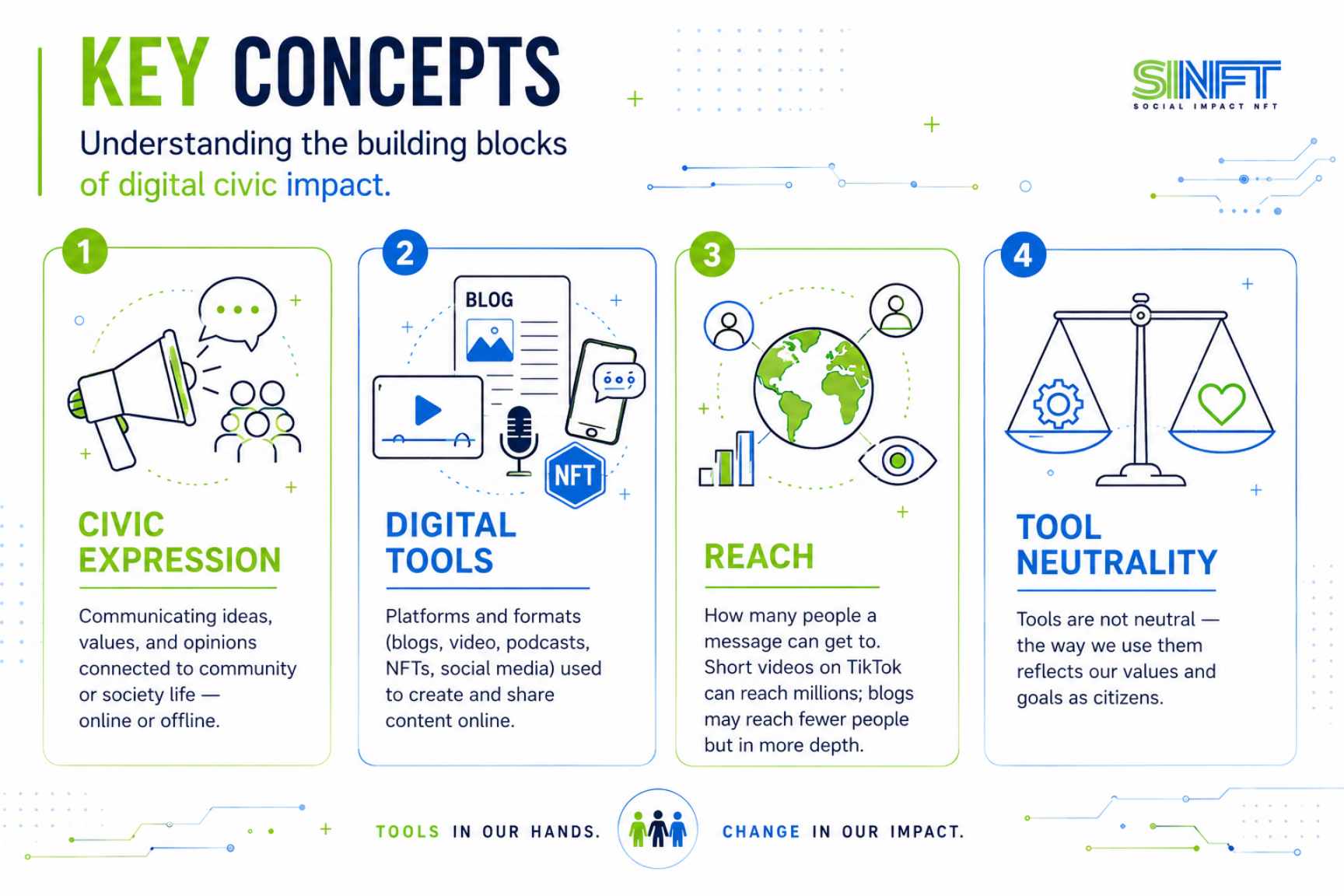
Key concepts of digital civic impact
Every tool shapes how a civic message travels.
Civic expression is not new. People have always used the tools available to them to communicate ideas, challenge injustice, organise communities and influence public life — from public meetings and newspapers to protest songs and community campaigns.
What has changed is the digital environment.
Today, a young person can publish a video, start a podcast, create a digital campaign or share a civic artwork with audiences far beyond their immediate community. This creates new possibilities for participation — but it also requires new choices.
To understand digital civic impact, we need to distinguish four connected ideas.
1. Civic Expression — What are you trying to say?
Civic expression is the communication of ideas, experiences, values or opinions connected to community and public life.
It can be as simple as sharing your perspective on an issue affecting your neighbourhood or as organised as contributing to an international campaign.
For example, a young person might:
- post a video about accessibility barriers in their city;
- create artwork supporting equality;
- interview other young people about unemployment;
- share a petition about an environmental issue.
The starting point is therefore not the technology.
It is the civic message or purpose .
2. Digital Tools — How will your message travel?
Once you know what you want to communicate, you need to choose an appropriate format.
A short video can communicate an idea quickly and emotionally.
A blog allows more explanation and reflection.
A podcast can create intimacy and give space to different voices.
Social media can create conversation and rapid circulation.
A digital badge or NFT may represent participation, identity or ownership of a digital civic object.
The strongest tool is not necessarily the newest one.
The right tool is the one that best serves your civic purpose and your audience.
This is particularly important in SINFT: using an NFT should be a purposeful choice, not the starting point of a project.
3. Reach — Who actually receives the message?
Digital impact is not simply about producing content. Someone needs to encounter, understand and potentially respond to it.
This is where reach matters.
Imagine two youth groups communicating the same environmental message:
Campaign A: a 30-second video reaches 20,000 people, but very few interact with it.
Campaign B: a digital story reaches 300 local residents, generates discussion and brings 25 people to a community meeting.
Which had greater civic impact?
There is no automatic answer. Large reach and meaningful impact are not the same thing.
This distinction will become important later when we examine outputs, outcomes and impact.
4. Tools Shape Participation
Digital tools are not completely neutral channels. Their design influences what becomes visible, how people interact and whose voices are amplified.
A short-video platform encourages brief, visual communication. A discussion forum allows slower and more detailed exchange. Algorithms influence what people encounter. Accessibility features determine who can participate. Platform rules influence what can be published.
So choosing a tool also means considering:
Who can access it? Who might be excluded? What type of communication does it encourage? What data does it collect? Does it support the civic purpose of the project?
This makes tool choice part of responsible digital citizenship.

Shape the Future.
Mint the Change.