
Citizenship Education Framework
2.2 Rights and Responsibilities Online
The internet offers remarkable freedoms — but with rights come responsibilities. In democratic societies, the values that protect us offline also apply in digital spaces. Understanding this balance is central to responsible digital citizenship.
Your rights do not disappear when you go online
When we enter a digital space, we do not leave our rights behind.
You still have the right to express an opinion, protect your privacy, access information and participate in public life. At the same time, digital environments create situations that are less obvious than those we encounter offline.
Imagine you post a video criticising a decision made by your local authorities. Someone disagrees and writes a critical comment. Another person reposts your video together with your full name, school and location. A third person begins sending you threatening private messages.
All of these actions happen around the same post — but they raise very different questions.
Where does freedom of expression end?
When does criticism become harassment?
Who has the right to share someone else's information?
Who is responsible for keeping digital spaces safe?
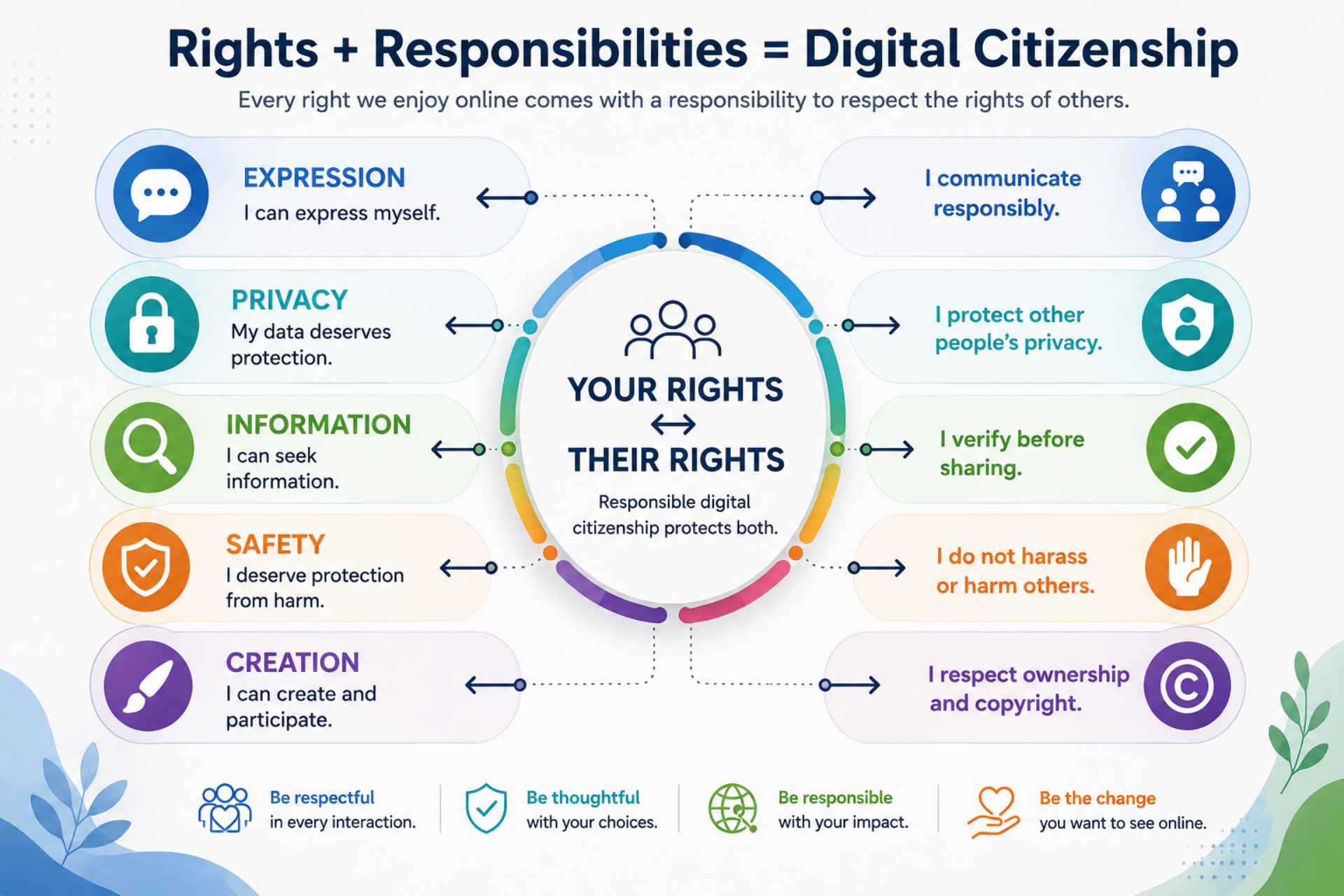
Digital citizenship requires understanding both sides of this relationship:
MY RIGHTS ↔ OTHER PEOPLE'S RIGHTS ↔ MY RESPONSIBILITIES
Your rights Online
Freedom of expression
You have the right to share your ideas, opinions, and creative work online. This is a fundamental democratic right — but it must be exercised responsibly, respecting others' dignity and avoiding hate speech or harm.
Right to privacy
Everyday digital activities generate information about us.
A fitness app may know your location.
A social network may know your interests.
A website may track what you click.
A photo may reveal where you were and who was with you.
Privacy therefore means much more than simply “having nothing to hide.”
Your personal data should be protected. You have the right to control what information is shared about you, who has access to it, and how it is used. This covers photos, location data, messages, and personal details.
Before giving an app permission to access your contacts, camera or location, a useful question is:
Does this service actually need this information to provide the function I want?
Right to access information
You have the right to seek, receive, and access information freely online. This includes news, educational content, and public data — free from unjustified censorship or restriction.
Right to digital safety
You have the right to use digital spaces without harassment, bullying, or threats. Platforms, communities, and governments have a shared responsibility to protect users from harm.
Right to digital identity
You have the right to manage your own digital identity — including the right to be forgotten (to request removal of personal data) and to choose what you share publicly.
Your responsibikities Online
Your responsibilities Online
Avoid Hate Speech & Harassment
Never use digital spaces to bully, threaten, humiliate, or discriminate against others. Online words cause real, lasting harm to real people — harassment is not less serious because it happens online.
→ I communicate without deliberately harming others.
Disagreement is part of democratic life. Harassment, humiliation, and threats are not constructive participation.
Respect copyright
Do not use, copy, or share others' creative work — images, music, videos, text — without permission or proper attribution. Intellectual property rights apply in digital spaces just as they do offline.
→ I respect other people's creative work.
Manage your digital footprint
Be mindful of the data trail you leave online. Posts, likes, comments, and searches can persist for years and affect your education, career, and personal reputation. Think before you click
Verify before sharing
Do not spread information you have not checked. Sharing fake news or manipulated content — even unintentionally — can cause serious harm to individuals, communities, and democratic processes.
→ I verify information before amplifying it.
Respect others' privacy
Do not share photos, personal information, or private messages of others without their explicit consent. Privacy is a right that belongs to everyone — including people who have not asked you to protect it.
→ I respect other people's privacy too.
Take responsibility for your digital footprint
Understand that what you post online may be seen by audiences you did not intend. Consider the potential impact of your content on others before publishing — especially vulnerable groups.

Shape the Future.
Mint the Change.