
Citizenship Education Framework
2. 1 Introduction to Digital Citizenship
Think about what you have already done online today.
Perhaps you checked a message, watched a video, searched for information, reacted to a post, shared a photo, accepted cookies on a website or communicated with someone in another country.
These actions may seem ordinary. But each of them involves choices.
What information do you trust?
What do you share about yourself or others?
How do you respond when someone is attacked online?
Who gets included — and who might be excluded?
How can digital spaces be used to contribute rather than simply consume?
This is where digital citizenship begins.
A digital citizen is not simply someone who knows how to use technology. Digital citizenship is about how we participate in digital environments — safely, critically, ethically and responsibly.
The Council of Europe's approach to Digital Citizenship Education emphasises preparing people, particularly young people, to participate actively and positively in increasingly digital societies.
So there is an important distinction:
Digital skills help you use technology.
Digital citizenship helps you decide how to use it responsibly.
According to the Council of Europe's Digital Citizenship Education Handbook (2019), digital citizenship education prepares people — especially young people — to live, participate, and contribute positively in digital environments. Digital citizens are not passive consumers of content: they are active participants who think critically, create responsibly, and engage with civic purpose.
From digital user to digital citizen
Imagine two young people who are equally skilled at using social media.
Both know how to create videos, use AI tools, edit images and reach thousands of people.
One shares information without checking whether it is accurate, posts photos of friends without asking permission and joins hostile discussions because they generate engagement.
The other checks sources, considers consent before sharing content, communicates respectfully and uses the same digital tools to organise a community initiative.
Technically, both are competent users.
But their choices demonstrate very different forms of digital citizenship.
This is why digital citizenship combines knowledge, skills, values and behaviour.
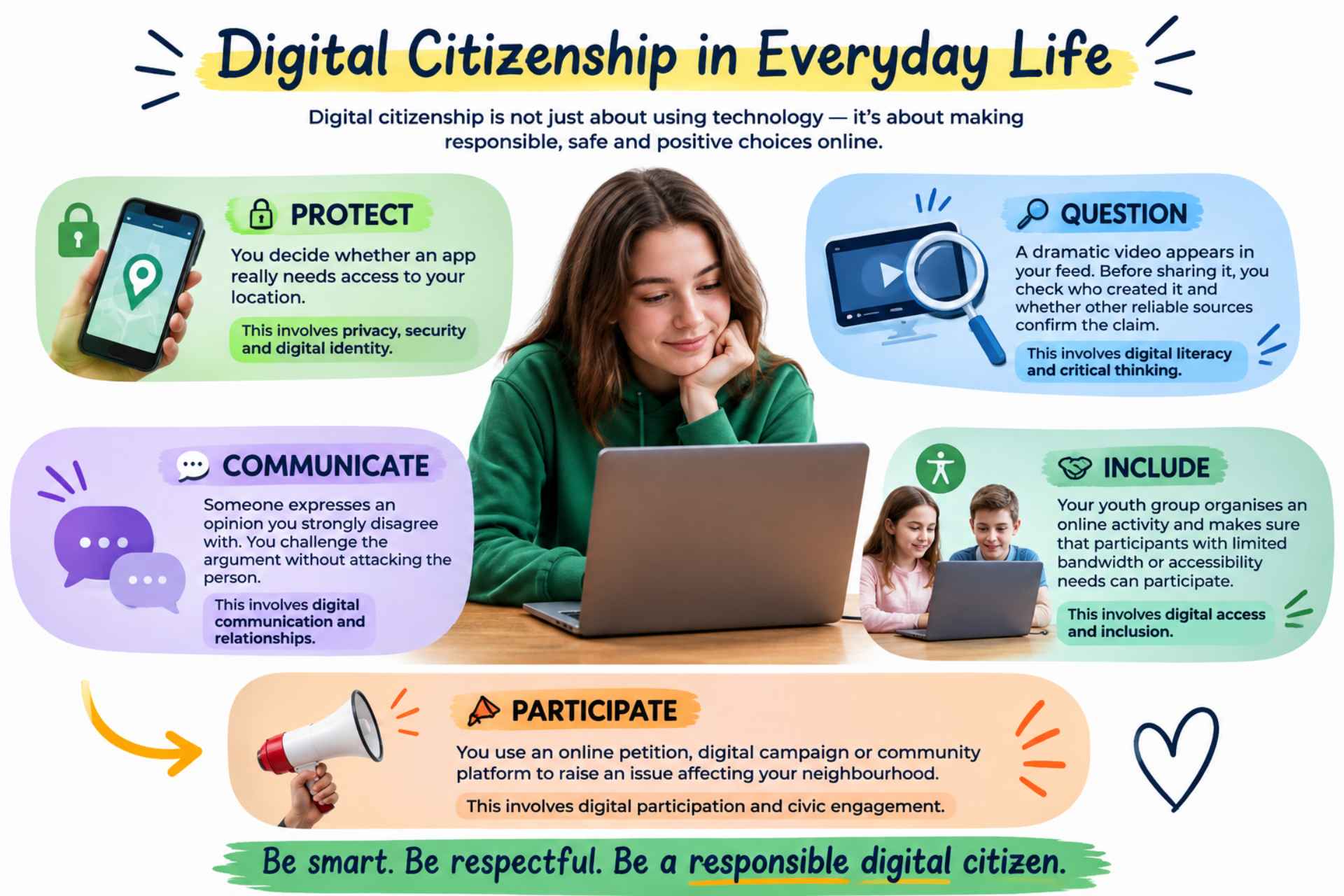
The Council of Europe Framework: 10 Domains
The Council of Europe organises digital citizenship education around 10 interconnected domains. Together, these form a comprehensive picture of what it means to be a competent, responsible, and empowered digital citizen:
|
Domain |
What it covers |
|
1. Internet & Screen Time |
Managing your online time and balancing digital and offline life in a healthy way. |
|
2. Privacy & Security |
Protecting personal data, understanding digital footprints, and managing online identity. |
|
3. Digital Footprint & Identity |
Understanding how your online activity shapes your reputation and identity over time. |
|
4. Cyberbullying & Online Safety |
Recognising, preventing, and responding to online harassment and harmful behaviour. |
|
5. Digital Literacy & Critical Thinking |
Evaluating sources, identifying misinformation, and thinking critically about online content. |
|
6. Digital Communication & Relationships |
Communicating ethically, building healthy digital relationships, and resolving online conflicts. |
|
7. Digital Access & Inclusion |
Ensuring everyone has equal access to digital tools, regardless of background or ability. |
|
8. Digital Commerce & Rights |
Understanding consumer rights, copyright, and ethical participation in digital economies. |
|
9. Digital Health & Well-being |
Managing screen time, digital stress, and promoting positive mental health in online life. |
|
10. Digital Participation & Civic Engagement |
Using digital tools to contribute to democracy, community, and social change. |
The central question is:
Am I using technology intentionally, or is technology shaping my behaviour without me noticing?
Why does this matter? Because young people's decisions in digital spaces — what they share, how they communicate, what they create — have real consequences for themselves, for others, and for democratic societies. Digital citizenship education gives them the tools to navigate these decisions wisely and responsibly.

Shape the Future.
Mint the Change.