
Active / Digital Participation & Online Expression
Core Reading 2: Data-Driven Movements & The Mechanics of Digital Governance
Once your digital initiative is conceptualized, the transition from strategy to real-world execution requires strict organizational focus. Launching a campaign successfully means establishing ethical transparency, mastering data-driven monitoring metrics, and understanding the emerging decentralized platforms that are transforming global youth activism.
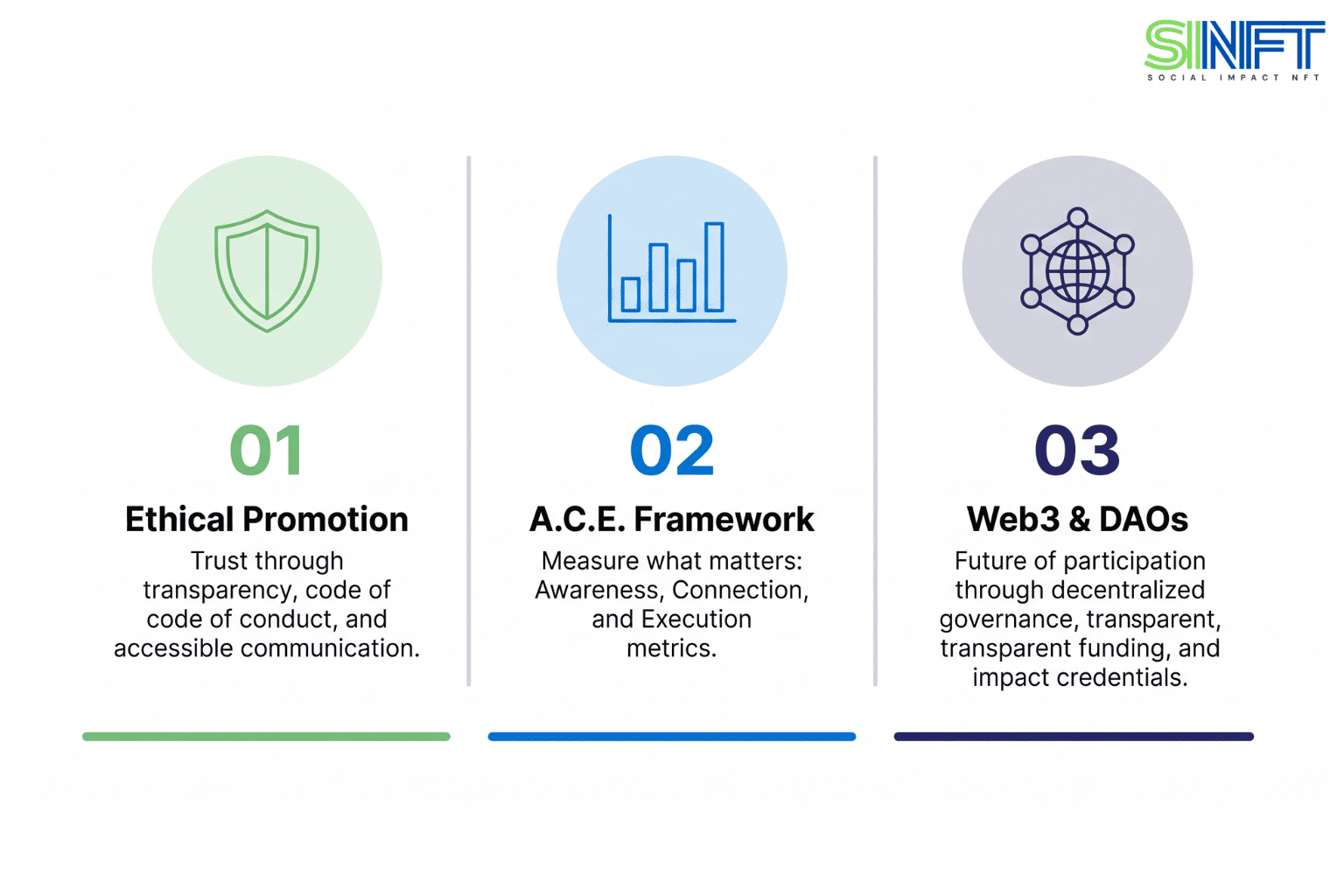
1. Launching with Trust: The Pillars of Ethical Promotion
When you introduce your digital initiative to the public, cultivating community trust is your primary objective. Ethical promotion ensures that your project remains credible and professional:
-
Radical Transparency: Always disclose who is behind the initiative, your core objectives, and exactly how community data or inputs will be utilized. If your project has institutional support from a student-youth council or international partners, state it openly.
-
The Campaign Code of Conduct: Establish clear internal rules for your media team. Commit to avoiding misleading clickbait headlines, respecting intellectual property laws when utilizing graphics, and using non-violent communication guidelines when responding to critics or public pushback.
-
Accessible Message Distribution: Match your channels to your audience. Deploy high-energy, rapid-reach content (like short-form video) on social networks alongside stable, long-form project articles on professional platforms for structural stakeholders.
2. Monitoring & Evaluation: Tracking Real Impact vs. Vanity Metrics
A common pitfall for young advocates is measuring project success purely by "Vanity Metrics"—such as a sudden spike in social media likes, views, or follower counts. While these numbers look encouraging, they do not automatically equal real-world civic change. To evaluate your movement effectively, utilize the A.C.E. Framework:
-
Awareness (The Reach): Tracking unique impressions, video views, and profile visits. This evaluates if your opening 3-second hook is successfully cutting through the digital noise.
-
Connection (The Engagement): Measuring post saves, intentional comments, and shares. Are people discussing your cause constructively, or are they scrolling past? High share rates indicate deep relevance to the community.
-
Execution (The Conversion): Tracking the click-through rate on your Call to Action (CTA). This measures how many digital observers actually converted into active participants (e.g., signing your petition, downloading your educational toolkit, or registering for a community cleanup).
3. The Horizon: Web3 and Decentralized Autonomous Organizations (DAOs)
As explored in our video resource, the digital public square is expanding into decentralized ecosystems. Modern youth initiatives are increasingly looking at Web3 technologies to redefine how global citizens organize:
-
Decentralized Governance: In a DAO, projects operate without a traditional, top-down hierarchy or central management office. Rules are embedded transparently into software, and members use digital voting tokens to collectively decide on project strategies, operational adjustments, and resource allocation.
-
Tamper-Proof Funding (Crypto-Philanthropy): By using public blockchain ledgers, international donors can stream micro-grants directly to grassroots youth groups globally with absolute financial transparency and zero institutional delays.
-
Tokenized Proof of Work: Modern campaigns use digital badges or Social Impact NFTs to reward active community volunteers. These credentials provide permanent, un-falsifiable proof of your community field experience, which you can showcase on professional networking platforms and CVs.

Shape the Future.
Mint the Change.