Understanding NFTs, Fiat Money, and the Future of Ownership
The Architecture of Digital Value
To comprehend how digital value, ownership, and trust are structured in the modern economy, one must look closely at the shift from traditional financial systems to decentralized blockchain technology. For decades, economic exchanges relied exclusively on centralized intermediaries, centralized databases, and government-backed currencies. Today, the emergence of Non-Fungible Tokens (NFTs) is shifting how digital property, artistic authenticity, and community fundraising are recorded and monetized.
1. Fiat Currency vs. Non-Fungible Tokens: Fungibility vs. Uniqueness
At the heart of modern economic structure lies the important concept of fungibility.
Fiat Currency & Fungible Assets: Traditional paper fiat currencies (such as the Euro or US Dollar), as well as standard fungible cryptocurrencies (such as Bitcoin, Solana, or USDC), are completely interchangeable.
One 10-euro coin or one unit of USDC carries the exact same function and monetary value as another identical unit. They can be swapped 1-to-1 without any operational difference. Furthermore, fiat currency systems depend on centralized authorities—such as central banks and financial institutions—to manage monetary supply, validate transactions, and maintain private ledgers.
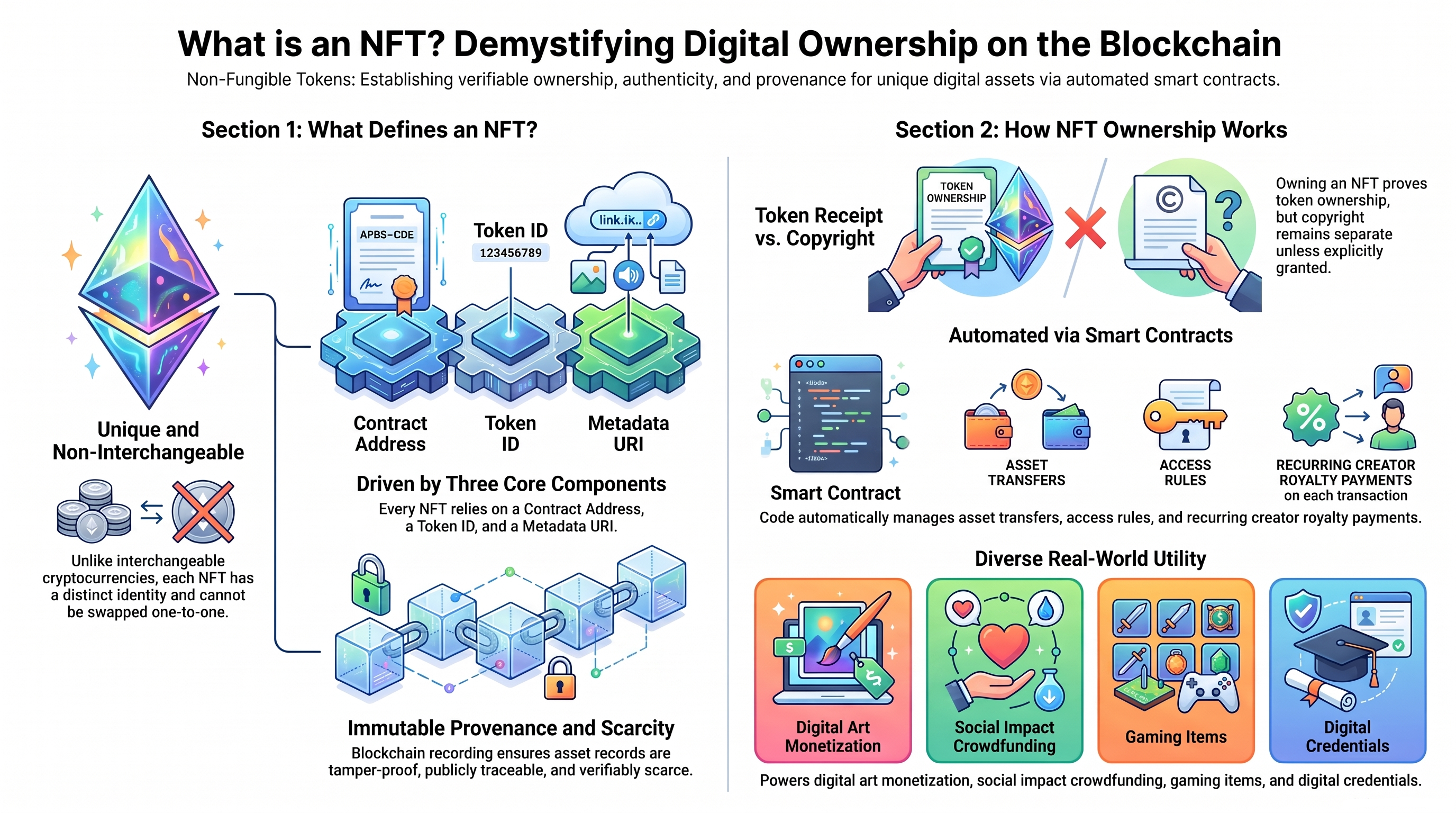
Non-Fungible Tokens (NFTs): An NFT is a unique digital token recorded on a public, decentralized blockchain ledger that certifies ownership and authenticity for a distinct digital or physical asset. Unlike fiat money, every NFT possesses a unique identity and set of attributes. Because no two tokens share the same record or serial number, NFTs are non-fungible and cannot be swapped on a direct 1-to-1 basis.
Rather than relying on central banks or corporate databases, NFTs operate across decentralized blockchain networks. Information is shared across independent network nodes, ensuring that once a transaction or ownership record is written to the ledger, it becomes immutable, transparent, and tamper-proof.
|
FIAT CURRENCY VS. NON-FUNGIBLE TOKENS |
|
|
FIAT / FUNGIBLE CURRENCIES |
NON-FUNGIBLE TOKENS (NFTs) |
|
· Fully Interchangeable (1:1 Value) |
· Fully Interchangeable (1:1 Value) |
|
· Issued & Controlled by Central Banks |
· Issued & Controlled by Central Banks |
|
· Issued & Controlled by Central Banks |
· Verifiable Digital Receipt of Ownership |
|
· Private, Centralized Ledgers |
· Immutable, Public Blockchain Ledger |
1. Demystifying the NFT: What Is It Really?
Stripped of complex technical jargon, a Non-Fungible Token (NFT) is a digital certificate that confirms ownership of a unique asset, for example, digital art, music, and video clips, as well as virtual real estate, game items, and community badges.
An Analogy for the Non-Technical World
Imagine you are a collector of rare vintage stamps or original paintings. Every item in your collection is unique, possesses its own history, and cannot be replaced by a standard printed copy because it lacks original provenance. An NFT functions as that exact rare item within the digital realm. When a creator produces a piece of digital art, the NFT serves as an unalterable digital certificate of authenticity. Even though others can view or share the digital file online, the blockchain ledger provides public, permanent proof of who owns the single authentic original.
The Technical Anatomy of an NFT
Every NFT is constructed from three primary technical components:
Contract Address (or Mint Address): The smart contract deployed on the blockchain that establishes the overarching rules, total supply, permissions, and royalty rates for the token collection.
Token ID: A unique serial number assigned to each individual asset within the collection, ensuring that every token retains a distinct identity.
Metadata URI: A Uniform Resource Identifier pointing to an off-chain JSON file containing descriptive information such as the asset’s name, description, media link, visual traits, and social cause tags.
|
THE THREE-PART NFT ANATOMY |
|
|
1. CONTRACT / MINT ADDRESS |
-> Rules, supply limits, and automated royalties |
|
2. TOKEN ID |
-> Unique serial identifier for the specific token. |
|
3. METADATA URI |
-> Link to JSON file with name, art link, and tags. |
Digital Ownership vs. Copyright
A critical distinction in digital property rights is the difference between owning an NFT and holding legal copyright. Purchasing an NFT grants the buyer a verified digital receipt of token ownership on the blockchain. It does not automatically transfer copyright or intellectual property (IP) rights to the underlying artwork unless the creator explicitly includes copyright transfer terms within the smart contract or licensing agreement.
1. How Creators, Buyers, and Ecosystems Monetize NFTs
By eliminating costly traditional middlemen, NFTs establish direct economic bridges between creators and their communities.
Revenue Streams for Creators and Buyers
Creator Earnings: Creators earn direct revenue from the primary sale of their digital work.
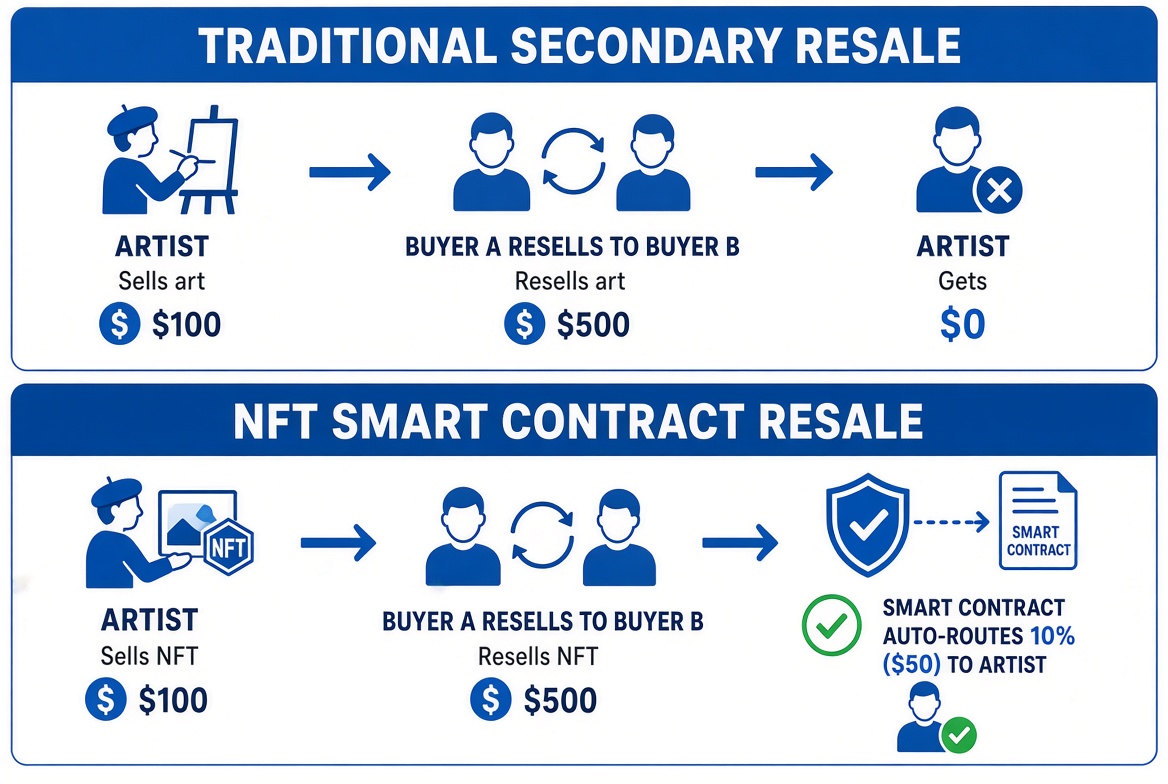
Furthermore, through smart contracts—self-executing code stored on the blockchain—creators can program automated secondary royalties. Every time the NFT is resold between collectors in the future, a pre-set percentage (e.g., 10%) is automatically routed back to the original creator’s wallet.
Buyer/Owner Earnings: Buyers can generate return on investment by reselling tokens if market demand increases, leasing game assets or music usage rights to others, or earning token-based dividends and community access perks.
Metadata vs. Dynamic Usage Tracking
While metadata JSON files store static asset descriptions, metadata alone does not track real-time analytics like view counts or stream tallies. To track dynamic interactions—such as how many times a song is streamed—external streaming platforms, Application Programming Interfaces (APIs), and specialized smart contracts work together. The external platform tracks plays via API, and the smart contract processes and distributes real-time micro-payments.
4. The SINFT Social Impact Revenue Model
In the official SINFT platform, the social impact revenue model is simplified into 3 primary stakeholders.
The Mission / Organization (70%)
· Who it goes to: The verified non-profit, youth organization, or civil society organization (NGO) leading the campaign.
· Purpose: This 70% majority share goes directly into the organization's wallet to fund the concrete real-world community activities outlined in the campaign—such as workshops, shelter support, or environmental projects.
The Young Creators / Lab Members (29%)
· Who it goes to: The international team of young people (aged 18–30) who co-created the campaign artwork, story, and digital assets inside the Innovation Lab.
· Purpose: This share recognizes the digital creativity, time, and teamwork of the youth creators. The smart contract automatically divides the 29% equally among all Lab members, so every creator receives an identical share directly in their digital wallet without requiring manual calculations.
Reinvestment in Lab Credits (1%)
· Who it goes to: The SINFT platform credit ecosystem.
· Purpose: This is not a commercial profit fee. Instead, this 1% is reinvested back into the platform to generate new generation credits for future youth Innovation Labs, allowing more teams to launch social impact campaigns. It is set at the technical minimum required by the system architecture.
Why This 3-Stakeholder Model Works
· Checkout Transparency: Before confirming a purchase, the supporter sees a clear box on the campaign listing page titled "Where your payment goes", breaking down the exact dollar amounts sent to the mission, the student artists, and platform reinvestment.
· Automated & Middleman-Free: The smart contract handles the fund split instantly on the blockchain, eliminating administrative delays, handling fees, or manual bookkeeping.
· Non-Speculative Focus: Because campaigns focus on direct community support rather than secondary market flipping, every sale follows this exact, predictable distribution
5. The Expanding Horizon of NFT Products
Beyond digital art, the versatility of blockchain tokenization allows virtually any unique digital or tokenized physical asset to be minted as an NFT:
Digital Art & Media: Exclusive digital graphics, 3D animations, short films, and limited-edition music albums.
Education & Credentials: Tamper-proof digital diplomas, course completion badges, and verified skill certificates.
Gaming & Metaverse Assets: In-game character avatars, weapons, virtual land parcels, and digital fashion accessories.
Physical Real Estate & Supply Chains: Property ownership titles, land registration records, and conflict-free supply chain tracking tokens.
Charitable Badges: Non-speculative digital thank-you receipts and verifiable community impact tokens.
By combining low-cost blockchain transactions, transparent smart-contract revenue sharing, and youth education, platforms like SINFT show how NFTs can evolve from speculative commodities into powerful, transparent tools for lasting social change.
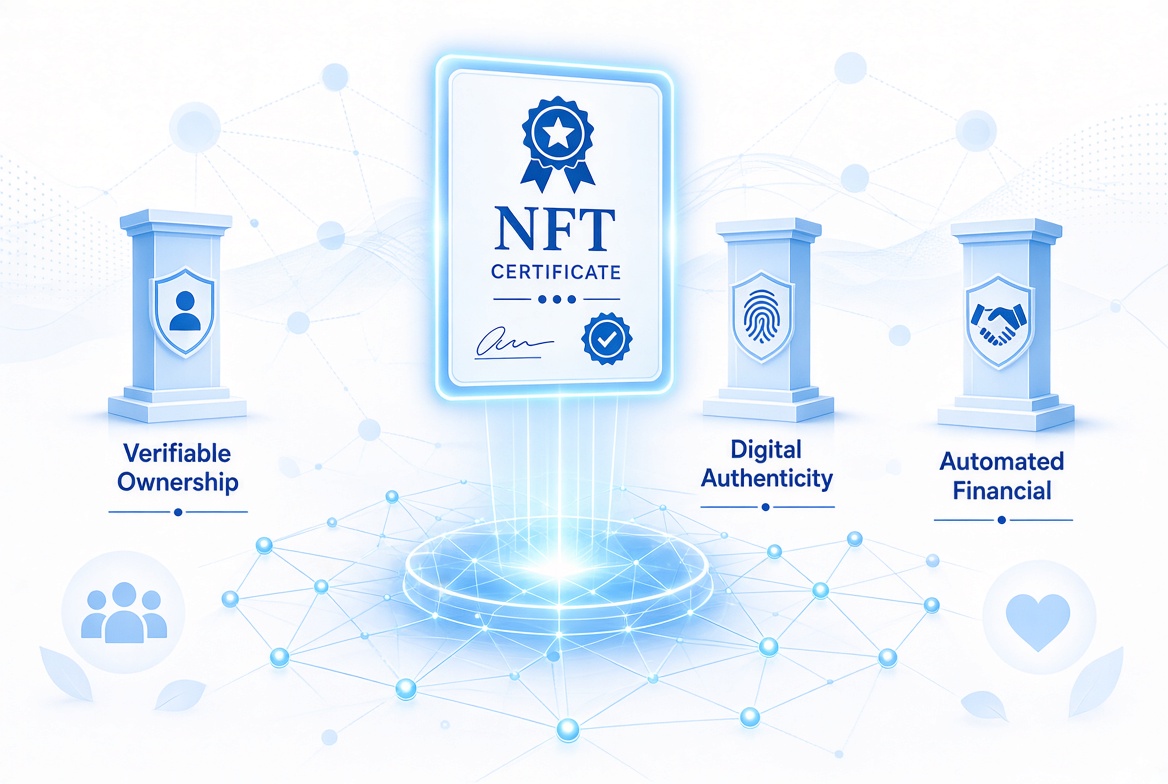
Non-Fungible Tokens represent far more than a trend in digital collectibles. At their core, NFTs establish a novel framework for verifiable ownership, digital authenticity, and automated financial trust in an increasingly digital world. To learn more, visit the course https://sinft.net/course/view.php?id=123.